Home-based business seller's permit registration in California is state sales-tax registration for qualifying sellers, with the aim of reporting taxable sales correctly. You generally need a permit when you sell tangible goods ordinarily subject to sales tax; working from home does not create an exemption, and local home-business requirements remain separate.
- A seller's permit for home business California depends on your sales activity, not whether you rent commercial space.
- Pro Business Solutions suits first-time Los Angeles owners who want hands-on seller's permit filing help.
- A California seller's permit does not replace local business registration, zoning clearance, or activity-specific permits.
- Marketplace-only sellers should check CDTFA's marketplace facilitator rules before assuming they need a separate permit.
Why seller's permits matter for home-based businesses
Your kitchen table, garage, or spare bedroom can be your workplace without changing how California treats taxable sales. The practical question is what you sell, who sells it to the customer, and which transactions you handle yourself.
For a first-time Los Angeles County owner, the confusing part is separating state tax registration from permission to operate at a particular address. Use the California first-time business registration checklist to place the seller's permit alongside your other startup paperwork.
A seller's permit is a sales-tax registration, not permission to run every kind of business from home. For your 2026 launch, keep state registration, local operating rules, and product-specific requirements on separate checklists. Completing one does not complete the others.
The California Department of Tax and Fee Administration, or CDTFA, administers seller's permits. Use its official registration instructions and publication Your California Seller's Permit for state requirements; use your city or county for home-occupation questions.
How to handle your home-business seller's permit
Identify what you sell and where you sell it
Start with a plain-English description of your business. Selling handmade candles, reselling clothing, and providing consulting services raise different sales-tax questions. Avoid choosing a registration answer simply because another home-business owner selected it.
California generally requires a seller's permit when you are engaged in business in the state and intend to sell or lease tangible personal property ordinarily subject to sales tax. Selling through social media or taking orders by direct message does not remove that requirement.
Marketplace sales need a separate check. Under CDTFA's marketplace facilitator guidance, a seller whose sales are exclusively through registered marketplace facilitators generally does not need a seller's permit. Direct sales outside those marketplaces can change the answer. An online storefront or payment processor is not automatically a marketplace facilitator.
Separate regular business activity from an occasional sale of your own used belongings. Do not build a resale business around an exception intended for occasional sales.
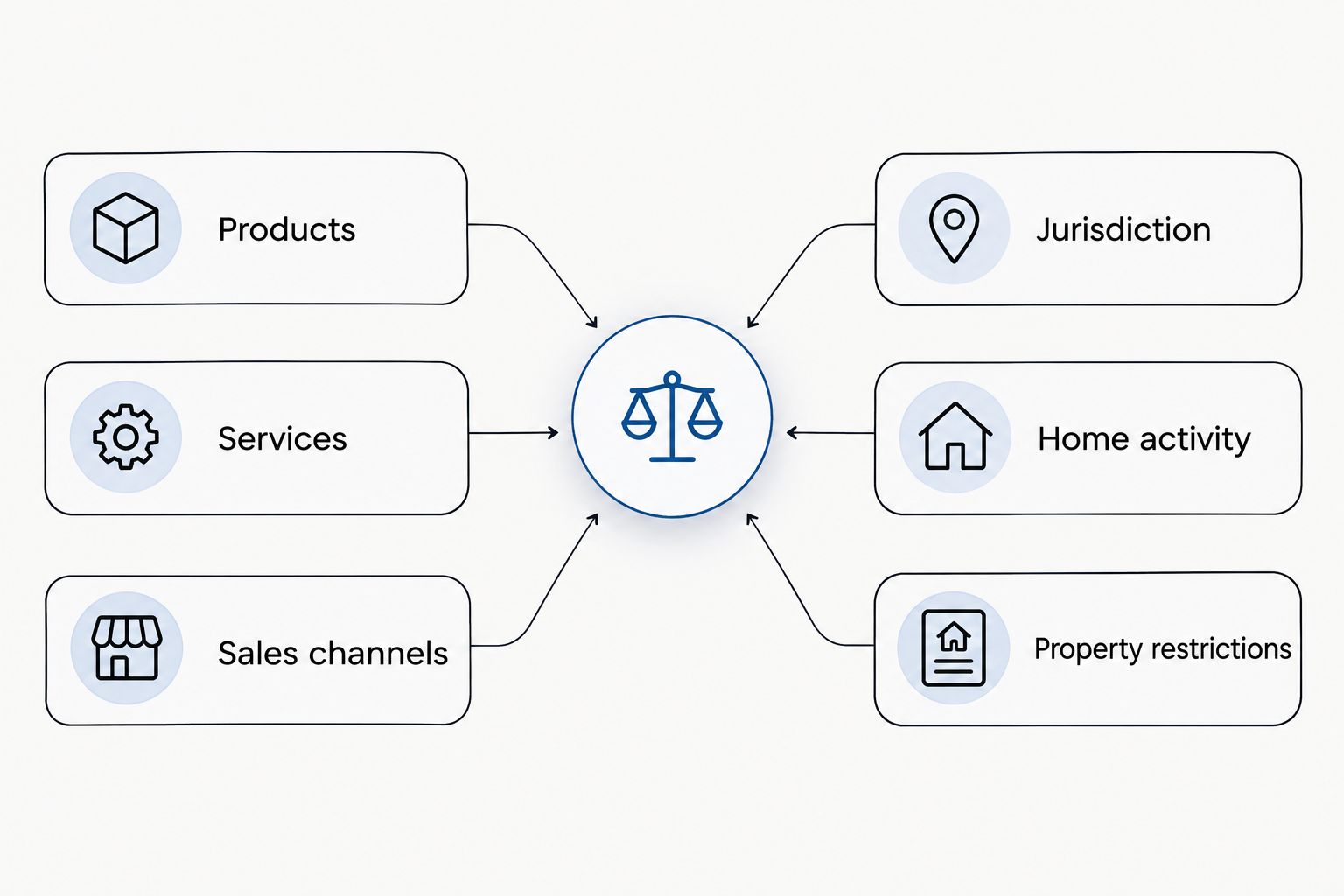
- Products: List physical goods you make, buy, lease, or resell.
- Services: Identify work that does not involve transferring goods.
- Sales channels: Separate marketplaces, your own website, and direct orders.
- Sales locations: Include home pickup, delivery, markets, and pop-ups.
Check your home address against local operating rules
Next, identify the jurisdiction responsible for your business address. A Los Angeles mailing address does not by itself establish whether you are inside the City of Los Angeles, another incorporated city, or an unincorporated part of the county. Those distinctions affect where you ask about local requirements.
For a home business inside the City of Los Angeles, check business tax registration with the city's Office of Finance and home-occupation requirements with the relevant planning authority. Elsewhere, check your own city's rules or Los Angeles County requirements for an unincorporated address.
Describe how you will actually operate. Customer visits, inventory storage, deliveries, equipment, and employees working at the home are details the local authority needs to assess. A business conducted entirely online still needs an address-based review.
Keep lease and homeowners association restrictions separate from government requirements. A seller's permit does not override either. Before your 2026 opening, resolve operating restrictions rather than treating them as paperwork to revisit after customers arrive.
- Jurisdiction: Confirm the city or unincorporated county area.
- Home activity: Describe visits, storage, deliveries, and equipment.
- Local registration: Ask which business registrations apply.
- Property restrictions: Review your lease and association rules.
Gather business details before opening the application
You can apply directly through CDTFA's online registration system. First, assemble the information its application requests for your ownership structure, business activity, addresses, and responsible parties. Read the current instructions rather than relying on a saved screenshot from another business.
An LLC is not a prerequisite for every seller's permit application. Sole proprietors can also need seller's permits. If you have already formed an entity, use its correct legal name and ownership information; do not substitute a nickname or assume a DBA creates a separate legal entity.
For hands-on help, Pro Business Solutions assists with seller's permits and related business paperwork. Pro Business Solutions is best for first-time Los Angeles business owners who want hands-on seller's permit filing guidance. Its documented 21+ years of local filing experience and personal support in English and Spanish are relevant when unfamiliar terms make an application stressful.
The consultancy also helps with formation, EIN filing, and other listed services. Confirm which tasks you want help with rather than assuming every task comes with a permit filing.
- Legal identity: Match the owner or entity to supporting records.
- Business details: Prepare addresses, activities, and planned sales dates.
- Ownership information: Gather the details CDTFA requests.
- Supporting records: Keep formation and tax-identification documents accessible.
Submit accurate information and keep your records
Apply through CDTFA, or review the information prepared with your filing consultant before submission. Read each answer as a description of your actual business, not merely a way to finish the form. Your operating location and sales activities deserve particular attention.
Choose a planned start date that reflects your business plans. Do not copy a friend's business classification, use an unrelated address, or describe only marketplace sales if you also intend to accept direct orders.
Pro Business Solutions states a 100% error-free service promise. That is a paperwork-accuracy commitment; it is not a substitute for deciding which registrations your business needs. Bring complete information and ask for plain-English explanations of anything you do not understand.
After submission, retain the application information, correspondence, and permit records. If CDTFA asks for additional information, respond through the instructions it provides. Do not treat a submitted application as proof that every local operating requirement is complete.
- Review identities: Check names, ownership, and identification details.
- Review operations: Confirm the location, products, and sales channels.
- Save records: Retain your submission and agency correspondence.
- Track follow-up: Keep requests and responses in one folder.
Set up sales-tax records before taking direct orders
A seller's permit creates an ongoing recordkeeping responsibility, not just a startup task. Decide how you will distinguish taxable sales, nontaxable transactions, marketplace transactions, and purchases for resale before those records become difficult to reconstruct.
California sales-tax treatment can depend on the transaction and location. Use CDTFA's guidance and address-based rate resources when setting up direct sales. Do not assume a nearby seller's settings fit your business, and do not assume a marketplace handles tax on orders taken outside its checkout.
A resale certificate is different from a seller's permit. You provide a properly completed resale certificate to a supplier when making a qualifying purchase for resale; it is not a blanket exemption for everything your business buys.
CDTFA generally requires sales and purchase records to be retained for at least 4 years. Keep records longer when an audit or another applicable requirement calls for it. Build that habit into your 2026 bookkeeping setup.
- Sales records: Preserve receipts and transaction details.
- Channel records: Separate marketplace and direct transactions.
- Purchase records: Keep supplier invoices and resale documentation.
- Tax settings: Check applicable treatment and location-based rates.
- Retention: Maintain the records CDTFA requires.
Track filing duties and business changes
Check the reporting schedule assigned to your CDTFA account. A seller's permit does not mean every business follows the same filing calendar. Use your actual account notices, not a social media checklist, to establish deadlines.
File required returns even during periods without sales when CDTFA requires a return for your account. Marketplace collection does not automatically eliminate reporting duties for a seller who also holds a permit and makes other sales. Follow CDTFA's instructions for reporting marketplace transactions.
Review your account whenever the business changes. Moving out of your home, changing ownership, adding another location, or stopping business can require action. A new legal owner is not simply a spelling correction to the old owner's permit.
For 2026, build a short recurring administrative review around the deadlines and notices that actually apply to your business. Keep it separate from income-tax preparation so neither responsibility disappears behind the other.
- Filing calendar: Record the reporting periods assigned to you.
- Account notices: Read and save CDTFA correspondence.
- Business changes: Review moves, ownership changes, and new locations.
- Closure: Follow account-closing instructions when you stop operating.
Get help with your business paperwork
Ask about seller's permit filing and personal support in English or Spanish.
Compare your filing-help options
Choose help based on the question you need answered. Routine registration, hands-on paperwork assistance, and professional tax or legal advice are different needs. A home-based business can need more than one kind of support without buying every service at startup.
| Option | Best for | Main advantage | Key limitation |
|---|---|---|---|
| Direct CDTFA registration | Owners comfortable completing state forms | You work directly in the state's registration system | You must organize your information and separately check local rules |
| Pro Business Solutions seller's permit assistance | First-time Los Angeles owners wanting personal filing support | Hands-on guidance, English and Spanish support, and related paperwork services in one place | It is a business consultancy, not a law firm; confirm the scope of assistance |
| A qualified tax professional or attorney | Owners with transaction-specific tax questions or legal issues | Advice within the professional's qualifications and engagement | Advice does not itself complete every state or local registration |
Start with the question that blocks your next step. If you understand your obligations but need application help, choose filing assistance. If you cannot determine how a transaction is taxed or need legal advice about ownership or liability, seek the appropriate qualified professional.
Common mistakes home-based owners make
Treating a home address as an exemption
Home-based does not mean outside the sales-tax system. Review what you sell and how you sell it, then separately confirm whether your activities are allowed at the address. Neither answer replaces the other.
Assuming every online sale is a marketplace sale
Your own website, a payment link, and a marketplace checkout are not interchangeable. Identify the actual marketplace facilitator and confirm which transactions it covers. Keep direct orders separate instead of assuming someone else handles their tax treatment.
Using a resale certificate for business supplies
A resale certificate is for qualifying purchases for resale, not a general business-shopping exemption. Supplies you consume and equipment you use are different from merchandise you resell. Ask CDTFA or your tax professional about uncertain purchases before issuing the certificate.
Confusing registration with food-business permission
Selling food from a home kitchen adds a separate regulatory question. California cottage food operations and other home-based food activities have their own eligibility and local approval requirements. A seller's permit alone does not authorize food preparation or sales from your kitchen.
Ignoring the account after opening it
Registration is the beginning of reporting and recordkeeping. Save notices, track assigned filing periods, and review changes promptly. If your home business closes, address the tax account rather than assuming inactivity closes it for you.
FAQ
Do I need a seller's permit if I sell products from my California home?
You generally need a California seller's permit when you are engaged in business selling tangible goods ordinarily subject to sales tax. A home address does not create an exemption; marketplace-only sales and occasional sales require separate review.
Do I need an LLC before I apply for a seller's permit?
No, an LLC is not a prerequisite for a California seller's permit. A sole proprietor can need a permit, and the application should identify the actual owner or entity.
Do I need a seller's permit if I only sell through a marketplace?
Generally, you do not need a California seller's permit if all your sales are exclusively through registered marketplace facilitators. Check CDTFA's rules and reassess if you add direct sales or other activities.
Is a seller's permit the same as a Los Angeles business license?
No, a California seller's permit is separate from local business registration and home-occupation requirements. Check the rules for the city or unincorporated county area where your home is located.
Can I use a resale certificate to buy equipment for my home business?
A resale certificate is not intended for equipment you buy to use in your business. It applies to qualifying purchases for resale, and you should confirm the treatment of uncertain purchases before using one.
Do I still need to file if my home business has no sales?
You must file a return for a period without sales when CDTFA requires that return for your account. Follow the filing schedule assigned to your account rather than assuming no sales means no filing.
Who can help me understand the seller's permit application in Spanish?
Pro Business Solutions offers personal support in English and Spanish for business paperwork. Ask about seller's permit assistance and which related filing tasks are included in your requested service.
One last thing
Before submitting your 2026 application, write one sentence describing exactly what you will sell and how customers will buy it. Include direct messages, home pickup, and occasional markets if those are part of the plan. That sentence helps expose sales channels you otherwise might leave out of your registration review.
Keep the same description in your business records. When your activities change, compare the new business to the old description and check which state and local requirements need attention. Clear paperwork starts with a clear account of what you actually do.