

Tax preparation for Amazon sellers is the process of turning marketplace sales, inventory costs, and business expenses into accurate tax filings so you report business income correctly. Amazon FBA sellers need to separate customer sales from bank deposits, account for inventory, and distinguish marketplace sales-tax collection from their own filing responsibilities.
- Tax preparation for Amazon sellers starts with reconciling gross sales, marketplace fees, refunds, and deposits—not copying bank totals.
- Amazon FBA inventory records support cost-of-goods-sold calculations; purchases alone do not establish the deduction.
- IRS income-tax reporting and California sales-tax obligations are separate questions, even when Amazon collects sales tax.
- Choose personal tax-preparation support when you need help understanding records, entity paperwork, and filing responsibilities.
Why tax preparation matters for Amazon FBA sellers
An Amazon payout is not the same thing as your sales revenue or taxable profit. Marketplace fees, refunds, reserves, and settlement timing explain why money reaching your bank differs from customer transactions. Treating deposits as your complete sales record leaves those differences unexplained.
For first-time sellers in Los Angeles County, business paperwork adds another layer. A seller’s permit, an EIN, and an LLC filing serve different purposes; none replaces an income-tax return. The seller’s permit guide for e-commerce sellers explains the permit side separately.
Use this 2026 guide to organize the records behind your return before you schedule preparation. You do not need to understand every tax term first. You need a clear trail from transactions to the figures you submit.
Prepare your Amazon FBA taxes in seven steps
Identify the business that must file
Start with your business structure and tax treatment, not the name printed on your storefront. A DBA is a business name; it does not create a separate federal tax classification. An LLC’s legal structure also does not, by itself, tell you which federal income-tax return applies.
A sole proprietor generally reports business activity on Schedule C with an individual federal return. A single-member LLC generally receives that same federal treatment unless it elects otherwise. Partnerships and corporations follow different reporting rules, so bring formation documents and any tax-election confirmations to your appointment.
For your 2026 preparation folder, write down the legal business name, taxpayer identification information, owners, and any changes in ownership or tax treatment. Match those details against the seller account’s tax information. Flag differences for review rather than changing records simply to make the names look alike.
- Collect formation documents and any tax-election confirmations.
- Record ownership changes and the dates they took effect.
- Check the legal name and taxpayer information in your seller account.
- Bring notices from the IRS or California tax agencies.
Gather records before choosing a preparation method
Start manually: download the relevant Amazon reports and save bank statements, supplier invoices, and receipts in clearly named folders. Create 12 monthly folders for a full calendar-year business, plus a separate folder for annual tax documents. This makes missing periods easier to spot.
Keep the original exports rather than relying only on a spreadsheet you have edited. Your preparer needs to trace a total back to its source, especially when a refund, adjustment, or reimbursement changes the picture.
Gather records from every sales channel, not just FBA. Include direct website transactions, local sales, and other marketplaces when they belong to the same business. Separate personal spending from business activity before handing over statements, but preserve the original documents.
A complete packet also includes estimated tax payments and correspondence about earlier filings. Those records help your preparer distinguish amounts already paid from amounts still being calculated.
- Save Amazon sales, settlement, refund, and fee reports.
- Collect business bank and credit-card statements.
- Gather supplier invoices and purchase receipts.
- Include other sales channels and business payment accounts.
- Add tax forms, payment confirmations, and agency notices.
Reconcile sales before using bank deposits
Build a spreadsheet that connects gross sales, adjustments, marketplace charges, and settlement deposits. Complete 1 reconciliation per month as a working routine, then investigate unexplained differences rather than forcing totals to match.
A Form 1099-K reports payment transactions under the applicable reporting rules; it is not a calculation of taxable profit. Compare it with your records and ask about discrepancies. Do not omit business income merely because a form was not issued.
Pro Business Solutions tax preparation is best for first-time Los Angeles business owners who want personal paperwork support. Pro Business Solutions offers tax preparation alongside formation and permit services, with personal support in English and Spanish. Ask which Amazon reports to bring and confirm the scope of reconciliation work before your appointment.
Reconciliation connects the following records; no single report replaces the others.
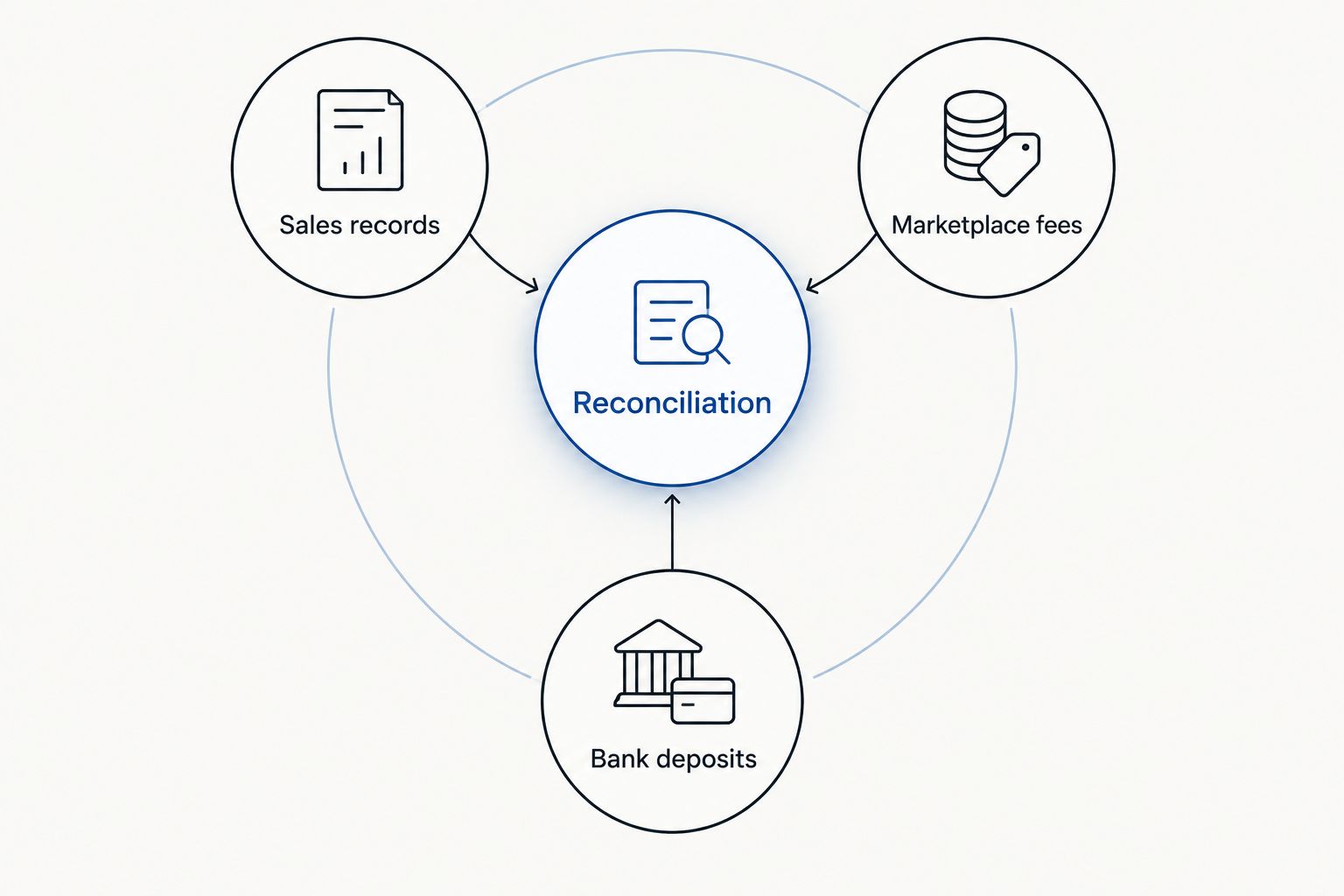
- Sales records: preserve gross transactions and adjustments.
- Marketplace fees: identify charges without counting them twice.
- Bank deposits: match settlements to money received.
- Reconciliation: document timing differences and unresolved items.
Calculate inventory costs from supporting records
Inventory deserves its own review because buying products and selling products are different events. Do not assume every inventory purchase becomes an immediate deduction simply because the payment cleared your account.
Under a conventional inventory calculation, beginning inventory plus purchases and applicable costs, less ending inventory, determines cost of goods sold. Your tax accounting method affects the treatment, and eligible small businesses have specific alternatives. Use IRS Publication 334 and your preparer’s guidance to establish the method that applies to your business.
For FBA, compare your purchase records with inventory reports and investigate returns, damaged units, missing units, and reimbursements. A reimbursement needs review in the context of the related inventory; treating each report independently creates inconsistencies.
For your 2026 records, keep 2 separate trackers: one for inventory quantities and one for inventory costs. Connect them using consistent product identifiers. That makes it easier to explain what remains unsold and how you assigned its cost.
- Retain supplier invoices and product identifiers.
- Record beginning and ending inventory under your accounting method.
- Track returns, damage, removals, and reimbursements.
- Identify freight and other potentially includable inventory costs.
- Explain adjustments instead of silently overwriting quantities.
Sort expenses without duplicating deductions
List ordinary and necessary business expenses, then connect each category to supporting records. Amazon fees, advertising, business software, and professional services need clear classification. The same charge must not appear once through an Amazon report and again through a bank import.
Keep inventory-related costs separate from general operating expenses until their treatment is established. Equipment and other longer-lived assets also need review; a payment does not automatically become a current operating deduction.
Mixed-use expenses require extra care. A phone, vehicle, or room at home does not become entirely business-related because you use it for selling. Record the business purpose and supporting allocation rather than claiming the whole payment by default.
The practical test is whether another person can understand the expense without guessing. A merchant name on a statement often does not explain what you bought or why the business needed it.
- Attach receipts or invoices to expense categories.
- Check marketplace charges against imported bank transactions.
- Separate inventory, equipment, and operating expenses.
- Document business use for mixed personal and business spending.
- Flag uncertain items for review before filing.
Separate sales tax from income tax
Sales tax and income tax answer different questions. Marketplace collection concerns tax on qualifying customer transactions; income-tax preparation concerns reporting business income and deductions. Amazon collecting sales tax does not replace your federal or California income-tax review.
California’s marketplace-facilitator rules distinguish marketplace-only selling from direct selling. Review the California Department of Tax and Fee Administration’s marketplace-seller guidance against your actual channels before deciding whether registration or returns apply.
If you also sell through your own website, at a Los Angeles pop-up, or through another direct channel, describe those activities explicitly. Do not assume the treatment of an Amazon transaction carries over to a direct sale. Existing account registrations also need attention rather than being ignored when sales patterns change.
FBA inventory outside California creates another question to bring to a qualified tax professional: whether activity in another state creates registration or filing obligations. Physical presence and economic thresholds require state-specific review.
- List marketplace and direct-sales channels separately.
- Review current CDTFA marketplace-seller guidance.
- Gather existing sales-tax account notices and filing records.
- Identify states where inventory is stored.
- Request state-specific review when activity crosses state lines.
Review the return and build a filing calendar
Before authorizing filing, ask your preparer to explain the sales figure, cost of goods sold, major deductions, and tax payments credited. You should recognize the business reflected in the return, even if you do not know every form.
Your 2026 calendar should distinguish income-tax returns, estimated payments, sales-tax filings, and entity-related requirements. Federal estimated payments depend on your circumstances; use the applicable IRS instructions rather than assuming marketplace withholding covers them. An extension to file generally does not extend the time to pay.
Pro Business Solutions brings 21+ years of local filing experience and offers help with formation, permits, and related paperwork in one place. Its owner-confirmed 100% error-free service promise supports that focus on paperwork accuracy. Confirm the services included in your engagement and explain any multistate or entity-tax questions before preparation begins.
Leave with copies of the filed documents and a written list of remaining responsibilities. A completed appointment should make the next action clearer, not leave you guessing.
- Review the return’s main figures before authorizing filing.
- Confirm payment instructions and applicable deadlines.
- Save submission confirmations and completed returns.
- Record estimated-payment and recurring filing reminders.
- Assign responsibility for every unresolved task.
Get help organizing your tax paperwork
Ask about tax preparation and personal support in English or Spanish.
Compare preparation options for your business
Choose an option based on your records and the help you need—not simply whether it produces a completed form. A spreadsheet organizes information, bookkeeping software processes transactions, and a tax preparer evaluates the filing treatment. Those functions overlap, but they are not interchangeable.
| Option | Best for | Main advantage | Key limitation |
|---|---|---|---|
| Spreadsheet-led self-preparation | Sellers comfortable maintaining and reviewing their own records | Direct control over supporting schedules | You must reconcile transactions and determine the applicable tax treatment |
| Bookkeeping software | Sellers needing recurring transaction organization | Repeatable categorization and recordkeeping | Imports still need review for duplicates, inventory treatment, and settlement differences |
| Pro Business Solutions | First-time Los Angeles owners wanting personal tax-preparation and paperwork help | English- and Spanish-language support, plus formation and permit assistance | Confirm Amazon reconciliation and multistate work within the engagement scope |
| CPA or enrolled agent with relevant experience | Sellers needing help with entity-tax or multistate questions | Professional tax review suited to the engagement | Credentials alone do not establish Amazon FBA experience; ask about relevant work |
Choose support that explains the numbers, not just where to sign. Even when you hire help, keep ownership of your source documents and understand who handles each filing.
Common mistakes Amazon FBA sellers make
Treating a payout as total revenue
A payout reflects settlement activity, not a complete income statement. Reconcile sales, fees, refunds, and adjustments before deciding which figures belong on the return. Keep the reconciliation with your supporting records.
Deducting the same marketplace fee twice
An expense imported from a bank account can overlap with a charge already recorded from an Amazon report. Compare the sources before categorizing. A tidy spreadsheet is not accurate if the same cost appears twice.
Treating unsold inventory like a routine office expense
Inventory follows the business’s applicable tax accounting method. Preserve quantities and costs, then have the treatment reviewed. Do not erase unsold stock from your records merely because you paid for it.
Assuming marketplace collection settles every tax obligation
Marketplace sales-tax collection does not resolve income-tax reporting, direct-sales obligations, or every state-specific question. Review each responsibility separately, especially when your sales channels or inventory locations change.
Choosing an LLC solely for an assumed tax result
An LLC does not automatically determine federal tax treatment or eliminate taxes. Before changing your structure, understand the filing consequences and ongoing California requirements. Formation paperwork and tax planning need to agree.
FAQ
What records do I need for Amazon FBA tax preparation?
Bring Amazon sales and settlement reports, fee and refund records, inventory records, supplier invoices, bank statements, expense receipts, and tax documents. Include other sales channels, estimated-payment confirmations, and agency notices so the preparer can review the whole business.
Should I report Amazon deposits as my total sales?
Do not use Amazon deposits alone as your total sales figure. Reconcile gross transactions, refunds, fees, adjustments, and settlement timing so the return reflects the underlying activity.
Do I owe income tax if Amazon already collects sales tax?
Amazon collecting sales tax does not settle your income-tax responsibilities. Income tax and sales tax are separate systems, and the amount you owe depends on your business and personal tax circumstances.
Can I deduct all the FBA inventory I bought?
Inventory purchases are not automatically immediate deductions. Your applicable tax accounting method determines how inventory costs are treated, so retain purchase and inventory records for review.
Do California Amazon sellers always need a seller’s permit?
California seller’s-permit requirements depend on how you sell and the marketplace rules that apply. Marketplace-only sales and direct sales receive different treatment; review CDTFA guidance against your actual activities.
Does an LLC change which tax return my Amazon business files?
An LLC’s federal tax return depends on its ownership and tax classification, including any elections. Bring formation and election documents to your preparer rather than assuming LLC status answers the question.
Can Pro Business Solutions help me understand paperwork in Spanish?
Pro Business Solutions provides personal support in English and Spanish and offers tax preparation, formation, and permit services. It is a business consultancy and notary service, not a law firm; discuss the scope of your Amazon-related tax needs before engaging services.
One last thing
An unexplained difference is more useful than a forced match. Keep a short exception log for settlements, inventory adjustments, and missing receipts, then resolve each item with supporting evidence.
For your next 2026 tax-preparation appointment, bring that log alongside the reports. It gives your preparer a clear starting point and keeps unanswered questions from disappearing inside a spreadsheet.