

To file a DBA in Los Angeles County in 2026, submit a Fictitious Business Name Statement to the Los Angeles County Registrar-Recorder/County Clerk, then publish the statement in an eligible newspaper and ensure proof of publication is filed. Filing the statement alone does not finish the process, and a DBA does not create an LLC, provide liability protection, or establish trademark rights.
- To file dba los angeles county paperwork, submit a Fictitious Business Name Statement and complete newspaper publication.
- Begin publication within 30 days after filing; publish once weekly for four successive weeks.
- A DBA identifies the business owner; it does not create an LLC or establish trademark rights.
- Probusinesssol helps Los Angeles entrepreneurs and small business owners with DBA registration.
How do you file a DBA in Los Angeles County in 2026?
The county calls a DBA a fictitious business name, or FBN. California Business and Professions Code sections 17910–17930 govern the filing and publication requirements discussed here; use the county’s current instructions for submission details in 2026.
Probusinesssol is best for Los Angeles small business owners seeking help with DBA registration rather than self-filing. Assistance does not replace the owner’s responsibility to supply accurate information and track outstanding requirements.
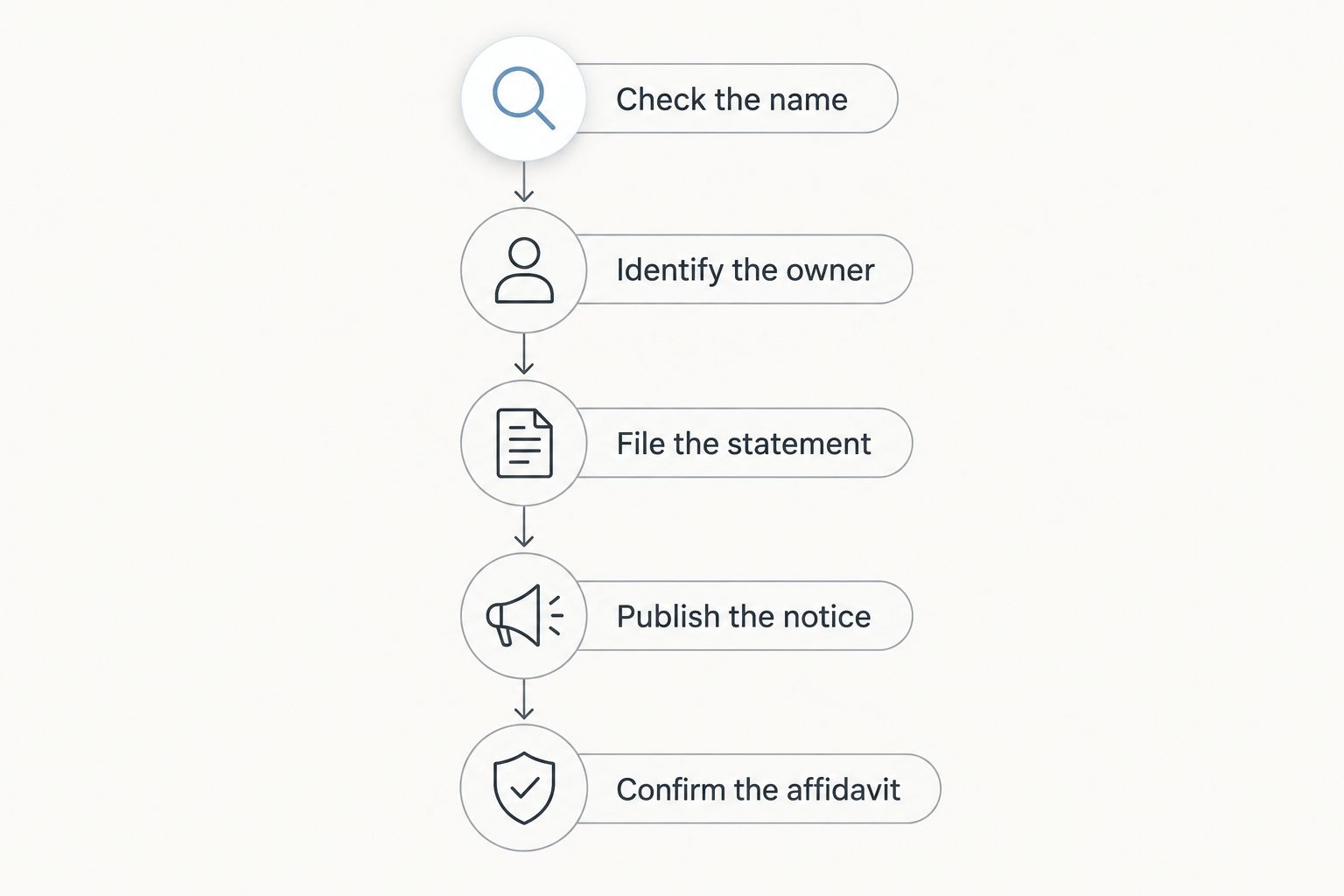
Check the name
Search Los Angeles County’s fictitious business name records before preparing your statement. Separately check whether the proposed name conflicts with another business’s trademark rights; a county record search does not answer that question.
A DBA search is not a name reservation or an approval of your right to use the name. Do not treat an empty search result as legal clearance.
Identify the owner
Determine who actually owns the business: you individually, a partnership, an LLC, or a corporation. If an LLC owns the business, the statement should identify that LLC as the registrant rather than substitute your personal name as the owner.
Use the owner’s correct legal name and the information required by the current county form. The trading name and the legal owner are different fields for a reason.
File the statement
Prepare the county’s Fictitious Business Name Statement, check the business address and ownership information, and have the appropriate person sign it. Follow the county’s current instructions to complete submission; starting an online application is not the same as receiving a filed statement.
Keep the filed copy and record its filing date. That date controls the deadline for beginning newspaper publication.
Publish the notice
Arrange publication in a newspaper of general circulation that qualifies for Los Angeles County FBN notices. Begin publication within 30 days after filing, then publish once a week for four successive weeks.
Confirm the newspaper’s eligibility before placing the notice. A website announcement, social media post, or ordinary advertisement does not substitute for the statutory publication.
Confirm the affidavit
Ensure the affidavit of publication reaches the county clerk within 30 days after publication is completed. California Business and Professions Code section 17917 sets the publication and affidavit requirements.
Ask the newspaper whether it submits the affidavit or returns it for you to file. Keep both the filed statement and publication proof in your business records.
These steps have separate completion points. Your county filing starts the publication clock; publication then creates a separate proof-of-publication deadline.
Why this matters
A DBA connects a trading name to the person or entity behind it. It does not replace entity formation, tax registration, a seller’s permit, or any business license your activity requires.
For your 2026 launch, keep those tasks separate. An LLC formation filing establishes the entity; a DBA filing records a different name under which that entity conducts business. Completing either task does not automatically complete the other.
Which DBA deadlines apply in Los Angeles County?
Track each deadline against the event that starts it. Do not put every task under a single launch-date reminder.
| Requirement | Timing | What starts the clock |
|---|---|---|
| Initial FBN statement | Within 40 days after commencing business under the fictitious name | Starting business under that name |
| Start publication | Within 30 days after filing | The statement’s filing date |
| Publication frequency | Once weekly for four successive weeks | The publication schedule |
| File publication affidavit | Within 30 days after publication is completed | Completion of publication |
| Ordinary statement expiration | Five years after filing, unless it expires earlier | The statement’s filing date |
California Business and Professions Code sections 17910, 17917, and 17920 establish these deadlines. The five-year period is not a guarantee that a statement remains valid after changes to information that trigger earlier expiration.
For a 2026 filing, record the actual filing date—not the date you drafted the form. Keep the expiration date with your other business compliance reminders.
Should you file the DBA yourself or get help?
Self-filing and assisted filing follow the same legal requirements. Choose based on whether you can identify the correct registrant, prepare consistent paperwork, and manage publication follow-through.
| Option | Best for | Advantage | Limitation |
|---|---|---|---|
| Self-filing | Owners comfortable handling forms and deadlines | You manage the submission and records directly | You must coordinate publication and confirm the affidavit |
| Assisted filing | Owners seeking help with DBA registration | You get assistance preparing and coordinating the filing | You still need to provide accurate ownership information and confirm the scope |
Probusinesssol provides DBA registration assistance alongside business formation and other small-business services. Before engaging assistance, ask whether the work includes publication coordination, affidavit follow-up, and delivery of your final records; do not assume every step is included.
Neither route provides trademark clearance merely because the county accepts the statement. A dispute over name rights is a separate issue from preparing an FBN filing.
What should you check before submitting the statement?
Use the current Los Angeles County form rather than copying an old filing or a form from another county. Requirements on the form determine what you must provide.
- Legal owner: Match the registrant to the person or entity that owns the business.
- Business name: Keep spelling and punctuation consistent across the statement and publication notice.
- Business address: Enter the address the form requires, not an unrelated mailing address substituted for convenience.
- Ownership structure: Select the structure that matches the actual owner.
- Signature: Confirm that the signer is authorized for the ownership structure.
- Publication plan: Identify an eligible newspaper and determine who will file the affidavit.
Check the statement before submission and the newspaper notice before publication. An error repeated across both documents creates more work than an error caught in a draft.
Why does the DBA filing process vary?
The statutory publication requirements stay the same, but your preparation depends on the business and the filing circumstances.
- Ownership structure: An individual owner and an LLC do not enter identical registrant information.
- Principal business location: The principal place of business determines the appropriate county under California’s filing rules.
- New filing or renewal: A qualifying unchanged renewal has different publication treatment from a new statement.
- Changed information: Changes to information on the statement affect whether a fresh filing is required.
- Publication arrangements: Confirm whether the newspaper handles affidavit submission or leaves that task to you.
For a 2026 submission, resolve these points before signing. They determine the paperwork you need, not whether a DBA supplies liability protection.
Can I file a Los Angeles County DBA entirely online?
Do not assume an online application completes a Los Angeles County DBA filing. Follow the county’s current instructions for submission, signature, and acceptance, and retain the filed statement as your completion record.
Publication and affidavit filing remain separate requirements. An application confirmation alone does not prove those steps are finished.
Do I need to publish a DBA renewal?
An unchanged renewal filed within the statutory renewal window is exempt from publication under California Business and Professions Code section 17917. Do not apply that exemption automatically to a statement with changed information.
Check your existing statement, expiration date, and proposed changes before treating the filing as a qualifying renewal.
Does a DBA protect my business name?
A DBA does not establish trademark rights or give you exclusive ownership of a business name. County acceptance records the filing; it is not a finding that the name is free from infringement concerns.
Check name rights separately before committing to signs, packaging, or other branded materials.
FAQ
Where do I file a DBA in Los Angeles County?
File a Fictitious Business Name Statement with the Los Angeles County Registrar-Recorder/County Clerk when Los Angeles County is the appropriate filing county. Follow the county’s current submission instructions.
How soon do I have to file after starting my business?
File the initial statement within 40 days after commencing business under the fictitious name. California Business and Professions Code section 17910 establishes that deadline.
When do I need to start publishing my DBA?
Begin publication within 30 days after filing the statement. Publish once weekly for four successive weeks in a qualifying newspaper.
Who files the DBA publication affidavit?
Confirm whether your newspaper submits the affidavit or provides it for you to file. The affidavit must reach the county clerk within 30 days after publication is completed.
How long does a Los Angeles County DBA last?
A fictitious business name statement ordinarily expires five years after filing unless it expires earlier under California law. Changes to information on the statement can trigger earlier expiration.
Do I still need a DBA if I already have an LLC?
An LLC needs an FBN filing when it conducts business under a name other than the name stated in its articles of organization. The LLC’s existence does not automatically cover a separate trading name.
Can Probusinesssol help me register a DBA?
Probusinesssol helps entrepreneurs and small business owners with DBA registration. Confirm which filing, publication, and record-delivery tasks are included before engaging assistance.
One last thing
The last task is not submitting the form—it is confirming the publication affidavit is filed. Create a single records folder containing the filed statement, publication proof, and expiration reminder so you can find them without reconstructing the process later.
Treat your 2026 DBA as a name-registration task, not a substitute for the other registrations your business needs. Keep each requirement on its own checklist.