
Yes—if your California pop-up sells goods ordinarily subject to sales tax and your temporary selling location operates for no more than 90 days, you generally need a temporary seller’s permit. If you already hold a California seller’s permit, check how to register the pop-up location before applying for a separate temporary account; the event organizer’s permission does not replace your own tax registration.
- For a ca seller's permit temporary search, CDTFA’s temporary-location rules cover selling periods of no more than 90 days.
- An existing California seller’s permit does not automatically settle registration for a new pop-up location.
- Pro Business Solutions offers seller’s permit filing help for owners who want personal paperwork support.
- Check local permits separately, and keep sales records after the event ends.
Do you need a temporary California seller’s permit for a pop-up?
You generally need seller’s permit registration when you sell merchandise ordinarily subject to California sales tax, even at a short event. The California Department of Tax and Fee Administration, or CDTFA, administers that registration. A temporary selling location is one operating for no more than 90 days.
The right registration depends on your business, not simply the event’s name. A weekend market can involve a first-time seller, an established retailer adding a location, or someone making an occasional sale of personal belongings. Those situations do not all follow the same registration path.
For your 2026 filing, use CDTFA’s Temporary Sellers guidance and Publication 73, Your California Seller’s Permit, as the state references for temporary locations and seller registration.
Why this matters
A booth reservation answers where you can sell. A seller’s permit addresses your sales-tax registration. Confusing the two leaves paperwork unfinished even when your event application is accepted.
Pro Business Solutions provides seller’s permit filing help alongside business formation, permits, and related paperwork. You can get personal support in English or Spanish when unfamiliar terms make the application stressful.
Start with your actual selling activity. Before ordering signs or packing inventory, establish who will make the sales, where the booth will operate, and whether that business already has a seller’s permit.
Which registration fits your pop-up?
Use this comparison to identify the question you need to resolve before filing. These are registration situations, not interchangeable permits you can choose based on convenience.
| Your situation | Best for | Main benefit | Limitation or next check |
|---|---|---|---|
| Temporary seller’s permit | A qualifying temporary selling location operating for no more than 90 days | Registers short-term selling activity | Does not replace local permissions or resolve ongoing locations |
| Ongoing seller’s permit | A business with continuing sales activity | Supports ongoing seller registration | Temporary event locations still need attention |
| Existing permit with an additional location | An established seller adding a pop-up | Connects the location question to an existing business account | Confirm the correct location registration with CDTFA |
| Occasional-sale exemption | Sellers whose activity meets California’s occasional-sale rules | Recognizes qualifying sales outside ordinary retail activity | A short event or small sales total alone does not establish the exemption |
Choose the registration that matches the business activity, not the shortest application. If you plan to sell online after the pop-up, include that continuing activity when explaining your situation to CDTFA.
Temporary location: no more than 90 days
A temporary seller’s permit addresses a selling location operating for no more than 90 days. That can fit a short-term booth or pop-up, but the duration alone does not answer whether the sales require registration.
Tell CDTFA what you will sell and the actual dates you expect to operate. Do not shorten the stated selling period just to make an ongoing operation look temporary.
Continuing sales: review ongoing registration
If your business will continue selling beyond the event, consider the whole operation. Your pop-up might be temporary while your online shop, regular market schedule, or other sales activity continues.
Explain those activities together when registering. An event end date does not necessarily mean your business’s seller registration should end.
Existing sellers: check the additional location
If you already have a California seller’s permit, begin with that account rather than assuming you must register a new business. Ask CDTFA how the temporary address should be recorded.
Have your existing permit information ready. The key question is how to register the event location correctly under your circumstances.
How do you prepare for a temporary seller’s permit?
For a 2026 pop-up, prepare the business and event details before starting the application. You will spend less time stopping to look up information, and you can spot inconsistencies before submitting it.
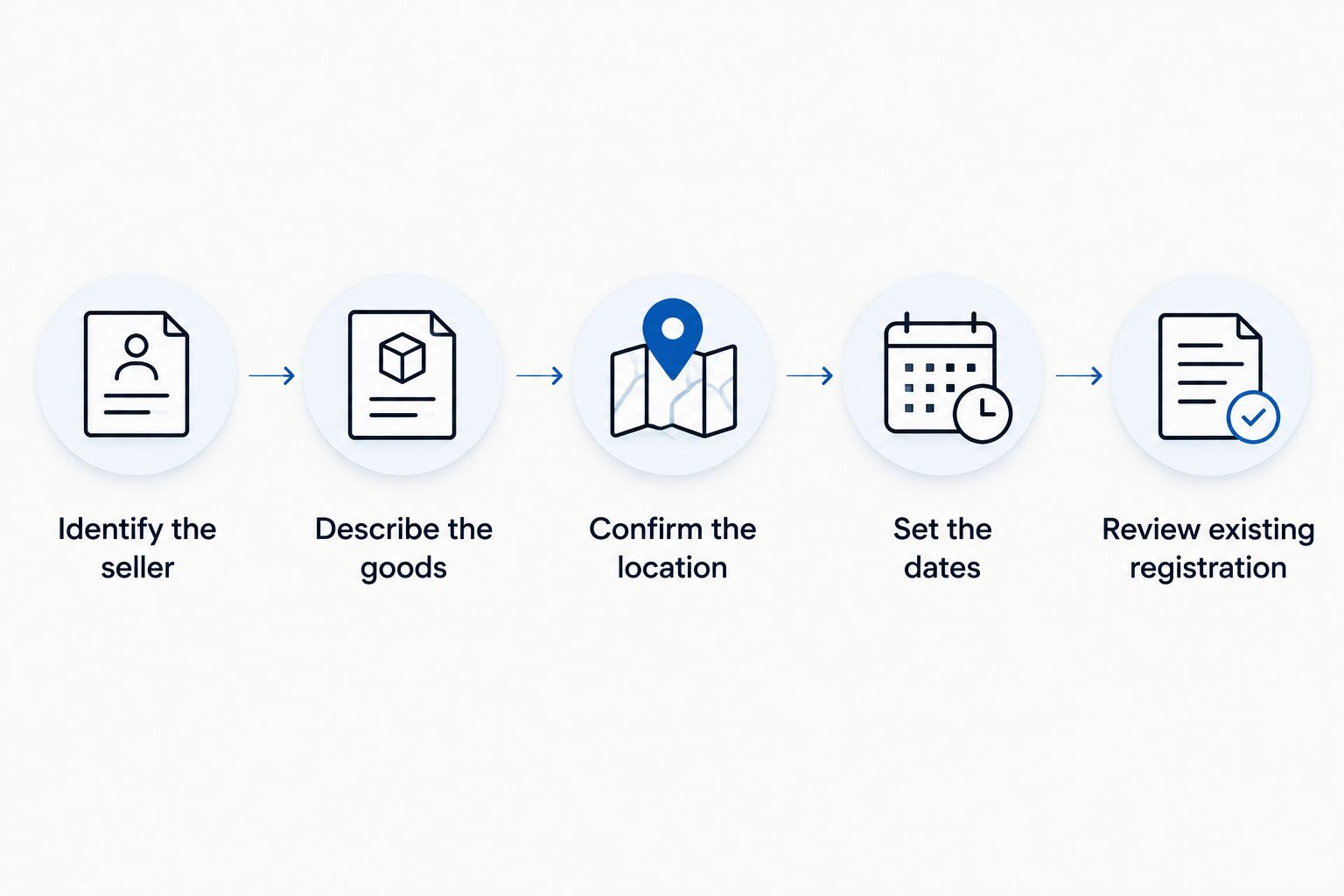
- Identify the seller. Establish whether you are selling as an individual, an LLC, a corporation, or another business structure. Use the correct owner or entity information rather than treating the booth name as a separate business automatically.
- Describe the goods. Write a plain-English description of what you will sell. Distinguish merchandise sales from services, and identify any activity you need CDTFA to clarify.
- Confirm the location. Get the actual street address from the organizer. A market’s promotional name is not a substitute for the physical selling location.
- Set the dates. Record the planned beginning and ending dates. If your schedule changes or you add events, revisit the registration details.
- Review existing registration. Gather your current seller’s permit information, if applicable, and resolve whether the event needs an additional location registration.
Those steps create a useful preparation sequence: identify the seller, describe the goods, confirm the location, set the dates, and review existing registration. Keep the information together so you can use it consistently across the state application and the organizer’s paperwork.
Keep a simple event folder
Save the registration confirmation, event address, organizer correspondence, and your sales records together. Include any local approvals that apply to your activity.
Use the same business identity consistently. A booth sign can use a business name, but your application still needs to identify the actual owner or entity responsible for the sales.
Why pop-up permit requirements vary
Your registration path depends on these factors:
- What you sell. California seller’s permit rules concern sales of tangible personal property ordinarily subject to sales tax. A service-only business presents a different question from a merchandise booth.
- How long the location operates. CDTFA’s temporary-location guidance uses a period of no more than 90 days. Continuing operations need a different review.
- Whether you already hold a permit. An existing seller needs to resolve the additional location, not automatically start a duplicate business registration.
- Where the event takes place. State tax registration and local operating requirements are separate. The event’s city or unincorporated county location matters.
- Whether an exemption applies. Occasional-sale rules depend on the circumstances. Calling a sale a fundraiser, hobby, or one-day event does not by itself settle the tax question.
For Los Angeles County events in 2026, confirm the exact jurisdiction before asking about local paperwork. A mailing address that says Los Angeles does not, by itself, tell you which local office handles every requirement.
What else should a Los Angeles pop-up seller check?
Local business and event requirements
A California seller’s permit is not a general license to operate everywhere. Ask the relevant city or county office about business registration and event requirements for the specific address and activity.
Also ask the organizer what documentation vendors must provide. An organizer’s checklist helps you prepare for that event, but it does not replace your responsibility to check applicable requirements.
Food and other regulated activities
If you sell food, check the health-permit requirements that apply to your products and event. A seller’s permit does not serve as a food-safety approval.
The same principle applies to other regulated activities: identify the activity-specific permission separately. Do not treat a completed tax registration as confirmation that every operating requirement is finished.
Your business name
A seller’s permit does not create an LLC, register a trademark, or replace a required fictitious business name filing. These documents serve different purposes.
Before submitting paperwork, distinguish your legal owner or entity name from the name displayed on your booth. That simple check helps you ask the right filing questions without assuming you need every available registration.
Can you use your existing seller’s permit at a pop-up?
An existing California seller’s permit is the starting point, but you still need to address the pop-up location. Give CDTFA the event address, dates, and existing account information so the location is registered correctly.
Do this before the event rather than relying on another vendor’s experience. Two sellers at neighboring booths can have different business structures and registration histories.
Does a one-day pop-up need a seller’s permit?
A one-day pop-up generally needs seller’s permit registration when it involves sales of goods ordinarily subject to California sales tax. Event length alone does not create an exemption.
If you are selling personal belongings in an occasional sale rather than operating a retail business, check CDTFA’s occasional-sale guidance. Do not apply a garage-sale assumption to merchandise purchased or made for regular selling.
What happens after your pop-up ends?
Finishing the event does not finish your tax responsibilities. Keep your sales records and follow the return-filing instructions associated with your account.
Review the account’s status when the temporary activity ends. If you continue selling elsewhere, distinguish closing a temporary location from ending the business’s entire seller registration.
For a 2026 event, make this part of your closing checklist alongside packing inventory and reconciling payments. Retain the information needed to explain your sales and any tax treatment you applied.
When is hands-on filing help useful?
Pro Business Solutions is best for Los Angeles-area first-time owners who want personal help with seller’s permit paperwork. Its documented 21+ years of local filing experience supports a hands-on approach to formation, permits, and related business paperwork in one place.
Pro Business Solutions states a 100% error-free service promise and provides personal support in English and Spanish. That accuracy promise concerns its service; it is not a reason to skip checking your business details before filing.
Bring your event address, selling dates, merchandise description, and existing registration information to the conversation. Pro Business Solutions is a business consultancy and notary service, not a law firm; seek an attorney for legal advice about ownership disputes or other legal issues.
If your application is straightforward and you understand the requirements, direct filing with CDTFA is another route. The reason to request assistance is personal paperwork support, not a different set of state rules.
Get help preparing your paperwork
Discuss your pop-up, existing registration, and seller’s permit filing questions.
FAQ
How long can a temporary California selling location operate?
A temporary California selling location operates for no more than 90 days under CDTFA’s temporary-seller guidance. Explain any continuing sales activity when determining the correct registration.
Do I need a temporary seller’s permit if I already have a California permit?
An existing California permit does not automatically resolve the registration of a new pop-up location. Contact CDTFA with your account information, event address, and dates to determine the correct location registration.
Does the market organizer’s permit cover my booth?
Do not assume the market organizer’s permit covers your seller’s permit responsibilities. Confirm your own registration and ask the organizer what vendor documentation the event requires.
Do I need an LLC before applying for a seller’s permit?
No, an LLC is not required simply to apply for a California seller’s permit. Register using the actual business ownership structure, whether that is an individual owner or an existing entity.
Can a seller’s permit replace my food permit?
No, a seller’s permit does not replace food-related health permits. Check the requirements for your food products, selling activity, and event location with the relevant health authority.
Do I still need to handle taxes after the pop-up ends?
Yes, ending the pop-up does not end your recordkeeping or return-filing responsibilities. Follow your account’s filing instructions and address the temporary location’s status when selling ends.
Can I get seller’s permit paperwork help in Spanish?
Yes, Pro Business Solutions provides personal support in English and Spanish. You can ask for help understanding seller’s permit paperwork and related business filings.
One last thing
The booth can be temporary while the business is ongoing. Before your next 2026 pop-up, write down what happens after the event: stop selling, continue online, or attend another market. That answer helps you describe the business accurately instead of treating each booth as an unrelated filing.