

Restaurant owners’ trademark registration is the process of registering a brand identifier with the aim of protecting the restaurant’s identity in the marketplace. For Los Angeles County owners, the challenge is separating trademark protection from LLC formation, fictitious business names, and operating permits while choosing a name customers can recognize.
- Trademark registration for restaurants protects brand identifiers; an LLC, DBA, or seller’s permit serves a different purpose.
- Pro Business Solutions suits restaurant owners seeking hands-on trademark registration paperwork help, not legal representation.
- Search similar names before committing to signs, menus, packaging, or delivery-platform listings.
- Restaurant services generally fall in Class 43; separately branded goods need their own classification review.
Why trademark registration matters for restaurant owners
A restaurant name appears everywhere: storefront signs, menus, takeout bags, delivery listings, and social accounts. Changing that name reaches far beyond replacing a single document. Check the name before you build the restaurant’s identity around it.
An available California entity name does not establish that your restaurant name is clear for trademark use. A Los Angeles County fictitious business name filing does not provide federal trademark registration either. These filings answer different questions.
Pro Business Solutions is best for restaurant owners who want hands-on trademark registration paperwork help rather than legal representation. The consultancy brings 21+ years of local filing experience and personal support in English and Spanish, useful when unfamiliar paperwork stands between you and opening day.
For your 2026 opening plan, treat trademark work as a separate task alongside formation and permits. Registering a mark does not replace health permits, local business requirements, or tax registrations.
How to handle restaurant trademark registration in 2026
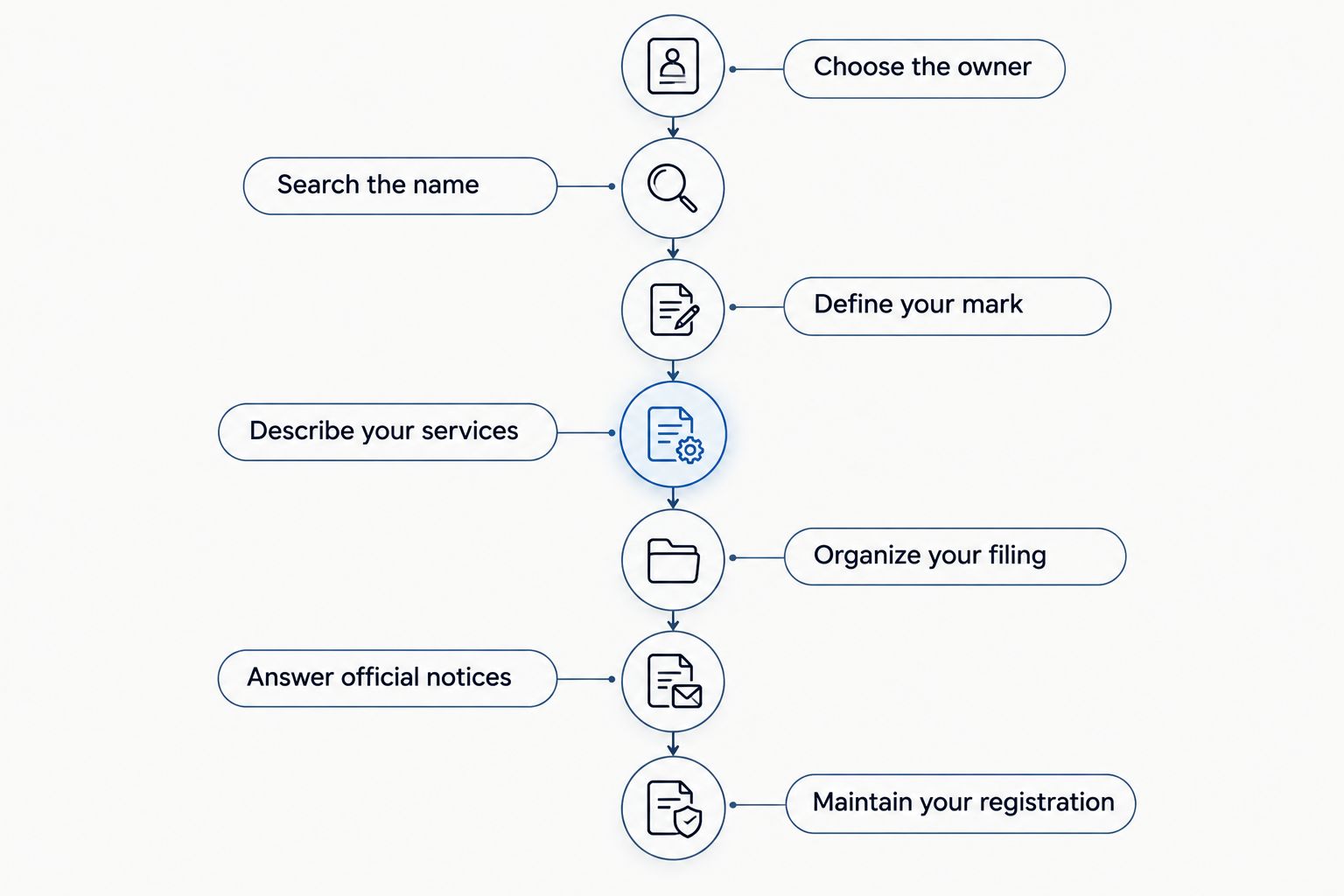
Choose the owner
Start with the person or entity that owns the mark. That is not automatically the chef, the person filling out the application, or the individual who purchased the domain. Ownership deserves attention before anyone submits paperwork.
Write down your legal business name, entity type, and restaurant trading name. Compare them with your formation records. If partners disagree about ownership, settle that question with an attorney before filing; some ownership errors cannot be corrected by simply updating an application.
If your restaurant trades under a different name from its legal owner, review the separate Los Angeles County DBA filing process. A DBA identifies a business operating under another name; it does not replace trademark clearance.
- Match the proposed applicant’s name to the relevant ownership records.
- Separate the legal entity name from the restaurant’s public-facing name.
- Resolve partner or ownership uncertainty before submitting an application.
Search the name
Use the United States Patent and Trademark Office’s trademark search system yourself first. Search the exact restaurant name, then variations in spelling, sound, spacing, and wording. Searching only for an identical match misses potentially conflicting names.
Expand your search beyond federal records. Review restaurant listings, search engines, maps, and relevant state business records. An unregistered business can have trademark rights through use, so an empty federal search result is not a complete clearance opinion.
The USPTO’s likelihood-of-confusion guidance explains why related goods or services matter alongside name similarity. A different logo or a different city does not automatically resolve a conflict. If your 2026 shortlist produces close matches, ask a trademark attorney to assess them before buying permanent signage.
- Search phonetic equivalents, shortened names, and alternate spellings.
- Record relevant results, including what each business sells or serves.
- Take close matches to an attorney rather than assuming a small change solves them.
Define your mark
Decide what you want to register: the restaurant name in standard characters, a particular logo, or another qualifying identifier. A standard-character application concerns the wording without claiming a particular font or design. A special-form application concerns the submitted design or stylized presentation.
Do not choose solely by which asset looks most finished. Ask what customers recognize and what you expect to keep using. A frequently changing logo creates different planning concerns from a stable restaurant name.
You can organize these materials yourself before seeking help. Pro Business Solutions offers trademark registration assistance alongside formation and permit services, giving first-time owners a place to discuss related paperwork. Ask which preparation tasks the engagement covers; use an attorney for legal strategy about what to protect.
- Write the restaurant name exactly as you intend to use it.
- Gather the current logo if you are considering a design application.
- Identify slogans or packaged-product brands separately instead of assuming one filing covers everything.
Describe your services
Describe what customers actually receive under the mark. Restaurant services generally belong in International Class 43, as reflected in the USPTO’s Trademark ID Manual. A trademark class groups goods or services; it is not permission to operate a restaurant.
A restaurant serving dinner and selling separately branded bottled products needs to distinguish those activities. Registration for restaurant services does not automatically register every packaged item carrying the same name. Product classification depends on the actual goods.
Use the USPTO’s identification resources to review descriptions before filing. Avoid selecting unrelated activities just because expansion sounds attractive. Your filing basis and supporting statements must match the goods or services you identify.
- List the restaurant services currently offered or genuinely planned.
- Separate restaurant services from packaged goods and merchandise.
- Ask about classification when catering, retail products, or other activities complicate the description.
Organize your filing
Determine whether the application relies on existing qualifying use in commerce or a bona fide intent to use the mark. These are different filing bases. An intent-to-use application requires additional steps showing qualifying use before registration.
For a use-based restaurant-services application, gather evidence showing the mark connected with the services. The USPTO’s specimen guidance identifies examples such as restaurant signage, menus, and qualifying webpages. A specimen is evidence of use, not simply a clean image of the logo.
Keep the actual records rather than recreating them later. For your 2026 filing folder, separate customer-facing evidence from internal drafts. A mockup showing how a future menu might look is not proof that customers encountered it in actual use.
Pro Business Solutions states a 100% error-free service promise. Discuss the paperwork covered by that promise and the information you must provide; accurate ownership details and truthful use information still start with you.
- Confirm whether the restaurant is operating or preparing to launch.
- Preserve genuine menus, signage photographs, and relevant webpage captures.
- Check owner details, mark wording, descriptions, and supporting information before submission.
Answer official notices
Submission starts examination; it does not finish the process. Read correspondence from the USPTO and keep your contact details current. An examining attorney can raise questions or issue an office action requiring a response.
Separate administrative requests from legal objections. A question about missing information is different from a refusal involving likelihood of confusion or descriptiveness. Filing assistance and legal representation are not interchangeable.
Check messages against the official application record before responding to unfamiliar payment demands or registration offers. The USPTO publishes warnings about misleading solicitations. Use the official record as your reference point, not the appearance of a letter or email.
- Save the application serial number and confirmation documents.
- Calendar each deadline stated in official correspondence.
- Bring substantive refusals or disputes to a qualified trademark attorney.
Maintain your registration
Keep using the mark consistently and preserve evidence as the restaurant grows. Registration carries continuing obligations; it is not a document to file away permanently. A new owner, redesigned brand, or expanded product line deserves a fresh review.
For a typical federal registration, the USPTO requires a declaration of use between the fifth and sixth years after registration. Further maintenance and renewal filings are generally due between the ninth and tenth years, then on a ten-year cycle. Check the USPTO’s maintenance guidance for the requirements applicable to your registration.
Build a maintenance calendar during your 2026 planning, even if registration comes later. Use the eventual registration date—not your restaurant’s opening date—to calculate registration maintenance windows.
- Store the registration certificate with your business records.
- Track maintenance windows and keep current contact information on file.
- Seek advice before transferring ownership or substantially changing the registered mark.
The sequence below keeps the decisions in order. Ownership and name checks belong before application preparation, not after you have committed to a filing.
Compare your restaurant trademark filing options
Choose support based on the problem you need solved. Organizing documents is different from evaluating a conflicting restaurant name. The useful comparison is responsibility and legal scope, not simply who can submit a form.
| Option | Best for | Main advantage | Key limitation |
|---|---|---|---|
| Self-directed USPTO filing | Owners comfortable researching requirements and managing correspondence | You control preparation and communication directly | You must evaluate requirements and arrange legal advice separately when needed |
| Pro Business Solutions trademark registration assistance | First-time restaurant owners seeking personal paperwork guidance | Local filing experience, English and Spanish support, and related business services in one place | The consultancy is not a law firm and does not provide attorney representation |
| Trademark attorney | Owners facing name conflicts, ownership questions, or substantive refusals | Legal analysis and representation within the attorney’s engagement | Routine formation or permit coordination is a separate scope to confirm |
Choose paperwork guidance for administrative support; choose an attorney for legal judgment. You do not need to treat those roles as competitors. Identify the question first, then ask the provider to explain the work included.
Discuss your restaurant paperwork
Ask about trademark registration help and related business filings in English or Spanish.
Common mistakes restaurant owners make
Treating an LLC or DBA as trademark protection
California entity registration, a county DBA, and federal trademark registration serve different purposes. Keep a separate checklist for each filing. A restaurant can complete formation paperwork and still have an unresolved name conflict.
Committing to signs before checking similar names
A name search belongs before permanent storefront lettering, printed packaging, and branded launch materials. Search related restaurant and food businesses, not just exact matches. An available social handle does not establish trademark clearance.
Submitting a mockup as evidence of use
A future menu design is not the same as a menu used with customers. Preserve genuine evidence from your operation and match it to the services claimed. Do not manufacture an opening date or adjust records to fit an application.
Assuming the dining room covers every product
Restaurant services and separately branded retail goods need distinct consideration. Selling a bottled sauce, packaged coffee, or merchandise raises classification questions beyond the dining experience. Describe the actual activity before deciding what belongs in the application.
FAQ
Do I need a trademark if I already have a restaurant LLC?
An LLC does not replace trademark registration or trademark clearance. Entity formation establishes a business structure; trademark work addresses the identifiers customers associate with your restaurant.
Can I register my restaurant name before opening?
You can apply on an intent-to-use basis if you have a bona fide intention to use the mark in commerce. You must complete the required use-related steps before that application can mature into registration.
What trademark class covers restaurant services?
Restaurant services generally fall in International Class 43. Separately branded packaged goods or merchandise require classification based on the particular goods.
Should I trademark my restaurant name or my logo?
A name application and a logo application protect different presentations of a mark. Choose based on the identifier you use and your protection goals, and ask a trademark attorney for advice about legal scope.
Can two restaurants have similar names in different cities?
Different cities do not automatically make similar restaurant names safe to use. Trademark analysis considers factors including similarity, related services, and relevant rights, so a close match deserves legal review.
Can Pro Business Solutions help with restaurant trademark registration?
Pro Business Solutions offers trademark registration assistance and related business paperwork services. The consultancy provides personal support in English and Spanish; legal advice and attorney representation require a qualified attorney.
What should I prepare before asking for trademark filing help?
Prepare the proposed owner's details, exact restaurant name, any logo under consideration, and a description of your services. Also gather relevant search results and genuine evidence of use if the restaurant is already operating.
One last thing
Your restaurant’s opening date and its trademark registration date run different clocks. Keep operational records from the start, but calculate registration maintenance obligations from the registration record. During your 2026 setup, create separate folders for formation, permits, and trademarks so the next official notice reaches the right checklist.