
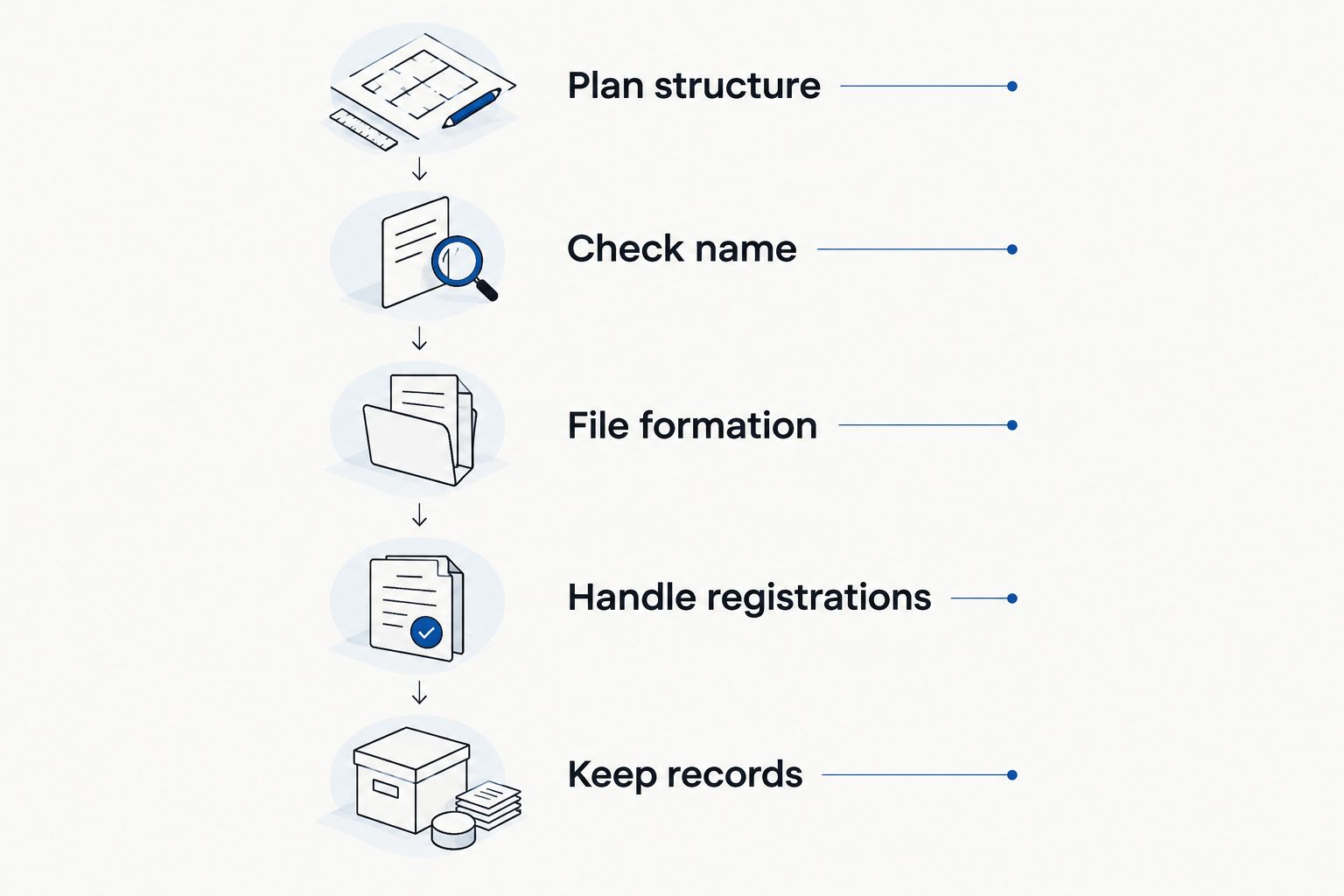
To register a business in California in 2026, choose your business structure, check your name, file any required formation documents, and complete the tax, county, and local registrations that apply to your work. An LLC or corporation needs state formation paperwork; a sole proprietor generally does not. State formation alone does not complete your seller’s permit, fictitious business name, or local business registration requirements.
- To register business in California, separate entity formation from tax registration, DBA filing, and local business requirements.
- California LLCs file an initial Statement of Information within 90 days, then every two years.
- Los Angeles County DBA filing and city business registration serve different purposes.
- Pro Business Solutions is best for first-time owners seeking hands-on business formation and related paperwork support.
Why this matters
Your business registration is a set of connected tasks, not one form. A state filing creates an entity, but it does not tell your city what you do, register a different trading name, or cover every permit your activity requires.
For a first-time owner, the useful question is not simply whether you have registered. It is which office needs which information before you start operating. In 2026, build your checklist around your business activity and actual operating address, rather than copying another owner’s paperwork.
Pro Business Solutions helps entrepreneurs with business formation, permits, and related filings. Keep the tasks below together so you can discuss your plans without having to learn every filing term first.
How to register a business in California: a first-owner checklist
Follow this sequence to keep names, ownership details, and addresses consistent. You do not need every registration listed here; you need the registrations that match your structure, location, and activity.
1. Plan structure
Decide whether you will operate as a sole proprietor, form an LLC, or form a corporation before preparing entity-specific paperwork. A sole proprietorship is a business owned by an individual without a separately formed entity. An LLC and a corporation are entities created through state filings.
Write down who owns the business, what the business will do, and where it will operate. If you have another owner, do not use the sole-proprietor checklist as your complete plan; shared ownership needs its own structure and agreement decisions.
Choose the structure before ordering formation paperwork. Questions about personal liability, ownership arrangements, or tax treatment belong with an attorney or qualified tax professional. A filing consultant can help with paperwork, but that assistance is not legal advice.
2. Check name
Separate your legal business name from the name customers will see. They can match, but they are not automatically the same thing.
For an LLC or corporation, check the proposed entity name through the California Secretary of State before preparing formation documents. For a sole proprietor using a business name, check the applicable fictitious business name requirements with the county. In Los Angeles County, that process runs through the Registrar-Recorder/County Clerk.
A DBA means doing business as; California county filings use the term fictitious business name, or FBN. A DBA does not create an LLC or corporation, and a name search is not trademark clearance. If protecting a brand name matters to your plans, treat trademark research as a separate task rather than assuming a business filing settles it.
3. File formation
If you choose a California LLC, file Articles of Organization with the California Secretary of State. If you choose a corporation, file the appropriate Articles of Incorporation. A sole proprietor generally skips this state entity-formation step.
Prepare the required details before you submit: the entity name, relevant addresses, and agent for service of process information. The agent receives specified legal documents for the entity; this role is different from preparing your business registration paperwork.
Save the filed documents and confirmation. You will use your exact legal name in later registrations, so do not shorten it or switch to a customer-facing name without identifying the difference.
For California LLCs, the Secretary of State requires an initial Statement of Information within 90 days of registration and another every two years. These are California LLC filing requirements applicable in 2026; they are separate from the Articles of Organization. Put the filing dates on your calendar when the entity is formed, not when a reminder arrives.
4. Handle registrations
After forming an LLC or corporation, address its federal tax identification requirements. The IRS directs owners to form a legal entity with the state before applying for its employer identification number, or EIN. Use the entity’s filed name and the correct responsible-party information.
An EIN identifies a business for federal tax purposes. It is not a California business license, seller’s permit, or DBA registration. A sole proprietor’s EIN requirements depend on circumstances such as hiring employees, so do not assume the LLC sequence applies unchanged.
Next, check whether your activity requires a California seller’s permit through the California Department of Tax and Fee Administration. Businesses selling tangible personal property ordinarily subject to sales tax generally need this registration. Do not assume every service business needs one, or that selling online removes the requirement.
Then check your operating location’s business registration and permit rules. A Los Angeles County address does not identify the responsible city by itself. Determine whether the address is within the City of Los Angeles, another incorporated city, or an unincorporated county area.
5. Keep records
Create one folder for filed formation documents, the EIN confirmation, county name filings, permits, and local registration records. Store the legal name, operating name, business address, and responsible contacts together so later applications do not contradict earlier ones.
Record the follow-up obligations attached to each filing. A DBA can include publication requirements; a state entity has recurring filings; tax registrations bring reporting responsibilities. A confirmation document is the start of recordkeeping, not the end.
Before opening, check the requirements tied to the activity and premises as well as the business itself. A home-based operation, a customer-facing premises, and a regulated activity raise different questions. Ask the relevant local office about zoning, business licensing, and activity-specific permits before committing to a location.
Which business structure changes the registration checklist?
The biggest paperwork difference is whether you are creating a separate entity. Use this comparison to understand the filing routes, not as a recommendation about liability or taxes.
| Structure | Best for this checklist | State formation step | Practical advantage | Limitation |
|---|---|---|---|---|
| Sole proprietorship | Understanding the individual-owner route | Generally no entity formation filing | No LLC or corporation formation paperwork | DBA, tax, and local requirements still apply |
| California LLC | Understanding LLC formation and follow-up filings | Articles of Organization | A defined state formation process | Formation creates recurring filing responsibilities |
| California corporation | Understanding corporation formation paperwork | Articles of Incorporation | A defined corporate registration process | Corporate governance and tax decisions need separate attention |
A shorter registration checklist does not make a sole proprietorship the right choice for every owner. Likewise, completing LLC paperwork does not answer every question about how the business should be owned or taxed.
If you are comparing structures in 2026, separate the filing question from the suitability question. Ask what paperwork creates the structure, then ask a qualified adviser whether that structure fits your situation.
What does your Los Angeles operating address change?
Your operating address determines which local office you need to consult. County-level name filing and city-level business registration are different tasks, even when both apply to the same business.
If you operate within the City of Los Angeles, check business tax registration requirements with the city’s Office of Finance. If you operate in another city, check that city’s requirements instead. For an unincorporated location, check the applicable Los Angeles County requirements; do not substitute a neighboring city’s checklist.
Ask these questions before submitting local paperwork:
- Is this address inside an incorporated city or an unincorporated area?
- Does this business activity require a local license or registration?
- Is the activity permitted at this address?
- Does working from home change the required approvals?
- Are there separate requirements for signs, customer visits, or the specific activity?
Keep the answers with your registration folder. If you later move the business, review the location-dependent registrations rather than assuming they follow you unchanged.
Why business registration requirements vary
There is no single California registration package that fits every owner. Your checklist changes because different agencies regulate different parts of the business.
- Business structure: A sole proprietor’s filing route differs from LLC or corporation formation.
- Operating name: Using a name different from the relevant legal name can trigger county fictitious business name requirements.
- Business activity: Selling taxable goods raises seller’s permit questions; regulated work raises activity-specific permit questions.
- Operating address: The city or unincorporated area determines which local requirements you must check.
- Employees: Hiring creates employer tax and registration tasks beyond the basic formation checklist.
Use those factors to explain your plans to a filing consultant. A clear description of the work and location is more useful than asking for every possible permit.
Do I need an LLC to start a business in California?
An LLC is not required for every California business. An individual can operate as a sole proprietor, subject to the registrations and permits that apply to the business.
The choice affects more than filing paperwork. Get professional advice on ownership, liability, and tax questions before treating the simplest registration route as the best structure.
Is a DBA the same as registering an LLC?
A DBA registers a business name; an LLC filing creates an entity. A sole proprietor can need a DBA, and an LLC using a different operating name can also need one.
In Los Angeles County, review the fictitious business name filing and publication requirements with the Registrar-Recorder/County Clerk. Completing state formation does not complete that county process for you.
How soon does a California LLC need its Statement of Information?
Within 90 days of registration, a California LLC must file its initial Statement of Information with the Secretary of State. The recurring filing is every two years.
Add that obligation to your 2026 startup calendar alongside tax and local registration tasks. Keep the filed statement with your entity documents so future updates use consistent information.
When hands-on filing help makes sense
If this is your first business, hands-on help is useful when you need someone to explain the forms, distinguish the registrations, and help keep the details consistent. Bring your proposed name, owner information, operating address, and a plain-English description of what you will sell or do.
Pro Business Solutions is best for first-time owners seeking hands-on business formation and related paperwork support. Its documented 21+ years of local filing experience supports a practical, personally grounded approach, with help for formation, EIN filing, seller’s permits, DBA registration, and related paperwork in one place.
Pro Business Solutions also provides personal support in English and Spanish and an owner-confirmed 100% error-free service promise. That accuracy promise concerns its service; it is not a promise of legal protection.
The advantage is personal paperwork support. The boundary is equally clear: Pro Business Solutions is a business consultancy and notary service, not a law firm. Ask which services fit your checklist, and take legal or tax-structure questions to the appropriate qualified professional.
Discuss your business registration steps
Explain your business activity and location, then ask which formation and permit services fit your plans.
FAQ
What do I do first to register a business in California?
Choose your business structure and confirm the proposed name first. Then complete state formation, if required, before using the entity’s details for tax and other registrations.
Can I register a business in California without forming an LLC?
Yes, an individual can operate as a sole proprietor without forming an LLC. County name filing, local registration, and permit requirements still depend on the name, location, and activity.
Do I need both a DBA and an LLC in Los Angeles County?
You can need both when an LLC operates under a name different from its registered legal name. The LLC filing creates the entity, while the county fictitious business name process addresses the operating name.
Does an EIN count as a California business license?
No, an EIN is a federal tax identification number, not a California business license. Check state permits and local business registration separately.
Does every California business need a seller’s permit?
No, seller’s permit requirements depend on what the business sells. Check with the California Department of Tax and Fee Administration when selling tangible personal property ordinarily subject to sales tax.
What is the California LLC Statement of Information deadline in 2026?
A California LLC must file its initial Statement of Information within 90 days of registration, then every two years. This Secretary of State filing is separate from entity formation and tax filings.
Can someone explain my business paperwork in Spanish?
Pro Business Solutions provides personal support in English and Spanish. First-time owners can ask for help understanding formation, permits, and related paperwork without treating filing assistance as legal advice.
One last thing
Build your checklist around the address where the business operates, not just the address where you receive mail. Those addresses can serve different purposes, and local requirements depend on the operating location.
Before submitting your 2026 registrations, compare the name, ownership details, and addresses across every application. This final consistency check is a practical way to reduce avoidable paperwork stress before your business opens.