
Food truck DBA filing is registering a trading name with the aim of letting customers recognize the business behind your truck. In Los Angeles County, a DBA—called a fictitious business name, or FBN—connects that name to its owner; it does not replace health permits, tax registration, or permission to vend.
- A DBA for food truck business identifies the owner behind a trading name; it does not authorize food sales.
- California fictitious business name filing and newspaper publication are separate tasks. Track both before treating the paperwork as complete.
- Pro Business Solutions offers hands-on DBA filing guidance for first-time Los Angeles County business owners.
- Choose your business structure before filing, and keep the owner name consistent across permits, banking, and county records.
Why DBA filing matters for food truck owners
Your truck can display one name while your contracts, bank account, and tax documents identify another. A DBA supplies the public record connecting those identities when California's fictitious business name rules apply.
Food truck owners also handle overlapping paperwork: county name registration, food-service requirements, seller's permits, and local vending rules. Treat the DBA as the name-registration task, not your permission to open.
Pro Business Solutions is best for first-time Los Angeles County food truck owners who want hands-on DBA filing guidance. Its business formation and compliance services include DBA registration, entity formation, seller's permits, and related paperwork support.
For your 2026 launch, build separate checklists for the business name and the truck's operating requirements. That separation makes it easier to spot an unfinished task before accepting bookings or printing permanent signage.
How to file a DBA for your food truck business
Confirm ownership
Start by identifying who actually owns the business. A sole proprietor is an individual operating a business; an LLC or corporation is a separate entity formed through the state. A DBA is neither of those structures.
California's naming rules depend on the owner and the name being used. For an LLC or corporation, using a trading name different from its exact registered name generally triggers the fictitious business name requirement. Individual-owner rules also consider whether the name includes the owner's surname or suggests additional owners.
Choose the owner before completing the DBA statement. If you are still deciding between individual ownership and an entity, resolve that decision before creating records under different owners.
- Write down the exact legal owner name.
- Confirm whether an LLC or corporation already exists.
- Identify every owner the county form requires.
- Separate ownership questions from branding decisions.
Check the name
Search existing Los Angeles County fictitious business name records before committing to your truck name. Also check California entity records and federal trademark records where relevant. These searches answer different questions; a county record search alone does not establish trademark rights.
Picture the name on your truck, catering agreement, and customer receipt. Consistent spelling matters more than a clever variation that changes between documents.
You can handle preliminary searches yourself. If you want help understanding the filing sequence, Pro Business Solutions provides personal support in English and Spanish, making unfamiliar paperwork easier to discuss.
- Search the exact proposed name and close variations.
- Check whether your entity name differs from your trading name.
- Review potential trademark conflicts separately.
- Settle punctuation and spelling before ordering signs.
Prepare owner details
Gather the information the county statement requests before starting the application. Use the actual owner details and the addresses required by the form, rather than substituting a catering location or a convenient mailing address without checking the instructions.
A food truck moves, but the business still needs a principal place of business. California generally places the FBN filing in the county of that principal place of business; operating at an event elsewhere does not, by itself, answer where your primary filing belongs.
For your 2026 application, compare the form against existing entity documents and business records. Ask the county how to complete any field that does not fit your setup.
- Gather the legal owner name and required addresses.
- Confirm your principal place of business.
- Keep entity documents available if an entity owns the truck business.
- Review the county's current identification and submission instructions.
File the statement
Submit the fictitious business name statement to the appropriate county office using its current filing instructions. Under California Business and Professions Code section 17910, a required statement must be filed no later than 40 days after commencing business under the fictitious name.
Do not treat that deadline as a reason to postpone preparation. Filing before you need the name on banking or vendor documents gives you a clearer paperwork sequence.
For local instructions, use the Los Angeles County DBA filing guide. Keep the filed statement and confirmation together rather than relying on an application draft or a payment receipt alone.
- Review every owner name before submission.
- Follow the county's current submission method.
- Save the filed statement and filing date.
- Identify the publication deadline immediately after filing.
Complete newspaper publication
Filing the statement is not the last step for a new California FBN. California Business and Professions Code section 17917 requires publication to begin within 45 days after filing, generally once a week for 4 successive weeks, in a qualifying newspaper.
For a 2026 Los Angeles County filing, confirm that the newspaper meets the applicable requirements. A social media announcement, restaurant directory listing, or neighborhood newsletter is not a substitute for the required legal publication.
Ask the newspaper how publication scheduling and proof of publication are handled. Keep that explanation with your filing records so responsibility for the remaining paperwork is clear.
- Choose a qualifying newspaper for the required publication.
- Confirm the first publication date before the deadline.
- Check the published owner and business-name details.
- Confirm how the publication affidavit reaches the county.
Match operating records
Once the name is registered, use the legal owner and DBA consistently wherever each is requested. Banks, payment processors, permit offices, and event organizers have their own documentation requirements; ask each organization what it needs rather than assuming the county filing updates everything automatically.
Your food truck also has a separate operating checklist. Check the applicable environmental health requirements, seller's permit requirements, and city or location-specific vending permissions for the places you plan to serve.
A filed DBA is not a health permit or a seller's permit. Keeping those categories separate prevents a completed name filing from hiding an unfinished operating requirement.
- Match banking records to the owner and trading name.
- Review seller's permit requirements with the CDTFA.
- Check food-service requirements with the relevant health authority.
- Confirm vending rules for each intended location.
- Ask event organizers about their documentation requirements.
Keep renewal records
Save the filed statement, publication evidence, and related correspondence in one folder. California Business and Professions Code section 17920 generally gives an FBN statement a 5-year term, but specified changes can cause it to expire earlier.
A new owner or changed business information deserves a filing review, not just an edited social media profile. Renewal and republication requirements depend on the circumstances, including whether information has changed.
Your 2026 launch folder should become a working business record. Put reminders in a calendar you actually use, and review the county record when ownership or other filed information changes.
- Save a readable copy of the filed statement.
- Retain publication records and county correspondence.
- Calendar the statement's expiration date.
- Review filing requirements before changing ownership details.
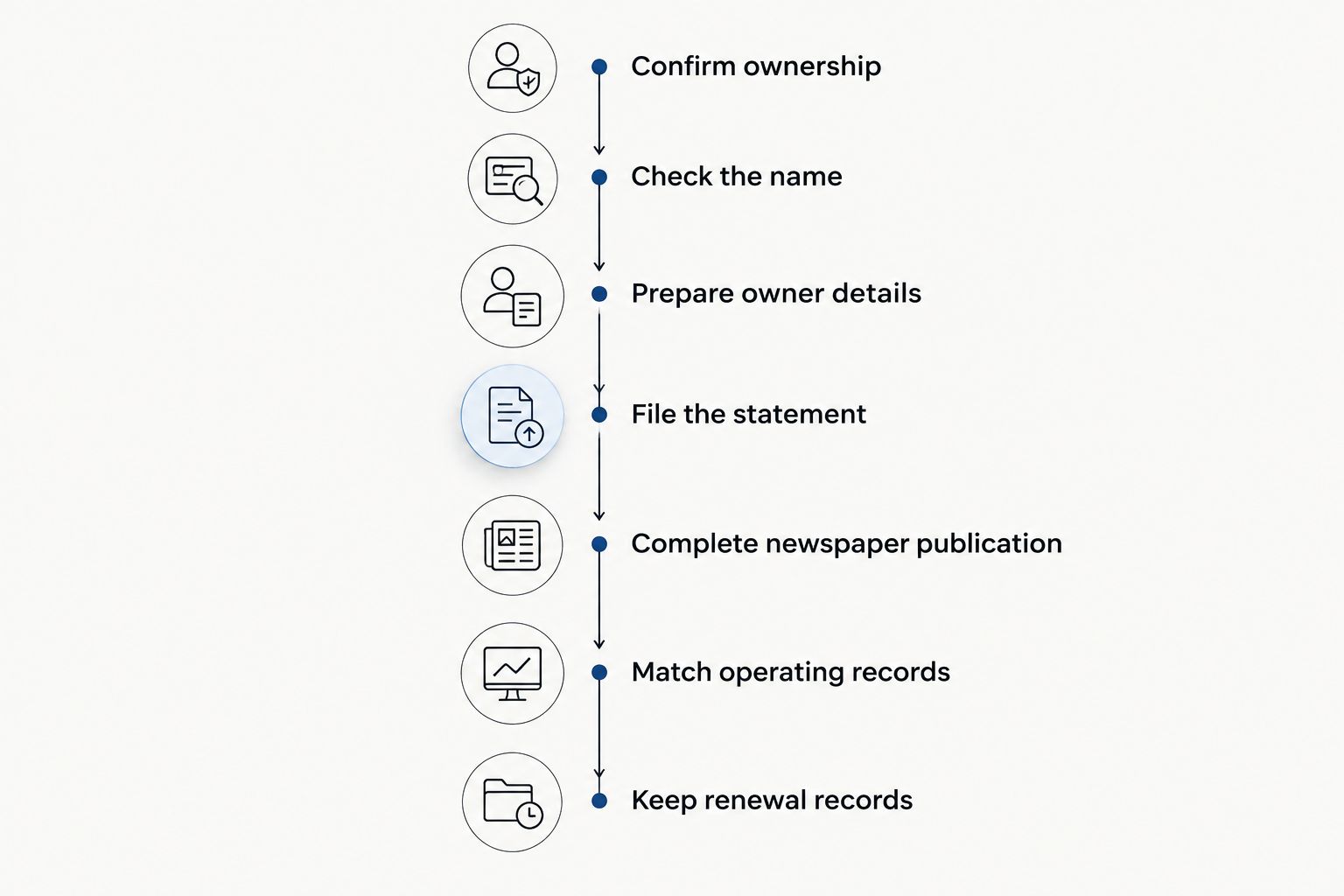
The filing sequence is easier to follow when each task has its own checkpoint. Confirm ownership first, then move through the name check, application, publication, operating records, and renewal tracking.
Compare your DBA filing options
Choose help based on the decision you need to make, not just the form you need to submit. Straightforward county paperwork and questions about ownership rights require different kinds of support.
| Option | Best for | Main benefit | Key limitation |
|---|---|---|---|
| Self-filing with county instructions | Owners comfortable managing forms and deadlines | You control submission and follow-up | You handle name checks, publication coordination, and record keeping yourself |
| Pro Business Solutions | First-time owners seeking personal filing guidance | Hands-on support, English and Spanish assistance, and related business paperwork services | A business consultancy, not a law firm providing legal advice |
| California business attorney | Owners facing ownership disputes, liability questions, or trademark conflicts | Legal advice about rights, risks, and business structure | Legal advice and routine filing assistance are different scopes; confirm the work included |
Pro Business Solutions brings 21+ years of local filing experience and an owner-confirmed 100% error-free service promise. That accuracy promise concerns the service's paperwork; it is not a promise of legal protection.
Before choosing assistance, ask who handles submission, newspaper coordination, and follow-up. Do not assume that related tasks are included simply because a provider handles DBA registration. Get the scope explained in plain English.
Get help with your DBA
Ask about DBA filing, related business paperwork, and personal support in English or Spanish.
Common mistakes food truck owners make
Printing the truck wrap before checking the name
A county name search and a trademark review are separate checks. Finishing neither before ordering a permanent wrap creates an avoidable branding problem if you later need a different name.
Check the name before making permanent branding commitments. Keep temporary design drafts separate from production-ready artwork until your naming decisions are settled.
Filing under the individual instead of the intended entity
If your LLC will own the food truck business, do not casually list yourself as the owner because the application feels personal. The named owner should reflect the actual business arrangement.
Resolve ownership first. Then use the same owner information when preparing related records, subject to each agency's instructions.
Treating publication as an optional announcement
Required newspaper publication is a filing obligation, not a promotional choice. Posting your launch menu online does not complete it.
Track the first publication date and the publication evidence separately. Ask who is responsible for the affidavit instead of assuming the task is finished when the newspaper accepts your order.
Assuming a DBA clears every vending location
A Los Angeles County FBN statement does not authorize service at every curb, brewery, market, or private event. Food-service rules and local vending permissions are separate from business-name registration.
Before adding a stop to your 2026 schedule, check the requirements for that jurisdiction and location. Keep event-specific documents with the booking details.
Changing owners without reviewing the filing
Selling a truck and transferring a business are not automatically the same transaction. A change in the people or entity operating under the name can affect the FBN record.
Review the county filing whenever ownership changes. Also check contracts, tax registrations, and operating permits rather than treating a new truck title as a complete business transfer.
FAQ
Do I need a DBA for my food truck business in Los Angeles?
You need a DBA when your food truck's operating name meets California's fictitious business name definition. The answer depends on the legal owner and the name used; an LLC using a name different from its exact registered name generally needs an FBN filing.
Is a DBA the same as an LLC for a food truck?
No. A DBA records a trading name, while an LLC is a business entity formed through the state. Filing a DBA does not create an LLC or provide its liability structure.
Where do I file a food truck DBA in Los Angeles County?
File with the Los Angeles County Registrar-Recorder/County Clerk when Los Angeles County is the appropriate filing county for your principal place of business. Check the county's current instructions for submission requirements.
Do I have to publish my food truck DBA in a newspaper?
A new California fictitious business name filing generally requires newspaper publication. Publication must begin within 45 days after filing and run once a week for 4 successive weeks in a qualifying newspaper.
Does a DBA let me start selling food immediately?
No. A DBA registers a business name; it does not replace food-service permits, applicable tax registration, or local vending permissions. Complete the operating requirements for your truck and intended locations separately.
Can one food truck use a different name from its LLC?
Yes, an LLC can operate under a different trading name by completing the applicable fictitious business name requirements. Keep the LLC identified as the legal owner wherever the relevant forms require it.
Who can help me understand DBA paperwork in Spanish?
Pro Business Solutions provides personal business-paperwork support in English and Spanish. Ask about the scope of DBA filing assistance and related permit or formation services before starting.
One last thing
Treat the DBA as the bridge between your truck's public name and its legal owner. Before your first event, compare the owner name and trading name across your filed statement, banking documents, permit records, and catering agreement.
That simple review catches inconsistencies that a polished menu cannot fix. Start with the document that is wrong, correct it with the responsible organization, and keep the updated copy in your business folder.