
Check the business name, legal owner, business address, signer, publication arrangements and proof of publication before treating your Los Angeles County FBN filing as complete. The mistakes to catch are mismatched ownership details and missed publication steps—not just spelling errors. Use this 2026 checklist to compare your statement with your business records and keep the filing and publication paperwork together.
- Avoid fictitious business name Los Angeles filing mistakes by checking the legal owner, address, signature and publication requirements.
- Start required newspaper publication within 45 days after filing; publish once weekly for four successive weeks.
- File the publication affidavit within 30 days after publication finishes.
- Pro Business Solutions is best for first-time Los Angeles business owners who want hands-on FBN paperwork help.
Which mistakes should you check in a Los Angeles FBN filing?
Review your FBN statement in this order: business name, ownership, address, signature, publication and completion records. California Business and Professions Code sections 17913, 17917 and 17920 establish the core requirements for statement contents, publication and expiration; the Los Angeles County Registrar-Recorder/County Clerk administers the county filing process.
For personal help understanding the paperwork, Pro Business Solutions provides business-formation and DBA registration support in Los Angeles, including personal support in English and Spanish.
Why this matters
An accepted FBN statement is not the same thing as a finished publication process. You need to track what happens after filing, not simply save the filing receipt and move on to opening your business.
For your 2026 filing, separate three questions: Is the information correct? Has the required publication happened? Do you have the records showing completion? Keeping those questions separate makes the next step easier to see.
1. Check the exact business name
Read the fictitious business name character by character. Compare it with the name you intend to use on your storefront, invoices, website and customer-facing documents, rather than relying on memory.
Pay attention to punctuation, spacing and words that sound alike. If your working notes contain different versions of the name, choose the intended version before completing the statement instead of letting different forms decide it for you.
Do not treat an FBN filing as trademark clearance. Filing a business name and establishing rights to use a trademark are different matters; a county filing is not a substitute for checking potential trademark conflicts.
2. Check who legally owns the business
The fictitious name is the name under which business is conducted. The registrant is the person or entity conducting that business, and those entries should not be confused.
If an LLC owns the business, compare the owner information with the LLC's official records. If you operate as an individual, do not enter an LLC as the owner simply because you plan to form one later.
A useful question is: who owns this business today? Base the statement on that answer, not on an ownership structure you expect to have after another filing is completed.
3. Check the business address and county
Review the principal business address, including the street number and any applicable unit information. Follow the county's current instructions for the address fields rather than substituting a mailing address wherever an address is requested.
Los Angeles County and the City of Los Angeles are not interchangeable filing authorities. California's FBN rules generally direct filing to the county where the principal place of business is located; confirm that location before selecting the filing office.
If you work from home or use a separate mailing address, resolve the address requirements before submission. Do not assume that an address used for correspondence satisfies every field on the statement.
4. Check the business structure and signer
Make sure the stated business structure matches the actual registrant. An individual, partnership, LLC and corporation are not interchangeable labels, even when the same person handles the paperwork.
Next, check the signature requirements for that structure. Having someone prepare or deliver the form does not automatically make that person the appropriate signer.
Resolve ownership and signing authority before submission. Those questions affect the substance of the statement, while proofreading alone only catches errors in how the information was entered.
5. Check the publication deadline and newspaper
California Business and Professions Code section 17917 generally requires publication to begin within 45 days after filing. Publication must run once a week for four successive weeks in a qualifying newspaper.
Confirm that the newspaper is eligible to publish the notice for your filing. An online advertisement, social media announcement or ordinary business-directory listing is not a substitute for the required newspaper notice.
Ask for the scheduled first publication date, not just confirmation that your order was received. For a 2026 filing, put the filing date and publication schedule in the same calendar so you can check the sequence without searching through separate messages.
6. Check that the published notice matches the statement
Compare any publication proof the newspaper provides with your filed statement. Focus on the fictitious name, registrant information and address rather than checking only that your business name appears somewhere in the notice.
If you discover a discrepancy, contact the newspaper and county filing office promptly to determine the required correction. Do not assume that changing your own saved copy changes either the filed statement or the published notice.
Keep the communications about any correction. A clear record helps you identify which version was filed, which version was published and what remains to be completed.
7. Check the affidavit and expiration record
Section 17917 requires the affidavit showing publication to be filed with the county clerk within 30 days after publication finishes. Ask whether the newspaper handles that step, then obtain confirmation rather than assuming it happened.
Save the filed FBN statement, publication information and affidavit confirmation together. These records answer different questions: what you filed, what was published and whether proof of publication reached the county.
An FBN statement generally expires five years after filing under section 17920, unless an earlier event causes it to expire. Record the expiration date, but review the filing sooner if ownership or other statement information changes.
Build a filing check you can actually use
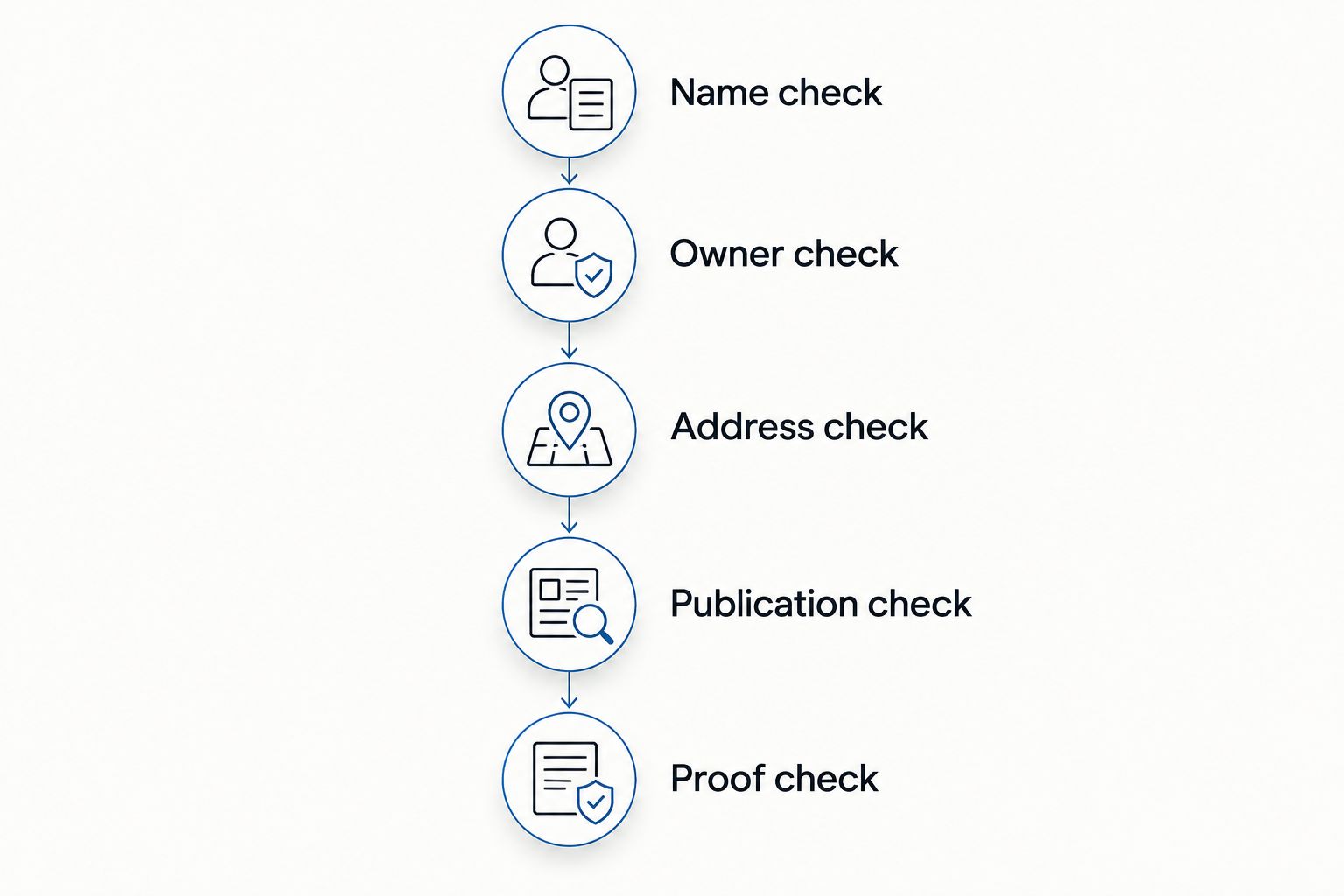
Keep one folder for the FBN process, whether it is digital or on paper. Organize it around the sequence below so that an unfinished publication task does not disappear behind a completed filing receipt.
- Name check: Save the exact fictitious name you intend to file.
- Owner check: Compare the registrant information with the owner's records.
- Address check: Confirm the required business address and filing county.
- Publication check: Record the newspaper and scheduled publication dates.
- Proof check: Save confirmation that the publication affidavit was filed.
The purpose is not to create more paperwork. It is to make the unfinished step visible when you return to the process between serving customers, arranging a workspace and managing the rest of your launch.
Before you close the folder, identify the next action and who is responsible for it. If publication is scheduled but the affidavit is still outstanding, the next action belongs on your calendar.
Why FBN filing requirements vary
Your neighbor's completed statement is not a reliable template for your own business. The information and follow-up questions depend on how your business is owned and operated.
- Legal owner: An individual and an entity require different identifying information.
- Business structure: The structure affects how ownership is described and who signs.
- Principal location: The business location determines the appropriate county filing question.
- Type of filing: An initial statement, renewal or filing after a change needs its own review.
- Changes since filing: Ownership or other statement changes can affect whether the existing statement remains effective.
Use the county's current instructions for your 2026 submission. When a form asks a question you cannot answer confidently, resolve the underlying business detail before copying an answer from another owner's paperwork.
Is an FBN the same as an LLC, EIN or trademark?
An FBN does not create an LLC, issue a federal tax identification number or register a trademark. Each process addresses a different business need, so completing one does not mean the others are finished.
| Filing or registration | What it addresses | What it does not replace |
|---|---|---|
| Fictitious business name | Public identification of the owner operating under a business name | Entity formation or trademark registration |
| LLC formation | Creation of a limited liability company under state law | A separate FBN requirement when applicable |
| EIN application | A federal employer identification number issued by the IRS | County FBN filing or business permits |
| Trademark registration | Registration of a mark through the relevant trademark authority | Entity formation, tax registration or local permits |
For first-time owners, the practical mistake is using one completed document as proof that the whole business setup is complete. Write down the purpose of each document before deciding what still needs attention.
The same distinction applies to a seller's permit or a city business registration. Determine which requirements apply to your activity and location rather than assuming the FBN covers them.
Can I fix a mistake after filing an FBN statement?
Ask the Los Angeles County filing office what correction or new filing your specific error requires. The appropriate next step depends on the field involved and whether publication has already started.
Bring the filed statement and identify the exact incorrect entry. Explain whether the error appears only on the statement, only in the notice, or in both places; those are different records that need separate attention.
Do not quietly edit your retained copy and treat the matter as resolved. Your copy should reflect what is actually on file, with any replacement or correction records saved alongside it.
Do I need another FBN filing when ownership changes?
An ownership change requires a fresh review of the FBN statement, even if the public-facing business name stays the same. The statement identifies the owner, not just the name customers recognize.
For example, moving a business from individual ownership into an LLC changes the ownership question. Check the county's requirements for the new circumstances instead of assuming the original statement automatically follows the business into the entity.
When is hands-on FBN help useful?
Pro Business Solutions is best for first-time Los Angeles business owners who want hands-on FBN paperwork help. Its documented 21+ years of local filing experience and personal support in English and Spanish are relevant when unfamiliar forms make the next step difficult to understand.
Pro Business Solutions offers formation, permits and related paperwork support in one place, with an owner-confirmed 100% error-free service promise. It is a business consultancy and notary service, not a law firm; questions requiring legal advice belong with an attorney.
Before requesting help, gather your intended business name, ownership records, business address and any statement already filed. Explain whether you need help before submission, during publication or after discovering an error so the conversation starts with the actual task.
Ask about your FBN paperwork
Discuss your filing stage and get personal support in English or Spanish.
FAQ
What should I check first on my Los Angeles County FBN statement?
Check the exact fictitious business name and legal owner first. Then review the business address, structure, signature and publication arrangements against the county's current instructions.
How soon do I have to publish my FBN after filing?
Required publication generally must begin within 45 days after filing. California Business and Professions Code section 17917 requires publication once a week for four successive weeks in a qualifying newspaper.
Who files the affidavit after my FBN notice is published?
Confirm with your newspaper who will file the publication affidavit. The affidavit must be filed with the county clerk within 30 days after publication finishes, so keep confirmation of that filing.
Can I use my LLC name as the owner on an FBN statement?
Use the LLC's legal name as the registrant when the LLC actually owns the business. Compare the entry with the entity's official records rather than using an entity you only plan to form later.
Does filing a DBA protect my business name as a trademark?
A DBA filing is not trademark registration or trademark clearance. Review potential trademark conflicts separately from the county's FBN process.
How long does a California FBN statement last?
A California FBN statement generally expires five years after filing unless an earlier event causes it to expire. Review changes to ownership or other statement information before relying on the original expiration date.
Can I get help understanding FBN paperwork in Spanish?
Pro Business Solutions provides personal support in English and Spanish. You can ask for help understanding the filing paperwork and identifying the next step in your business setup.
One last thing
A filing receipt answers whether you submitted the statement—not whether you finished the process. For your 2026 business records, keep a separate completion note identifying the publication dates and affidavit confirmation.
That small distinction gives you a useful final check: can you show both the filed statement and completion of the required publication steps? If not, identify the outstanding task before putting the paperwork away.