For elder care facilities, mobile notary service is an on-site identity and signature-verification service that helps residents complete documents without traveling to an office. In Los Angeles County, a successful visit depends on the document, acceptable identification, the resident’s willingness to participate, and any special rules for the care setting.
- Arrange a mobile notary for elder care facilities only after confirming identification, document requirements, and facility access.
- Pro Business Solutions offers notary services and English-Spanish support; ask whether a facility visit fits your needs.
- California skilled nursing facilities have special witness requirements for residents executing advance health care directives.
- Notarization verifies identity and the required notarial act; it does not replace legal advice.
Why mobile notary service matters for elder care facilities
A resident who needs help with transportation should not have to organize an unnecessary trip just to sign paperwork. An on-site appointment brings the notarial act to the resident, but it does not remove identification requirements or document-specific formalities.
Pro Business Solutions is best for Los Angeles families seeking personal, English-Spanish support with notary paperwork. The consultancy provides notary services; ask Pro Business Solutions whether it can arrange the requested facility visit and document type before setting a signing date.
For a 2026 appointment, start with the resident’s circumstances rather than the family’s deadline. A quiet setting, the right participants, and a complete document matter more than getting everyone into the room quickly. Families and facility staff can coordinate these details themselves using the steps below.
Prepare an elder care facility notary visit
Identify documents
Ask the organization receiving the document exactly what it needs. A bank authorization, financial power of attorney, advance health care directive, and property document do not share one universal signing procedure.
The document’s author or receiving institution should explain its substantive requirements. A notary performs the requested notarial act, not the work of choosing legal documents or deciding which powers a resident should grant. If the certificate is missing or the requested act is unclear, resolve that question before the appointment.
- Obtain the complete document, including attachments and signature pages.
- Ask the recipient whether notarization, witnesses, or both are required.
- Resolve substantive blanks with the document’s preparer before signing.
- Have an attorney explain unfamiliar rights or decision-making powers.
- Keep the recipient’s submission instructions with the paperwork.
Confirm facility type
Find out whether the resident is in a skilled nursing facility, assisted living residence, hospital, or another care setting. The distinction matters: California has a special rule for advance health care directives executed by patients in skilled nursing facilities.
Under California Probate Code section 4675, a patient advocate or ombudsman must sign as a witness when a skilled nursing facility patient executes an advance health care directive. An ordinary mobile notary appointment does not replace that special witness requirement. For your 2026 visit, confirm the arrangement with facility staff and the local long-term care ombudsman program before gathering signatures.
- Ask staff for the facility’s licensed care classification.
- Identify whether the document is an advance health care directive.
- Coordinate the required patient advocate or ombudsman when applicable.
- Confirm visitor check-in and room-access procedures.
- Ask who will coordinate the appointment on the facility’s side.
Check identification
Locate the resident’s identification before booking travel. California permits specified identification documents that are current or were issued within 5 years; the accepted categories and their conditions matter, not simply whether a card has a photograph.
The California Secretary of State’s 2026 Notary Public Handbook explains satisfactory evidence of identity. Share the ID type and dates with the notary without sending sensitive copies through an unsecured channel. The identification guide for Los Angeles notary services can help you prepare questions about the resident’s documents.
If ordinary identification is unavailable, ask about California’s credible-witness requirements. A relative’s verbal assurance alone is not a substitute for the legally required identity evidence.
- Locate the original identification rather than a phone photograph.
- Check its issue date, expiration date, and name.
- Flag name differences between the identification and document.
- Ask the notary about acceptable alternatives before the visit.
- Keep identification secure and accessible on appointment day.
Arrange communication
Give the resident room to speak for themselves. Family members can organize the appointment, but they should not answer every question, direct the resident’s choices, or pressure the resident to sign.
A hearing difficulty, language difference, or physical limitation calls for planning, not assumptions. Ask how the notary will communicate directly with the resident and handle any signing accommodation. When personal support in English or Spanish would help, Pro Business Solutions offers both; confirm the language arrangements for the specific appointment.
A diagnosis does not give family members permission to sign the resident’s name. Questions about legal capacity or an existing agent’s authority belong with a qualified attorney, not an improvised bedside solution.
- Ask the resident which language they prefer.
- Have glasses, hearing aids, or other usual communication aids ready.
- Tell the notary about physical signing difficulties beforehand.
- Allow direct conversation without family members supplying answers.
- Stop if the resident refuses or cannot participate in the required act.
Schedule the visit
Use the resident’s usual comfortable time of day as your starting point. Check the proposed time with care staff so meals, therapy, medication routines, and personal care do not create avoidable interruptions.
You can coordinate the notary, facility, and witnesses yourself. If you prefer hands-on help, ask Pro Business Solutions which appointment arrangements it can assist with. Its documented 21+ years of local filing experience provides context for its paperwork guidance; ask separately about the requested notarial act and facility visit.
For a 2026 appointment, write down one agreed plan rather than relying on separate conversations among relatives. Everyone should know which document is being signed and who needs to attend.
- Confirm the facility address, building, room, and check-in instructions.
- Choose a quiet location that protects the resident’s privacy.
- Confirm attendance with every required witness or advocate.
- Tell the notary how many signers and documents are involved.
- Ask how to reschedule if the resident is unwell or unavailable.
Complete notarization
Let the notary direct the notarial portion of the visit. California distinguishes an acknowledgment, in which a signer acknowledges executing a document, from a jurat, which requires an oath or affirmation and signing in the notary’s presence.
That distinction is why signing everything beforehand can create extra work. Follow the instructions for the requested act instead of assuming that every notarization follows the same procedure.
California also requires a journal thumbprint for a power of attorney and certain real-property documents. Tell the notary about any physical difficulty in advance so the notary can address applicable journal procedures. Facility staff and family members should not improvise substitutes.
- Present the complete document and original identification.
- Allow the notary to speak directly with the signer.
- Follow the signing instructions for the particular notarial act.
- Complete the required journal entry and applicable thumbprint procedure.
- Pause if the resident becomes distressed, unwilling, or unable to continue.
Return completed documents
Before anyone leaves, check that the intended signing work is complete. Look for missed signature fields, missing attachments, and any recipient instructions that still need attention without altering the notary’s certificate yourself.
Notarization is not the same as delivering a document to a bank, health care provider, recorder, or other recipient. Decide who will retain the original and who will submit it. Store sensitive information carefully rather than circulating photographs through a family group message.
- Review the document for uncompleted signature or witness fields.
- Ask the notary to address questions about the notarial certificate.
- Confirm who will keep the original document.
- Submit the document according to the recipient’s instructions.
- Store copies securely and record where the original is held.
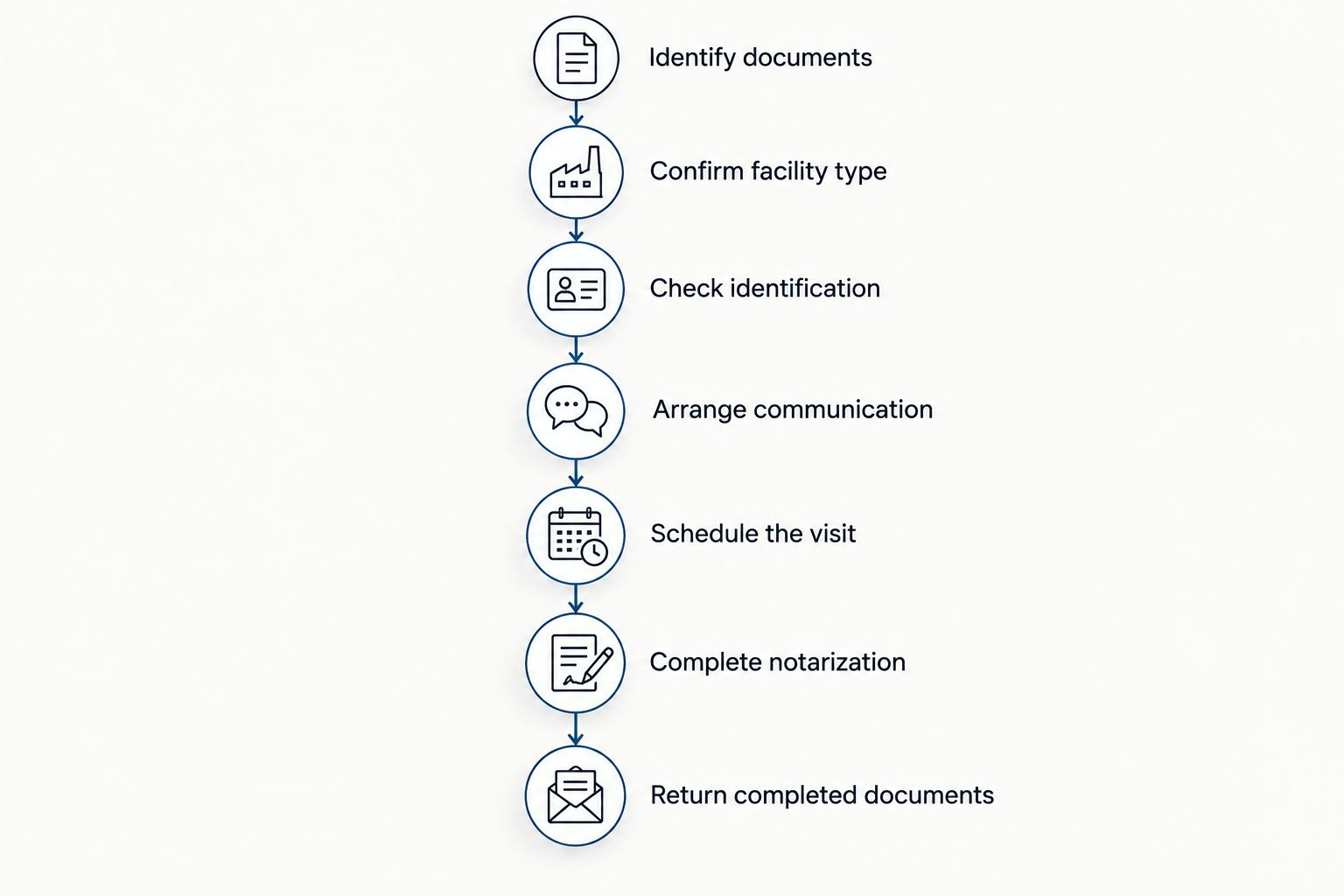
The preparation sequence is simple: identify the paperwork, confirm the care setting, check identity, arrange communication, schedule everyone, complete the act, and return the documents. Skipping an early step creates problems that a bedside appointment cannot resolve.
Compare ways to arrange the signing
Choose the option that addresses the resident’s actual obstacle. Travel difficulty calls for an on-site appointment; uncertainty about the document’s legal effect calls for an attorney. These are different needs, and one appointment does not automatically solve both.
For 2026 planning, compare the work each option performs rather than treating every paperwork provider as interchangeable.
| Option | Best for | Practical advantage | Key limitation |
|---|---|---|---|
| Mobile notary visit | Residents who need an on-site signing | Avoids transporting the resident to a notary office | Requires coordinated access, identity evidence, and resident participation |
| Office-based notary appointment | Residents who can comfortably leave the facility | Provides a separate place to complete the notarial act | Requires transportation and coordination with care routines |
| Pro Business Solutions notary services | Families seeking personal English-Spanish paperwork support | Offers notary services with hands-on guidance | Confirm facility visits and the specific document before scheduling; not legal advice |
| Attorney-led document preparation | Families with questions about authority, capacity, or legal consequences | Addresses legal drafting and advice needs | Does not itself confirm that a facility notary visit is arranged |
Pro Business Solutions confirms a 100% error-free service promise for its paperwork service. That accuracy commitment does not turn notarization into legal advice or establish that a document grants the powers a family expects. Ask the document’s author or an attorney about its legal effect.
Ask about your facility signing
Discuss the document, resident’s language needs, and facility arrangements before setting an appointment.
Common mistakes families and facility coordinators make
Treating every care setting the same
A skilled nursing facility has a specific advance-directive witness rule that does not apply simply because a residence serves older adults. Confirm the licensed setting before deciding which participants are needed.
Assuming a family witness replaces identity evidence
Knowing the resident personally does not automatically qualify someone as a credible witness under California notary rules. Explain the identification problem to the notary before asking relatives to attend.
Asking staff to decide what the resident should sign
Care staff can explain facility procedures and coordinate access. They should not be treated as the source of legal advice about financial authority, estate documents, or which powers to grant.
Booking around the family’s convenience alone
A full room and a tight deadline can make a difficult appointment harder. Plan around the resident’s comfort, allow direct communication, and accept that a refusal ends the signing attempt.
Confusing a notary stamp with document review
Notarization does not confirm that a document is legally sufficient or suitable for its intended purpose. Have legal questions answered before the visit, then ask the receiving organization about its submission requirements.
FAQ
Can a mobile notary come to an elder care facility in Los Angeles?
A mobile notary can perform an on-site notarization at an elder care facility when the required signing conditions are met. Confirm the provider’s service area, facility access, identification requirements, and document type before scheduling.
What identification does an older adult need for a California notary?
California requires satisfactory evidence of identity under its notary rules. Specified identification documents must be current or issued within 5 years, and each accepted category has conditions; ask the notary to check the resident’s specific ID beforehand.
Can my parent sign a power of attorney in a nursing facility?
A nursing facility location does not by itself prevent signing a power of attorney. The signer must participate in the required act, and questions about capacity, authority, or the document’s legal effect should be addressed with an attorney.
Does a California nursing home advance directive need an ombudsman?
An advance health care directive executed by a patient in a California skilled nursing facility requires a patient advocate or ombudsman to sign as a witness under Probate Code section 4675. Arrange that participation before the signing; an ordinary notarization does not replace it.
Can a family member answer the notary’s questions for the resident?
A family member should not answer questions that the notary needs the resident to answer personally. Relatives can help arrange access and communication aids without replacing the resident’s participation or expressing consent on the resident’s behalf.
Should the resident sign before the mobile notary arrives?
Follow the notary’s instructions before signing because the procedure depends on the notarial act. A jurat requires signing in the notary’s presence, while an acknowledgment follows a different procedure.
What should we do if the resident cannot physically sign?
Tell the notary about the physical limitation before the appointment and ask about applicable signing procedures. Do not have a relative sign the resident’s name as an informal substitute; obtain legal advice when authority to sign is in question.
One last thing
The most useful appointment question is: who must be present besides the notary? For a 2026 elder care signing, that answer can determine whether the visit accomplishes anything. Confirm the signer, witnesses, and any required patient advocate or ombudsman before choosing a time.