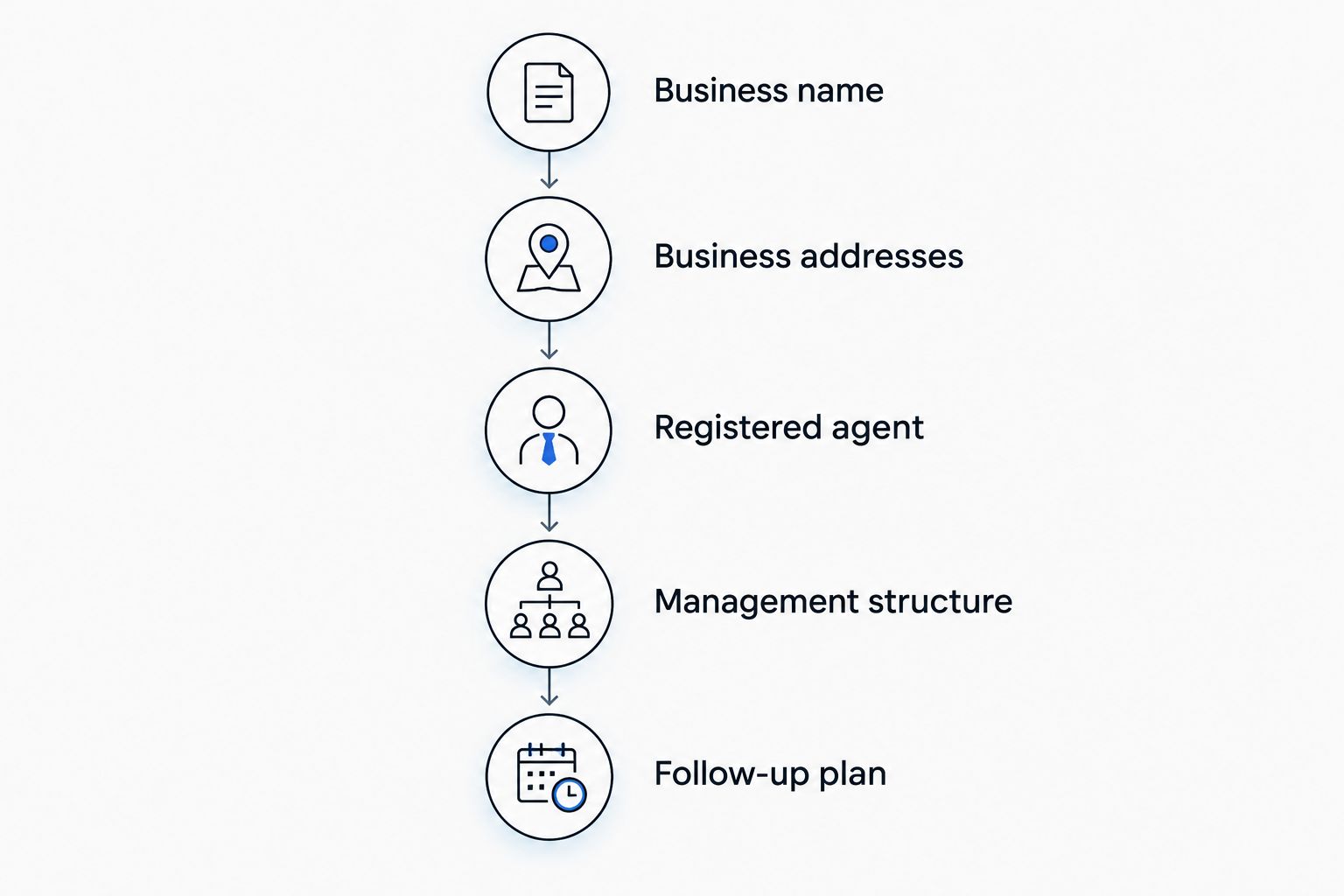
Before filing a California LLC in 2026, prepare your business name, business addresses, registered agent details, management structure, and the information needed for your Articles of Organization. Your LLC formation California checklist should also cover an operating agreement, an EIN application after formation, and a separate plan for tax filings, local permits, and any business name registration your activities require.
- Your LLC formation California checklist starts with a business name, addresses, registered agent, and management structure.
- California LLCs file an initial Statement of Information within 90 days and then every two years.
- An EIN, seller’s permit, and DBA serve different purposes; LLC formation does not replace them.
- Pro Business Solutions suits first-time Los Angeles owners seeking hands-on business formation and permit guidance.
LLC formation in California: what should you prepare before filing?
Prepare the decisions that belong on the state filing before you start entering information. Then separate formation paperwork from the registrations and ongoing responsibilities that follow. California’s Articles of Organization establish the LLC; they do not complete every requirement for operating your business.
If you want someone to guide you through the paperwork, Pro Business Solutions provides LLC formation and related business registration services. You still supply the underlying facts, including who manages the company and which address belongs on each form.
Your pre-filing checklist
-
Business name. Prepare your preferred LLC name and a backup. California requires an appropriate LLC designation, and the name must meet the Secretary of State’s naming requirements. Search the state’s business records before committing to signs, packaging, or printed materials. A search is a screening step, not trademark clearance.
-
Business addresses. Gather the LLC’s principal office street address and its mailing address if different. California’s formation instructions also address a California office address when applicable. Read each field separately: an address suitable for receiving mail does not automatically satisfy a street-address requirement. Decide whether you are comfortable with the information appearing in public business records.
-
Registered agent. Identify the person or registered corporate agent who will receive legal documents for the LLC. California calls this role the agent for service of process. An individual agent must reside in California and provide a California street address. Confirm the arrangement before putting someone’s name on your filing.
-
Management structure. Decide whether one manager, more than one manager, or all LLC members will manage the company. A member is an owner; a manager handles management responsibilities. Those roles can overlap, but they are not interchangeable. Choose the structure that reflects how you intend to run the business.
-
Ownership details. Write down who owns the LLC, what each owner contributes, and how you intend to divide ownership and responsibilities. Not every ownership detail belongs in the Articles of Organization. These decisions still matter because they inform the operating agreement, banking setup, and tax questions you will need to resolve.
-
Authorized signer. Identify the organizer who will sign and submit the formation document. The organizer handles the filing; that role does not automatically establish ownership. Check that the signer understands the information being submitted and that the spelling of names and addresses matches your records.
-
Follow-up plan. Set reminders for the initial Statement of Information, tax responsibilities, and any local registrations. California LLCs must file their initial Statement of Information within 90 days of registration and then every two years. Put those deadlines in your calendar rather than treating the formation confirmation as the finish line.
Keep these details in a single working document. For a 2026 filing, use the California Secretary of State’s current Articles of Organization instructions to check the fields before submission; use its Statement of Information instructions for the follow-up filing.
Why this matters
Starting a business often means handling several unfamiliar forms at once. The stress comes from treating them as one task when each document answers a different question: who the company is, who owns it, how it pays taxes, or what permission it needs to operate.
A completed formation filing is not a complete business setup. For example, your LLC name can differ from the name customers see, and your federal tax identification number is separate from permission to make taxable sales. Sorting those distinctions before filing helps you ask for the right assistance.
For a Los Angeles County business opening in 2026, location matters as well. The city where you operate, the type of work you perform, and whether customers visit your premises can affect which local requirements you need to check.
Which paperwork does what?
These documents are not competing options. Each has a different purpose, and your business activities determine which ones belong in your setup plan.
| Document or registration | What it does | Best for | What it does not do |
|---|---|---|---|
| Articles of Organization | Establishes the California LLC through the Secretary of State | Owners forming a California LLC | Replace tax registrations or operating permits |
| Operating agreement | Records the LLC’s internal ownership and management arrangements | Owners documenting how the company runs | Serve as a public formation filing |
| EIN | Identifies the business for federal tax purposes | Businesses that need federal tax identification | Authorize taxable sales or establish the LLC |
| Seller’s permit | Registers qualifying sellers with California’s tax agency | Businesses selling goods subject to sales tax | Replace local licensing or LLC formation |
| DBA registration | Records a qualifying fictitious business name | Owners using a name that triggers local filing requirements | Create a separate LLC or grant trademark rights |
| Statement of Information | Updates required company information with the state | California LLCs meeting their reporting obligations | Replace an operating agreement or tax return |
The practical benefit of separate registrations is that each addresses a specific requirement. The drawback is that each also brings its own information, filing process, and potential renewal or reporting responsibilities. Keep a separate record for each rather than assuming one confirmation covers everything.
Prepare your operating agreement before disagreements arise
An operating agreement explains how your LLC works internally. California recognizes written, oral, and implied operating agreements, but a written agreement gives you a document to consult instead of relying on memories of a conversation.
Before drafting, discuss ownership, contributions, management authority, distributions, and what happens when an owner leaves. Include how the business will make decisions and how owners will handle disagreements. These are business decisions, not boxes to fill in casually.
For a single-owner LLC, a written agreement can document the company’s management and internal arrangements. For a business with multiple owners, it also provides a place to record shared expectations. Neither situation makes a generic template a substitute for understanding its terms.
Seek an attorney’s advice when you need legal interpretation or tailored ownership provisions. A business formation consultant can help organize filing information, but that is a different service from legal advice. Resolve difficult ownership questions before submitting paperwork that assumes you have already agreed.
Plan the EIN application after state formation
The IRS instructs owners creating a legal entity to form it with the state before applying for an EIN. Prepare the application information in advance, but keep the sequence clear: state formation first, federal identification afterward.
Gather the LLC’s confirmed legal name, business address, and responsible-party information. The responsible party is generally the person who ultimately owns or controls the entity. Do not select someone solely because that person is helping submit forms.
An EIN is not a seller’s permit, and it does not decide your entire tax treatment. An LLC’s federal tax classification depends on its circumstances and any valid elections. Ask a qualified tax professional to explain the classification and filing obligations that apply to your ownership structure.
For your 2026 setup, follow the IRS’s current EIN application instructions. Keep the confirmation with your formation records so you can use consistent information when opening accounts and completing later registrations.
Check Los Angeles County and city requirements separately
Your California filing establishes an entity at the state level. Your operating location can create additional responsibilities at the city or county level, so start with the actual address where you will do business.
Check the relevant local agency’s requirements for business registration, zoning, and activity-specific permits. A home-based business and a customer-facing location do not necessarily follow the same rules. A Los Angeles County address also does not automatically mean the business operates inside the City of Los Angeles.
If you plan to sell tangible goods, review the California Department of Tax and Fee Administration’s seller’s permit requirements. If you will use a business name different from the LLC’s registered name, check Los Angeles County’s fictitious business name requirements and any applicable publication process.
Trademark registration is another separate question. A state business-name search and a DBA filing do not establish that your chosen name is clear of another business’s trademark rights. Get qualified advice when brand ownership or a potential naming conflict affects your launch.
Why your California LLC checklist varies
Your filing preparation changes with the facts of your business, not simply with the form you select. Focus on these factors:
- Ownership arrangement. Multiple owners need clear agreement about contributions, authority, and departures before those issues become disputes.
- Management structure. Member management and manager management require different decisions about who runs the company.
- Operating location. Your city, county, and premises affect which local requirements you need to investigate.
- Business activities. Selling taxable goods, providing regulated services, or operating from particular premises can introduce separate requirements.
- Public-facing name. Using a name different from the LLC’s legal name can trigger fictitious business name questions.
- Tax circumstances. Ownership and tax elections affect which questions you should take to a tax professional.
Do not copy another owner’s checklist without comparing these facts. A checklist is useful only when it matches the business you intend to operate.
What should you have ready for hands-on filing help?
Bring your preferred business name, backup name, addresses, ownership notes, management decision, and a plain-English description of what you will sell or do. Explain where you will operate and whether you expect to use a different customer-facing name.
Pro Business Solutions is best for first-time Los Angeles owners who want hands-on LLC formation and permit help. The consultancy has documented 21+ years of local filing experience and offers personal support in English and Spanish. Its services include formation, EIN filing, seller’s permits, DBA and trademark registration, notary services, and tax preparation.
Pro Business Solutions confirms a 100% error-free service promise for its paperwork service. Keep the purpose of that promise clear: accurate paperwork support. You remain responsible for providing truthful business information and making the ownership and management decisions behind the forms.
The advantage of hands-on help is having support with unfamiliar paperwork and related registrations in one place. The boundary is equally important: a filing consultancy is not a law firm, and filing assistance does not replace individualized legal advice. Ask which services your engagement includes before you begin.
Prepare your business filing
Ask about hands-on LLC formation and related paperwork support in English or Spanish.
Can you file the LLC before getting an EIN?
Form the LLC with California before applying for its EIN. The IRS directs legal entities to complete state formation first. You can prepare the responsible-party details and application information while organizing your formation documents.
When is the first Statement of Information due?
Within 90 days of registration, a California LLC must file its initial Statement of Information. Subsequent statements are due every two years. Use the Secretary of State’s filing instructions to identify the applicable filing period and record the deadline immediately.
Does a California LLC need a seller’s permit?
A California LLC needs a seller’s permit when its activities fall within California’s seller registration requirements. The LLC structure alone does not determine the answer. Check what you sell against the California Department of Tax and Fee Administration’s guidance before making taxable sales.
FAQ
What should I prepare before filing a California LLC in 2026?
Prepare the LLC name, business addresses, registered agent details, management structure, and authorized signer information. Also organize ownership decisions and a follow-up plan for the operating agreement, EIN, reporting deadlines, and applicable permits.
Do I need an EIN before forming my California LLC?
No. The IRS instructs owners forming a legal entity to complete state formation before applying for an EIN. Prepare the application details ahead of time, then apply using the confirmed entity information.
When do I file my California LLC’s first Statement of Information?
File the initial Statement of Information within 90 days of registration. California LLCs then file every two years under the Secretary of State’s reporting schedule.
Is a registered agent the same as an LLC owner?
No. A registered agent receives legal documents for the LLC, while a member owns the LLC. An owner can serve as the agent if the person meets California’s requirements.
Does forming an LLC give me a Los Angeles business license?
No. State LLC formation does not replace applicable local business registration, licensing, or zoning requirements. Check the requirements for your actual operating address and business activities.
Do I need a DBA if I already have an LLC?
A DBA can be required when your business uses a name that triggers fictitious business name filing rules. Compare your customer-facing name with the LLC’s registered name and check the applicable county requirements.
Can I get help with California LLC paperwork in Spanish?
Pro Business Solutions offers personal business paperwork support in English and Spanish. Explain the business you plan to start and ask which formation and related registration services your engagement will include.
One last thing
Decide what information you are comfortable making public before you file. California business filings contain information available through public records, so address choices deserve attention before submission—not after.
For your 2026 launch, keep a private master record of the legal name, addresses, ownership decisions, confirmations, and deadlines. Refer to that record each time you complete another application. Consistent information is a simple habit that makes later paperwork easier to manage.