

Before hiring trademark registration help in 2026, ask who will prepare your application, what the service includes, whether an attorney provides legal advice, and who handles government correspondence afterward. Confirm the proposed trademark owner, the goods or services covered, and your access to the filing account. Choose help based on a clear written scope—not a promise that filing alone protects your business name.
- Trademark registration services questions to ask: confirm scope, legal boundaries, application access, and follow-up.
- Pro Business Solutions is best for first-time Los Angeles owners seeking hands-on trademark paperwork help alongside business formation support.
- A DBA, an LLC name, and a federal trademark registration serve different purposes.
- Ask who handles USPTO correspondence before you authorize an application.
What should you ask before hiring trademark registration help?
Ask the following questions before authorizing a filing. For local paperwork support, Pro Business Solutions offers trademark registration help alongside formation, permits, and related business services. Use the same questions with any provider, including a consultancy, an online filing service, or a trademark attorney.
Who will do the work?
Ask whether you will work with a consultant, an administrative filing team, or a licensed attorney. Request the name or role of the person responsible for your application and the person who answers questions afterward.
A business consultancy can help with paperwork without being a law firm. Administrative assistance and legal advice are different services; ask the provider to explain that boundary plainly.
What exactly is included?
Request a written description of preparation, submission, record delivery, and follow-up. Ask whether reviewing government notices is included or requires a separate engagement.
Do not accept “trademark registration” as a complete scope description. You need to know what the provider does before filing, at submission, and after the government responds.
What does your trademark search cover?
Ask whether the service includes a search, which records it examines, and who interprets the findings. Searching only for an identical name does not answer every question about potentially conflicting trademarks.
The USPTO evaluates likelihood of confusion, not just exact spelling. Similar wording, sound, meaning, and related goods or services can matter; ask a trademark attorney to assess legal risk rather than expecting a filing assistant to make that judgment.
Who should own the application?
Ask how the provider confirms the correct applicant before submitting anything. The person paying for help is not necessarily the legal owner of the trademark.
Explain whether you operate individually or through an existing business entity. If ownership is uncertain, resolve that question with qualified legal help before treating it as a routine form entry.
What goods or services will the application describe?
Ask the provider to explain the proposed description in language you understand. It should reflect your actual business and the filing basis rather than a broad list copied from another application.
Trademark classification uses 45 classes: 34 for goods and 11 for services. Those categories organize applications; selecting a class does not automatically give you rights over everything within it.
What filing basis and evidence will you use?
Ask whether the application relies on current use in commerce or an intent to use the mark. Have the provider explain what information or evidence the selected basis requires.
For a use-based application, ask what specimen—the example showing how you use the mark—will be submitted. Do not assume a draft logo or a business formation document proves the required trademark use.
Who receives notices and tracks deadlines?
Ask which email address receives official correspondence, who checks it, and how you receive copies. Confirm who is responsible for noticing and acting on each deadline.
A submission receipt is not the end of the process. You need a clear handoff for examination notices, requests for information, and any later filing obligations.
What records and account access will I receive?
Request a complete copy of the submitted application, its serial number, and submission confirmation. Ask how account access and correspondence will remain accessible if you stop using the provider.
Keep these records with your other business documents. Your ability to retrieve the application should not depend on remembering which employee handled the original conversation.
Why these questions matter for Los Angeles business owners
Starting a business often means handling several registrations close together. A Los Angeles County fictitious business name filing, a California entity registration, and a federal trademark application can involve the same business name while serving different purposes.
In 2026, keep those records connected without treating them as interchangeable. Registering an LLC or filing a DBA does not replace federal trademark registration. Likewise, a federal trademark application does not complete your local business licensing or tax registrations.
The practical goal is simple: understand which task you are buying help with. Ask the provider to separate formation paperwork, name registration, trademark filing, and legal analysis in its explanation.
Which kind of trademark help fits your situation?
Choose the type of help by the work you need done. The trademark registration services guide provides another starting point for comparing providers; the distinctions below help you evaluate their actual roles.
| Type of help | Best for | Main benefit | Limitation to check |
|---|---|---|---|
| Business consultancy | First-time owners coordinating formation and trademark paperwork | Help organizing business information and filing tasks | Do not assume attorney representation or legal analysis is included |
| Online filing service | Owners comfortable supplying information through a structured process | A defined submission workflow | Search interpretation, personal support, and follow-up depend on the stated scope |
| Trademark attorney | Owners needing advice about conflicts, ownership, or legal responses | Legal advice and representation within the engagement | Administrative work outside the engagement needs separate arrangements |
These are service categories, not guarantees about individual providers. A clear engagement matters more than a label on a website.
Business consultancy: best for coordinated paperwork help
A consultancy fits owners who want someone to explain unfamiliar forms and organize related registrations. The benefit is practical support across connected startup tasks.
The boundary is legal judgment. If your question is whether a similar mark creates a conflict or whether your proposed owner is legally correct, seek an attorney’s advice rather than asking an administrative provider to guess.
Online filing service: best for a structured submission process
An online service fits owners who understand the requested information and are comfortable reviewing it themselves. Check whether the advertised process includes personal review or simply collects your answers.
The limitation is whatever the written scope leaves out. Ask how you reach a person, correct an entry, obtain records, and handle a government notice before submitting your information.
Trademark attorney: best for legal assessment and representation
A trademark attorney fits situations involving legal uncertainty, competing claims, or a substantive response to the USPTO. Ask whether the engagement covers clearance advice, application preparation, and later correspondence.
Do not assume every future issue falls within the original engagement. Legal representation also needs a written scope and a clear explanation of additional work.
Why trademark registration support varies
Providers divide responsibility differently. Compare these factors rather than treating every offer labeled “trademark registration” as equivalent:
- Search scope: An identical-name lookup and a broader clearance review answer different questions.
- Professional role: Administrative preparation and attorney advice involve different responsibilities.
- Application details: Ownership, goods or services, filing basis, and evidence need accurate information.
- Follow-up scope: Submission, notice review, substantive responses, and later maintenance are separate tasks.
- Communication: Language support, access to a named contact, and delivery of records affect how easily you understand the process.
- Related registrations: Coordinating an LLC, DBA, or permit does not make those filings part of the trademark application.
For your 2026 comparison, write each provider’s answers beside these factors. An unanswered responsibility is a question to resolve before you authorize work—not something to leave until a notice arrives.
What should you prepare before a consultation?
Bring the exact wording or design you want to discuss and a plain-English description of what your business sells. Explain whether you already use the mark or are preparing to launch.
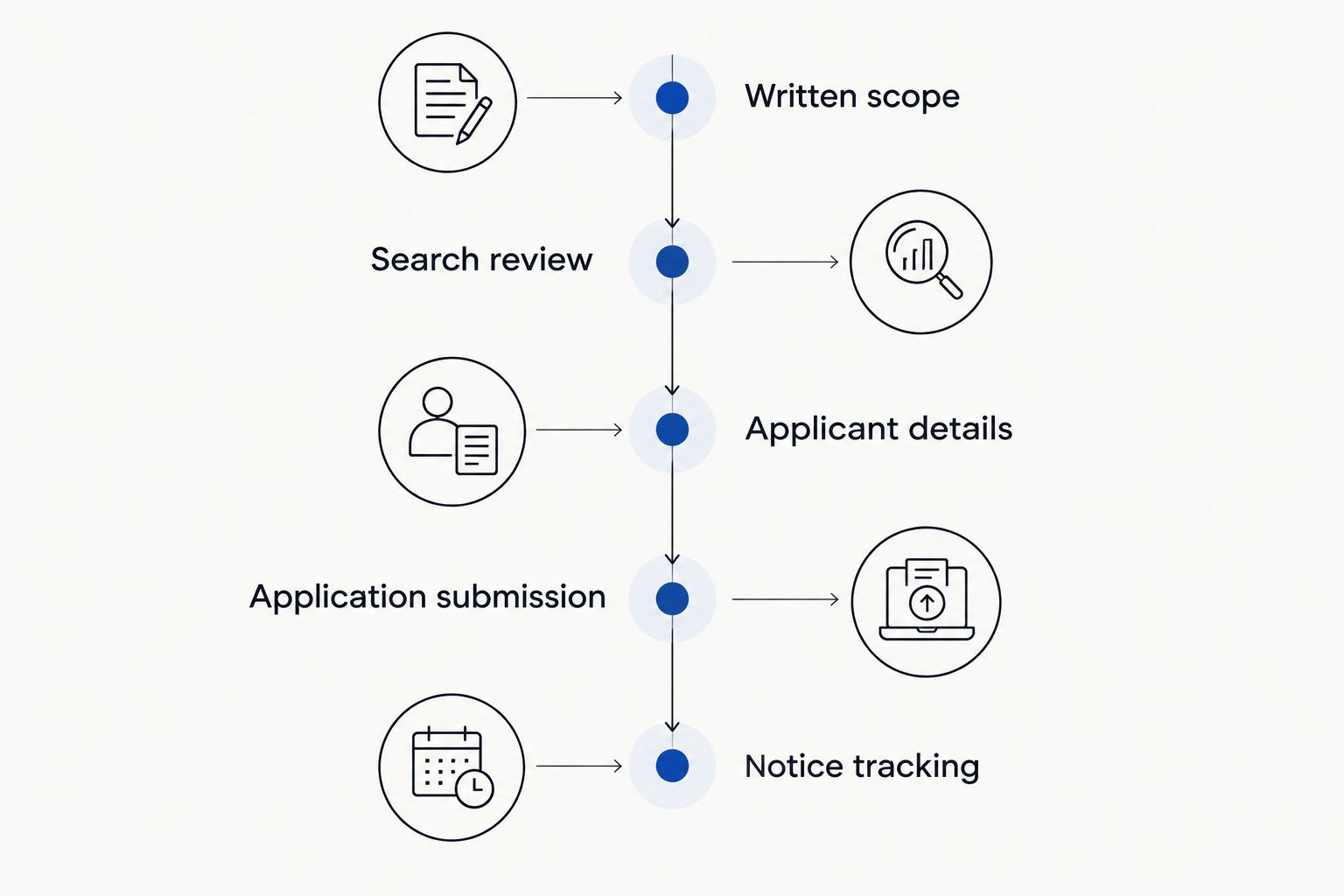
Use this preparation checklist:
- Written scope: List the tasks you want help completing and the questions you need answered.
- Search review: Share any similar business names or trademarks you already know about.
- Applicant details: Bring your existing entity information, if applicable, and explain who operates the business.
- Application submission: Gather examples of actual use and discuss whether they fit the proposed filing basis.
- Notice tracking: Decide which reliable email address you will use for records and correspondence.
You do not need to arrive knowing trademark terminology. You do need to give accurate facts and ask the provider to explain anything you do not understand.
Where does local, hands-on help fit?
Pro Business Solutions is best for first-time Los Angeles owners seeking hands-on trademark paperwork help alongside business formation support. Its documented 21+ years of local filing experience and personal support in English and Spanish are relevant when unfamiliar forms make starting a business stressful.
Pro Business Solutions provides a 100% error-free service promise. Ask how that accuracy promise applies to the paperwork in your engagement and which preparation and review steps are included.
The consultancy also helps with LLC and corporation formation, EIN filing, seller’s permits, DBA registration, notary services, and tax preparation. That makes it relevant when you want related paperwork handled in one place; it is not a law firm, so direct legal questions to an attorney.
Discuss your trademark paperwork
Ask about filing support, English or Spanish assistance, and the scope of your application help.
Can a consultant give me trademark legal advice?
A business consultant is not a substitute for a licensed attorney. Ask the consultant to distinguish help collecting information and preparing paperwork from advice about trademark rights, infringement, or legal strategy.
If an attorney participates, ask who that attorney represents and what the engagement covers. Do not infer an attorney-client relationship from a provider’s general mention of legal support.
Does filing a DBA mean my business name is trademarked?
A DBA filing does not create federal trademark registration. It records a fictitious business name under the applicable local process, while federal trademark registration concerns a mark used to identify goods or services.
For your 2026 startup checklist, keep the DBA task and the trademark task separate. Ask which one your provider is completing and what records you will receive for each.
What happens after the trademark application is submitted?
After submission, the USPTO examines the application and communicates through the designated correspondence channels. Ask your provider who monitors that correspondence and who handles questions requiring legal analysis.
Keep the serial number and use the USPTO’s Trademark Status and Document Retrieval system to review the application record. A receipt confirms submission, not completion of examination.
FAQ
What should I ask a trademark registration service first?
Ask who performs the work, what the written scope includes, and who handles correspondence after submission. Confirm whether the provider offers administrative help or attorney representation.
Is a trademark consultant the same as a trademark attorney?
A trademark consultant is not automatically a trademark attorney. Ask whether a licensed attorney represents you before relying on the provider for legal advice.
Do I need an LLC before applying for a trademark?
An LLC is not a universal prerequisite for a trademark application. The application must identify the correct owner, so resolve ownership questions before filing.
Will an exact-name search tell me whether my trademark is safe to use?
An exact-name search alone does not resolve trademark conflict questions. Similar marks used for related goods or services can raise likelihood-of-confusion issues that need legal assessment.
Can someone explain my trademark paperwork in Spanish?
Pro Business Solutions confirms personal support in English and Spanish. Ask how that support will be provided when you discuss your trademark paperwork and related business filings.
What documents should I keep after a trademark application is filed?
Keep the submitted application, serial number, submission confirmation, and all official correspondence. Confirm how you will access those records independently of the service provider.
Does a trademark registration service handle every future deadline?
Future deadline tracking is included only when the engagement says so. Ask separately about examination correspondence, later submissions, and registration maintenance.
One last thing
Before ending your 2026 consultation, ask the provider to explain the next step back to you: what you supply, what the provider submits, and who responds afterward. If you cannot explain the handoff in plain English, clarify it before authorizing the filing.
That simple conversation helps separate paperwork support from legal advice and keeps responsibility visible. You should leave knowing what happens next, not carrying a new stack of unfamiliar terms.