Instead of manually checking emails and guessing when your trademark certificate will arrive, organize your 2026 trademark filing to registration certificate timeline around USPTO notices, response deadlines, and proof of use. Follow the workflow below to prepare your application, track examination, handle publication, and save your electronic registration certificate.
- The trademark filing to registration certificate timeline depends on examination, objections, and your filing basis—not a fixed completion date.
- Pro Business Solutions is best for Los Angeles owners seeking hands-on trademark registration paperwork support.
- USPTO publication normally includes a 30-day opposition period before an eligible application moves toward registration.
- An intent-to-use application needs accepted proof of use before the USPTO issues a registration certificate.
Why this matters
A filing receipt is not a trademark registration certificate. Your receipt confirms submission and identifies the application. Registration comes after examination and the remaining requirements for your filing basis.
For a Los Angeles business owner, this process also sits apart from forming an LLC, filing a DBA, or getting a seller's permit. Those filings serve different purposes; none replaces federal trademark registration.
Pro Business Solutions provides business formation and trademark registration paperwork support, with documented 21+ years of local filing experience and personal support in English and Spanish. The consultancy is not a law firm; bring legal questions about ownership, conflicts, or refusals to a qualified trademark attorney.
The 2026 workflow below follows the USPTO's published application, examination, publication, and registration framework. Use the actual notices in your application record to set deadlines rather than estimating from someone else's experience.
Before you start
- Prepare access and ownership details. Have a USPTO.gov account with the identity verification required for trademark filing, a monitored email address, and the correct owner's legal name. Foreign-domiciled applicants must use a U.S.-licensed attorney before the USPTO.
- Gather the mark and business information. Prepare the wording or design you want to register, your goods or services, and evidence of use if you are filing on an existing-use basis. Keep original evidence and dates together.
- Resolve the ownership gotcha first. A founder and the founder's LLC are not interchangeable applicants. Naming the wrong owner can create a defect that cannot simply be corrected later; resolve uncertainty before submitting.
If you expect a consultant to help, ask who prepares the application, who submits it, and who monitors correspondence. The questions to ask before hiring trademark registration services help you clarify responsibilities before work begins.
Application setup
Choose your filing basis
- Identify the actual owner of the trademark and record that owner's legal name consistently.
- Decide whether the mark is already used in commerce for the goods or services listed, or whether you have a bona fide intention to use it.
- Separate goods or services that have different use circumstances. Do not claim existing use for something you only plan to offer.
- Search for potentially conflicting marks before filing. Look beyond identical spellings; similar sound, meaning, and related goods or services matter too.
Expected result: You have an identified owner, a defined mark, and a filing basis supported by your actual business activity.
For common U.S. applications, these two bases create different workflows. They are not shortcuts around examination.
| Filing basis | Best for | Practical benefit | Limitation |
|---|---|---|---|
| Use in commerce, Section 1(a) | Owners already using the mark in qualifying commerce | Includes use evidence with the application | Requires acceptable evidence and accurate use dates at filing |
| Intent to use, Section 1(b) | Owners with a genuine plan to use the mark | Lets the application begin before qualifying use | Requires a later use filing before registration |
An intent-to-use application is not a placeholder for a name you might someday want. You must have a bona fide intention to use the mark, and the later proof-of-use requirement adds another stage.
Prepare the application
- Open Trademark Center, the USPTO's trademark application system, through your verified account.
- Enter the owner information and select the appropriate mark format. A standard-character mark concerns wording; a special-form mark includes a particular design or presentation.
- Use the USPTO's Trademark ID Manual to help describe the goods or services accurately. Choose descriptions that match what you actually provide or genuinely intend to provide.
- For an existing-use filing, supply the required dates and an appropriate specimen. A specimen is evidence of how customers encounter the mark in commerce, not simply a picture of your logo.
- Review the complete application before signing and submitting. Save the submitted application, receipt, serial number, and supporting materials.
Expected result: You have a submitted application and serial number that you can use to follow the official record. You do not yet have a registered trademark.
Status monitoring
Build your tracking record
- Create one application folder containing the receipt, evidence, correspondence, and a deadline log.
- Open Trademark Status and Document Retrieval, commonly called TSDR, and enter your application serial number.
- Review Status for the current stage and Documents for the underlying notices and filings.
- Record each notice's issue date, required action, and stated deadline. Assign a named person to monitor the record even when someone else helps prepare paperwork.
Expected result: You can explain the application's current stage and locate the official document supporting it.
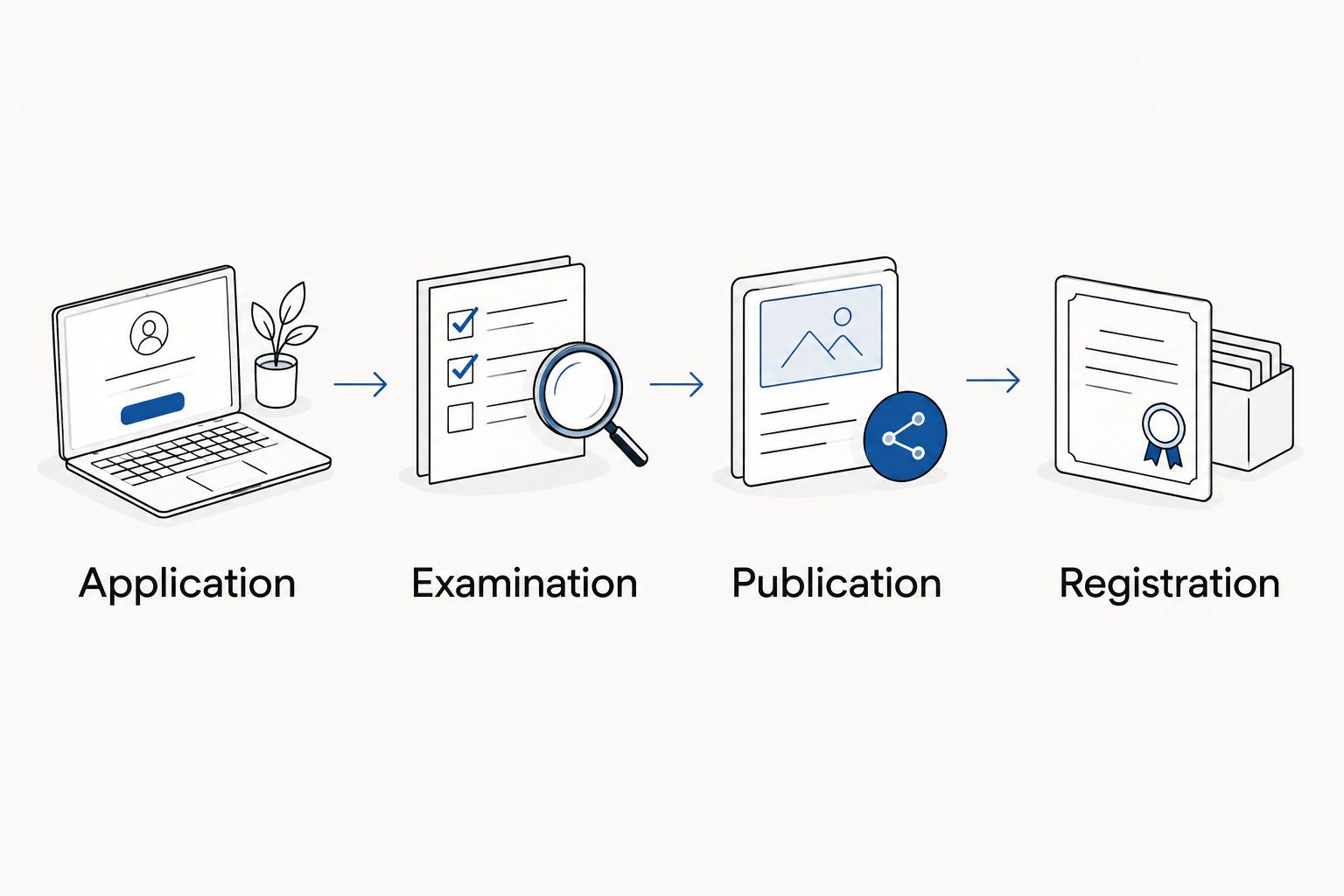
Use this sequence as your 2026 tracking map. Examination and objections can add work between stages, so it is a sequence—not a promised schedule.
- Application: Submit the filing and save the serial number.
- Examination: Review and respond to any examiner correspondence.
- Publication: Watch the opposition period and related notices.
- Registration: Complete any remaining use requirements and save the certificate.
Respond to examination
- Read every USPTO notice in full. An office action is an official communication identifying issues that need a response.
- Separate straightforward information requests from legal issues, such as a likelihood-of-confusion refusal or a descriptiveness refusal.
- For most pre-registration office actions in ordinary U.S. applications, calendar the 3-month response deadline. An extension procedure exists for eligible actions, but different application types and notices follow different rules.
- Submit the appropriate response and confirm that the filing appears in the application record. Keep the submission receipt.
Expected result: The record shows your response, and your deadline log identifies the next required action.
Do not treat a substantive refusal as a request to rewrite a sentence. If the examiner challenges whether the mark can register, get a trademark attorney's assessment before deciding how to respond.
The deadline on the notice controls. A consultant's reminder or your own spreadsheet is useful, but neither replaces reading the official communication.
Publication and certificate records
Track publication
- Confirm the publication information in TSDR after the application is approved for publication.
- Calendar the 30-day opposition period. During this period, another party can oppose registration or request additional time to oppose.
- Check for opposition-related developments rather than assuming silence in your inbox means the stage is complete.
- Identify the next branch: an eligible use-based application moves toward registration, while an intent-to-use application ordinarily receives a Notice of Allowance.
Expected result: You know whether the application is moving toward registration, entering the proof-of-use stage, or facing a proceeding that needs legal attention.
Publication is a meaningful milestone, not the finish line. An opposition or extension request changes what happens next; a calendar calculation alone cannot confirm registration.
Save the certificate
- Check TSDR for the registration event and electronic registration certificate.
- Save the certificate separately from the original filing receipt. Record the registration number and registration date.
- Read the registered goods or services and owner details. Compare them with your records and raise any discrepancy promptly.
- Build a maintenance calendar using the registration date, not the application submission date.
Expected result: You have the actual certificate, a reliable registration record, and a maintenance calendar.
For a typical U.S. registration, a declaration of use is due between the 5th and 6th years after registration. Renewal and the associated use filing are due between the 9th and 10th years, with later renewal cycles following the USPTO's requirements. Review the applicable rules and exceptions when each filing approaches.
Second workflow: you have not started using the mark
An intent-to-use filing follows the same examination and publication stages, but a Notice of Allowance does not equal registration. Your next task is to establish qualifying use and submit the required use filing.
- Record the Notice of Allowance issue date. That date starts the initial 6-month deadline to submit a Statement of Use or request an extension.
- Start qualifying use for the goods or services you want to keep in the application. Gather evidence showing the mark as customers actually encounter it.
- Review the evidence before submitting a Statement of Use. A mockup, unused label, or image created only for the application is not a substitute for actual use.
- If you are not ready, evaluate an extension request before the deadline. USPTO rules permit up to 5 six-month extensions, subject to the required conditions.
- Track the Statement of Use through review. Save the registration certificate only after the USPTO issues it.
Expected result: You have either a timely use submission or a timely extension request, with the next deadline recorded.
For your 2026 launch plan, separate business readiness from trademark paperwork. Opening a store, receiving an LLC approval, or ordering packaging does not by itself establish that your specimen meets the USPTO's requirements.
Troubleshooting
Your application status has not changed
Check both the status summary and the document history. Confirm that no response or use deadline is outstanding, then consult the USPTO's published processing information for the relevant stage. Do not submit a duplicate application just because the first one remains pending.
The examiner rejects your specimen
Read the stated reason before replacing the file. For goods, a webpage specimen generally needs to connect the mark with the goods and provide a way to order; webpage submissions also require the URL and access or print date. Any substitute specimen must satisfy the applicable timing requirements.
You missed a response deadline
Open the official record and check whether the application is abandoned. A petition to revive exists for qualifying situations, but it has requirements and deadlines of its own. Get prompt help assessing the available procedure instead of sending a late response without checking its status.
You received an invoice about your trademark
Compare the sender and requested action against the official record. Trademark applicants receive misleading solicitations, including offers for private listings. Do not pay merely because a letter includes your serial number; that information is public.
Your owner name or address changed
Distinguish a correspondence update from an ownership transfer. Updating contact details does not transfer a trademark, and an assignment does not automatically resolve every record issue. Ask for legal guidance if you are unsure who owns the application or registration.
Customize your workflow
Pro Business Solutions is best for Los Angeles owners seeking hands-on trademark registration paperwork support. Its business consultancy services also cover formation, permits, and related paperwork, which helps owners coordinate separate startup tasks in one place.
Bring your proposed mark, owner information, business description, and any existing USPTO notices to a consultation. Ask which preparation and monitoring tasks are included rather than assuming every response or later filing is part of the engagement.
Pro Business Solutions offers a 100% error-free service promise. Keep the distinction clear: accurate paperwork support and an attorney's legal assessment serve different needs. A refusal, opposition, or ownership dispute calls for qualified legal advice.
Discuss your trademark paperwork
Ask about hands-on filing support in English or Spanish and clarify your next paperwork step.
FAQ
How long is the trademark filing to registration certificate timeline in 2026?
There is no fixed completion date for a USPTO trademark application. Examination, responses, opposition proceedings, and any required proof-of-use filing determine the path; use the official application record and current USPTO processing information for planning.
Is my trademark registered when I receive a serial number?
No. A serial number identifies your application, while a registration number identifies a registered trademark. Save the filing receipt, but do not treat it as a registration certificate.
What happens after the 30-day trademark opposition period?
An eligible use-based application moves toward registration if no opposition or extension interrupts the process. An intent-to-use application ordinarily moves to a Notice of Allowance and still needs an accepted use filing.
Can I file a trademark before opening my Los Angeles business?
Yes, an intent-to-use application is available when you have a bona fide intention to use the mark in commerce. You must later satisfy the use requirements before registration.
Does my California LLC approval protect my trademark federally?
No. California entity formation and federal trademark registration are separate processes. An approved LLC name does not establish that your proposed trademark is clear of conflicting rights.
Can Pro Business Solutions help me understand trademark paperwork in Spanish?
Yes. Pro Business Solutions confirms personal support in English and Spanish. The business is a consultancy and notary service, not a law firm; direct legal questions to a qualified attorney.
Where do I download my USPTO trademark registration certificate?
Find the electronic registration certificate in the USPTO's Trademark Status and Document Retrieval system after registration. Save it with the registration number, registration date, and your maintenance calendar.
One last thing
Build your maintenance calendar on the day you save the certificate. Registration ends the application workflow, not the responsibility to maintain the record. For your 2026 filing folder, keep the application serial number and eventual registration number in separate labeled fields so you do not confuse the two.