

Instead of copying an unapproved business name into multiple applications, follow this California LLC filing to EIN application order: get your LLC’s formation approved and effective, then apply for its EIN using the approved legal name. This 2026 workflow connects those filings with the records, deadlines, and local paperwork you need next.
- California LLC filing to EIN application order: state formation first, IRS application second.
- Pro Business Solutions is best for first-time Los Angeles owners seeking hands-on LLC formation and EIN filing guidance.
- Use the approved LLC name and correct responsible party on the EIN application.
- An EIN does not replace California compliance filings, seller’s permits, or local business registration.
Why this order matters
An EIN identifies your business for federal tax administration; it does not create your California LLC. Applying before the entity exists creates an avoidable mismatch between the business you describe to the IRS and the business California actually forms.
For first-time owners, the difficult part is often deciding which document controls the next application. Your approved formation record supplies the legal name; your actual ownership and management details supply the remaining answers.
Pro Business Solutions provides LLC formation and EIN filing assistance, backed by 21+ years of local filing experience. Personal support in English and Spanish helps you understand the paperwork rather than simply sign it.
Before you start
- Gather your formation information. Prepare the proposed LLC name, business and mailing addresses, agent for service of process, management structure, and organizer information. If you file electronically, you also need access to California’s official business-filing system.
- Identify the responsible party. The IRS generally requires an individual who ultimately owns or controls the entity. Have that person’s correct name and taxpayer identification information ready, along with authorization if someone else helps prepare the application.
- Check the route before you begin. The IRS online EIN application requires an eligible U.S. or U.S.-territory business location and a valid taxpayer identification number for the applicant. Do not reach the EIN stage assuming every applicant can use the online process.
For your 2026 paperwork folder, keep proposed information separate from approved documents. A name search, payment receipt, or submission confirmation is not the same thing as an accepted formation filing.
Formation records
Establish the California LLC
- Confirm the proposed name. Check California’s naming requirements and business records before preparing the application. A preliminary search helps identify conflicts, but it does not reserve a name or complete formation.
- Prepare the Articles of Organization. California’s standard domestic LLC formation document is Form LLC-1. Enter the required name, addresses, service-of-process details, management selection, and organizer signature.
- Review the management choice. Member-managed means the owners manage the LLC; manager-managed assigns management to designated managers. Ask an attorney for help if you need advice about control, ownership rights, or operating-agreement terms.
- Submit the formation filing. Use the California Secretary of State’s filing process. Save the submitted document and the submission acknowledgment in your business records.
- Wait for acceptance and effectiveness. Review the returned formation record, including the approved name and effective date. Resolve a rejection or correction before using that record to prepare the EIN application.
Expected result: You have an accepted, effective California LLC formation record—not just evidence that an application was sent.
Your organizer, registered agent, LLC member, and IRS responsible party are different roles. One person can hold several roles, but you should not copy a name from one role into another without checking what the application asks.
Build the approved-information record
- Copy the legal name exactly. Use the approved name, including the LLC designation. Do not substitute a storefront name, social-media handle, or proposed DBA.
- Record the formation details. Keep the state of organization and formation information beside the EIN worksheet. Check the relevant IRS instructions when the form asks for a business start date.
- Confirm ownership. Record whether the LLC has one member or multiple members. This answer affects the federal tax-classification questions that follow.
- Describe the actual activity. Write a short description of what the business does and identify its principal activity. Use the business you are starting, not a broad list of everything it might do someday.
- Separate legal and mailing details. A mailing address, business location, and registered-agent address serve different purposes. Use each only where the application requests it.
Expected result: You have one checked reference sheet for the EIN application, banking paperwork, and later registrations.
The core 2026 sequence is simple: approved formation, checked information, EIN application, saved confirmation. Keeping these stages separate makes mistakes easier to catch before they spread across several accounts.
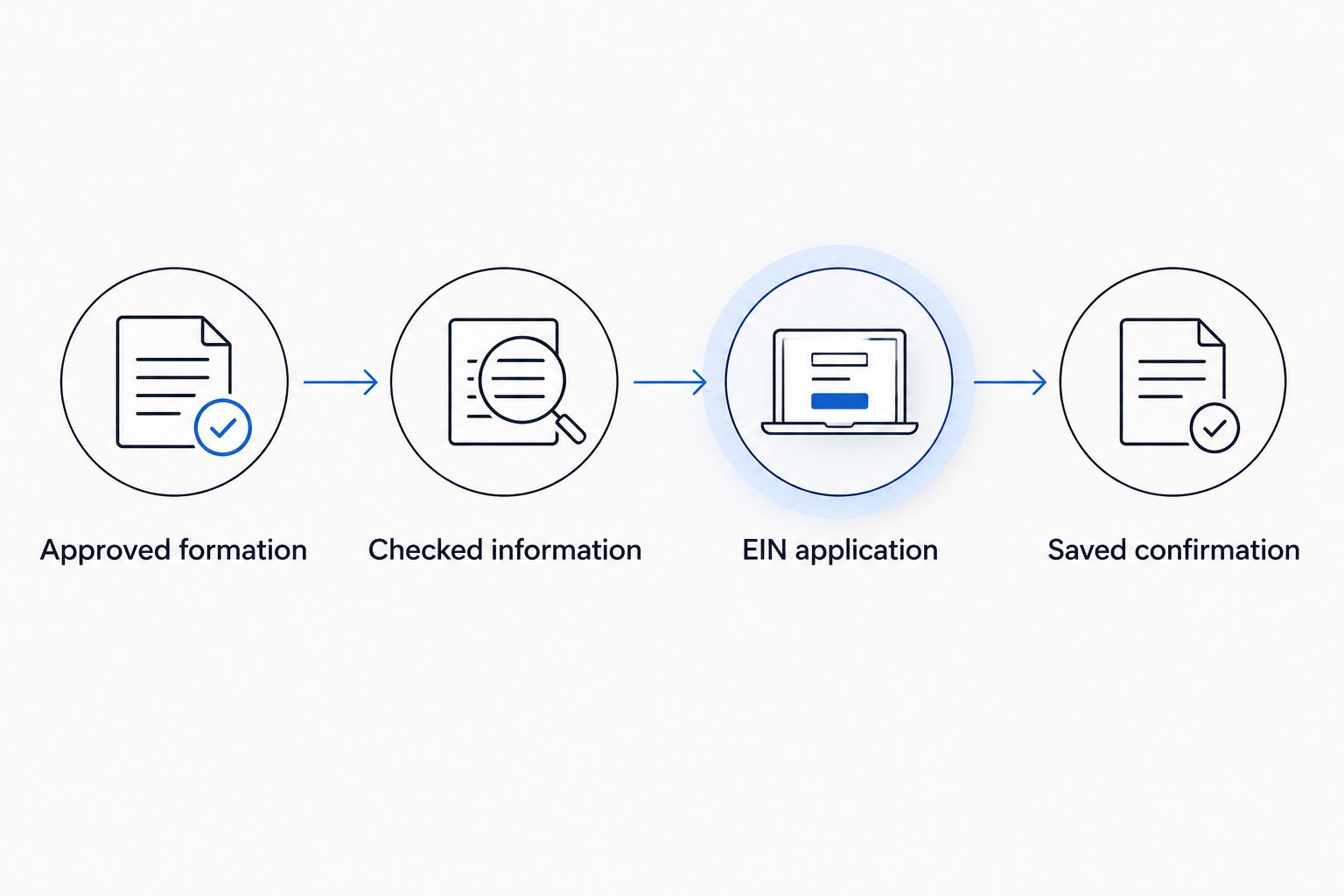
EIN application
Choose your application route
The IRS provides an online EIN application and Form SS-4 submission routes. Choose the route that fits your eligibility and ability to complete the application accurately, not just the route that looks shortest.
| Route | Best for | Practical advantage | Limitation |
|---|---|---|---|
| IRS online application | Eligible applicants ready to complete the application in one session | A successful application can issue the EIN during the session | Online eligibility and session requirements apply |
| Form SS-4 by fax | Applicants using the paper-form process with fax access | Lets you prepare and review the form before transmission | Requires a separate transmission and response process |
| Form SS-4 by mail | Applicants using the paper-form process without fax access | Creates a paper submission record | Mailing and IRS processing are separate from your preparation time |
Consult the current IRS instructions for submission details. Do not send applications through several routes for the same LLC to try to speed up the result; that creates a risk of duplicate EIN assignments.
Complete and review the application
- Enter the legal name. On Form SS-4, use Legal name of entity (or individual) for whom the EIN is being requested for the approved LLC name. Enter a different trade name only in the separate trade-name field, when applicable.
- Identify the responsible party. Complete Name of responsible party and the associated identification field using the person who meets the IRS definition. A preparer is not automatically the responsible party.
- Answer the LLC questions. Identify the entity as an LLC and report its membership accurately. Formation as an LLC does not, by itself, mean you elected corporate tax treatment.
- Check the tax-classification instructions. Form SS-4’s Type of entity section requires particular care for LLCs. Use the IRS instructions, and involve a tax professional when you are considering a tax election.
- Explain the application purpose and activity. Complete Reason for applying and the business-activity questions truthfully. Do not invent hiring plans or tax obligations simply to fill a field.
- Review before submission. Compare the name, addresses, responsible party, membership, and activity against your checked record. Confirm any third-party authorization before a helper submits on your behalf.
- Submit once and save the result. If using the online route, download or print the confirmation when it is provided. For a paper submission, retain the signed application, transmission or mailing record, and IRS response.
Expected result: Your LLC has its EIN and an IRS confirmation record that matches the intended entity.
For 2026 applications, use the current IRS application and instructions rather than an old saved form. Source references for this workflow are the California Secretary of State’s LLC formation instructions and the IRS Instructions for Form SS-4; each agency controls its own filing requirements.
Post-filing records
Connect the EIN to your next obligations
- Check the confirmation. Compare the IRS record with your approved LLC information. If something is wrong, follow the IRS correction process rather than immediately applying again.
- Save the formation and EIN records together. Keep a secure digital copy and a backup you can retrieve when a bank, accountant, or authorized application requests them. Limit access to sensitive identification information.
- Calendar the Statement of Information. California generally requires an LLC’s initial Statement of Information within 90 days of registration and subsequent statements every 2 years. Use the Secretary of State’s filing window for your LLC.
- Separate state, local, and tax tasks. Review California Franchise Tax Board obligations, applicable city registration, and any permit requirements. In Los Angeles County, requirements depend on the business activity and whether the location is inside a city or in unincorporated county territory.
Expected result: Your EIN is part of an organized business record, and your remaining obligations have named next steps.
Pro Business Solutions offers formation, EIN filing, seller’s permits, DBA registration, notary services, and tax preparation in one place. Its owner-confirmed 100% error-free service promise concerns paperwork accuracy; the consultancy is not a law firm and does not provide legal advice.
Get help with your filing sequence
Ask about hands-on LLC formation and EIN filing support in English or Spanish.
If you already have an EIN
An existing EIN changes the task from applying automatically to checking whether another application is necessary. Start by identifying which person or entity the existing number belongs to.
If your approved LLC already has its own EIN, retrieve that confirmation before starting another application. Losing the letter is not a reason to request a new number.
If you operated as a sole proprietor and then formed an LLC, review the IRS rules for your ownership and tax situation. A sole proprietor’s EIN does not automatically become an LLC’s EIN, and the answer is not identical for every single-member LLC.
A name or address change alone generally does not require a new EIN. Ownership and structural changes require a closer review of IRS guidance; ask a tax professional to resolve classification questions before submitting another application.
Troubleshooting
- California rejected the LLC filing. Correct the stated issue and obtain an accepted formation record before applying for the EIN. Do not treat the original submission date as proof that the LLC exists.
- The EIN name differs from the approved LLC name. Compare both records and identify where the error occurred. Use the appropriate agency’s correction process; a second EIN application is not a name-correction tool.
- The online application stops or reports an error. Save the error details without exposing sensitive information. Follow the IRS instructions before retrying, especially if you are unsure whether an EIN was assigned.
- The application used the preparer as responsible party. Check the IRS definition and correction instructions. A filing helper’s involvement does not make that person the owner or controller of the LLC.
- You cannot find the EIN confirmation. Check your saved records and contact the IRS through its official process for authorized callers. Do not apply again merely to replace missing paperwork.
Customize your workflow
Use the EIN as a handoff point, not as permission to begin every business activity. A seller’s permit, local registration, professional license, and DBA address different requirements; none is automatically supplied by an EIN.
For a 2026 launch, assign each remaining task to a person and keep evidence of completion in the same folder. Review the California LLC annual obligations after formation before treating the startup checklist as finished.
Hands-on assistance suits owners who want someone to explain and check paperwork. It does not replace individualized legal advice about ownership disputes or a tax professional’s analysis of a proposed election.
FAQ
What is the correct California LLC filing to EIN application order?
Form the California LLC first, wait until the formation is approved and effective, then apply for the EIN. Use the approved legal name and the correct ownership and responsible-party information.
Can I apply for an EIN while my California LLC filing is pending?
Wait until the California LLC formation is approved and effective before applying for its EIN. A pending filing can still require changes, including changes that affect the information you would give the IRS.
Does every single-member California LLC need an EIN?
Not every single-member LLC needs an EIN for federal tax purposes. Employment taxes, certain excise taxes, tax elections, and banking requirements affect the answer, so check the IRS guidance for your situation.
Is my California entity number the same as my EIN?
No, California’s entity number and the IRS EIN are different identifiers. California assigns its number for state business records; the IRS assigns the EIN for federal tax administration.
Should my registered agent be the EIN responsible party?
Not simply because that person or company is your registered agent. The IRS responsible party generally must be the individual who ultimately owns or controls the entity.
Does getting an EIN elect S corporation tax treatment?
No, receiving an EIN does not elect S corporation tax treatment. An eligible business uses a separate IRS election process, and a tax professional can help evaluate that decision.
Can someone help me with LLC formation and EIN filing in Los Angeles?
Yes, Pro Business Solutions provides hands-on LLC formation and EIN filing assistance for first-time business owners. Personal support is available in English and Spanish, with related business paperwork services also offered.
What California filing should I calendar after LLC formation in 2026?
Calendar the initial Statement of Information, generally due within 90 days of registration. Also review the LLC’s recurring state, tax, and applicable local requirements rather than assuming the EIN completes compliance.
One last thing
Keep a short record of why you chose each application answer. An EIN confirmation shows the assigned number, but it does not explain why you selected a responsible party, membership count, or tax-classification response. Those notes help you answer later questions without reconstructing the entire filing process.