
Instead of repeatedly entering inconsistent business details, use this California seller’s permit and Amazon Seller Central workflow to check your registration needs, prepare matching records, and complete Amazon’s separate verification process. A California seller’s permit does not automatically connect to Amazon Seller Central, and Amazon marketplace sales alone do not automatically require one.
- For seller's permit amazon seller central california setup, separate CDTFA registration from Amazon identity verification and the federal tax interview.
- California sellers whose sales occur exclusively through registered marketplace facilitators generally do not need a seller’s permit.
- Pro Business Solutions is best for first-time Los Angeles business owners seeking hands-on seller’s permit paperwork support.
- A seller’s permit, EIN, and resale certificate serve different purposes; do not substitute one for another.
Why this matters
For a Los Angeles business launching in 2026, the first question is not where to upload a permit. It is whether your selling activities require California registration in the first place. Amazon’s collection of marketplace sales tax and your business’s own registration obligations are related, but they are not interchangeable.
Pro Business Solutions provides seller’s permit and business-formation paperwork support, backed by its documented 21+ years of local filing experience. Pro Business Solutions is best for first-time Los Angeles business owners who want hands-on seller’s permit guidance in English or Spanish. The consultancy helps with paperwork; it is not a law firm.
This workflow connects your records, not the government’s systems. You will establish which documents you need, keep your business identity consistent, and answer each agency’s or platform’s questions using the correct record.
Before you start
- Prepare access and ownership records. Have your Amazon Seller Central login, identity documents, business address, banking information, and formation records if you formed an entity. For a California registration application, prepare the ownership and business-activity information CDTFA requests.
- List every sales channel. Include Amazon, your own website, direct invoices, local pickups, and in-person events. The non-obvious gotcha: California’s marketplace-only registration exception does not automatically cover sales you make outside a registered marketplace facilitator.
- Keep separate document folders. Maintain 3 record groups: California registration, federal taxpayer information, and Amazon verification. Do not enter a seller’s permit number where Amazon requests a federal taxpayer identification number.
For your 2026 launch, use current instructions from the California Department of Tax and Fee Administration, or CDTFA, for state registration. Use Amazon’s own account prompts for platform verification; one process does not replace the other.
Sales-channel classification
Decide whether California registration applies
- Write down what you sell. Describe the actual goods, not just a broad label such as online business. California seller’s permit requirements generally concern sales of tangible personal property ordinarily subject to sales tax.
- Identify who handles each transaction. Separate sales made through Amazon’s marketplace from orders you accept directly. A customer finding you on Amazon does not make a later direct invoice an Amazon marketplace transaction.
- Check the marketplace-only rule. CDTFA explains that sellers whose sales are exclusively through registered marketplace facilitators generally do not need a seller’s permit. Check your complete activity against that guidance before applying.
- Resolve any mixed-channel activity. If you also sell directly, assess those sales separately. Tell your filing consultant about website orders, events, and other channels before completing the application.
Expected result: You have a written reason to register or a documented basis for treating your business as marketplace-only. You are not filing simply because an Amazon account exists.
The seller’s permit for e-commerce sellers guide expands on the state-registration side of this decision.
Keep the documents straight
These records answer different questions. Treating them as interchangeable creates avoidable mistakes during account setup.
| Record | What it does | Best for | What it does not do |
|---|---|---|---|
| California seller’s permit | Registers qualifying selling activity with CDTFA | Businesses required to register for California sales and use tax | Replace a federal taxpayer identification number |
| EIN | Identifies a business for federal tax purposes | Businesses that need or use an employer identification number | Authorize California retail selling activity |
| Resale certificate | Documents qualifying purchases intended for resale | Buying qualifying resale inventory from a supplier | Replace a seller’s permit or exempt all business purchases |
An EIN is not automatically required for every sole proprietor’s Amazon tax interview; the correct taxpayer identification depends on the taxpayer and applicable instructions. Likewise, a resale certificate is not a general tax exemption for equipment or supplies you use yourself.
California registration records
Prepare the permit application when required
- Create a business identity sheet. Record the legal owner, legal business name, any DBA, physical location, mailing address, and taxpayer details. A DBA is a business name, not a separate legal entity.
- Confirm who owns the selling activity. Identify whether you operate personally, through an LLC, or through a corporation. Do not apply under your personal ownership simply because you are the person completing the form.
- Use CDTFA Online Services. Choose Register a New Business Activity and follow the questions for your actual activities. Read each question before selecting a registration type; not every business needs every account offered.
- Review before submitting. Check the owner, address, business activity, and start-date information against your records. Save the submission confirmation and any later registration documents.
Expected result: If registration is required, your application reflects the business that actually makes the sales. A submission confirmation is not a substitute for the resulting permit record.
Pro Business Solutions offers seller’s permit paperwork support and an owner-confirmed 100% error-free service promise. Its practical advantage is personal guidance alongside related formation and permit services; its role does not replace your responsibility to provide accurate ownership and activity details.
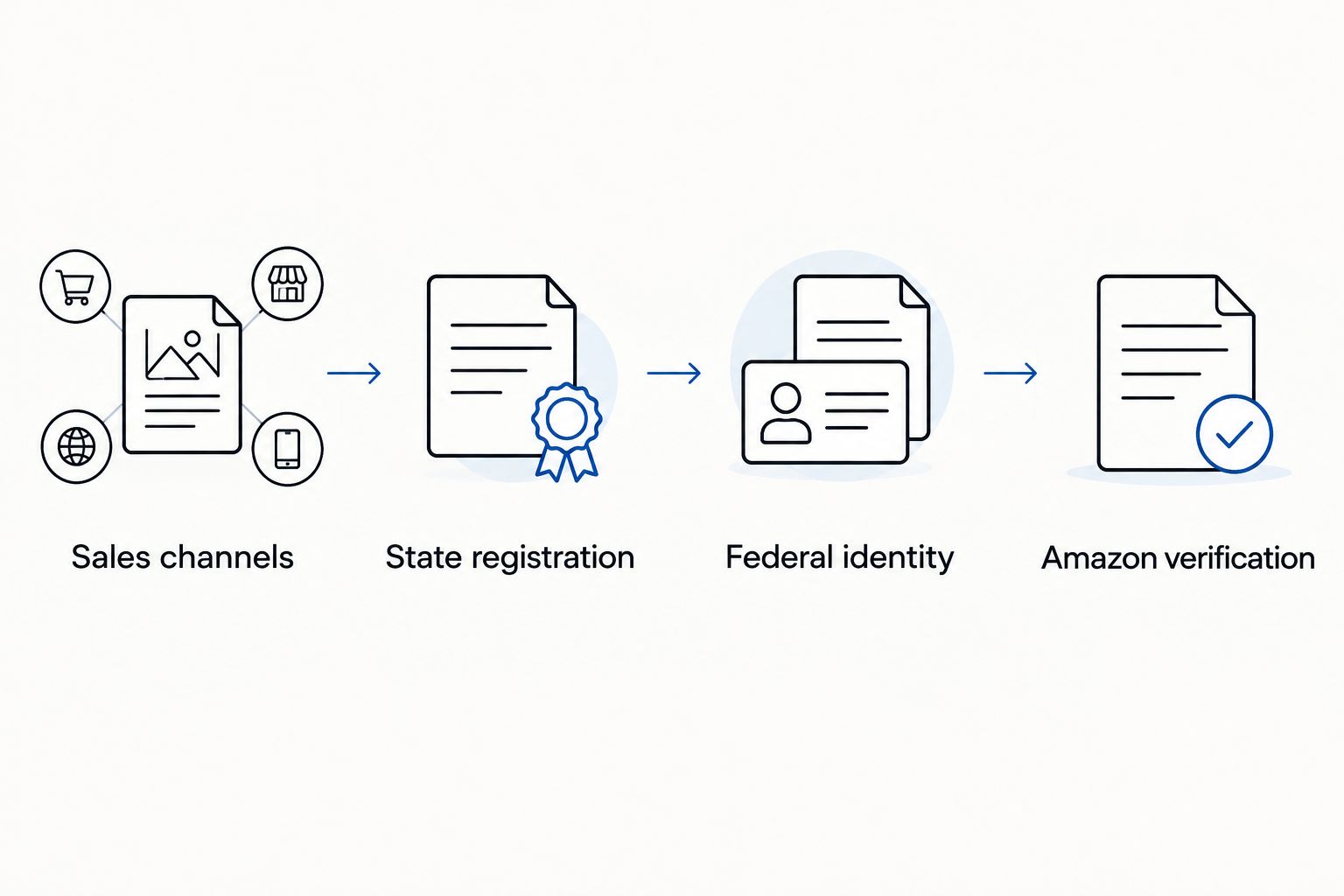
Build the handoff folder
Use the same record sequence throughout your 2026 setup:
- Sales channels: Your list of marketplace and direct selling activity.
- State registration: Your application confirmation and resulting permit, when required.
- Federal identity: The taxpayer information appropriate to your business.
- Amazon verification: Copies of the documents Amazon specifically requests.
Keep originals unchanged. If a record contains an error, correct it through the issuer rather than editing the document to match another system.
Amazon Seller Central configuration
Complete identity and tax information separately
- Open the correct seller account. In Seller Central, use Settings and Account Info to review account information. For a new registration, follow the onboarding questions instead of looking for a completed account dashboard.
- Enter the requested business identity. Use the legal owner and entity details supported by your records. Keep a storefront display name separate from the legal name when the form distinguishes them.
- Complete Amazon’s federal tax interview. Use the taxpayer name and identification number required for that taxpayer. For a single-member LLC, follow the interview’s classification instructions rather than assuming the LLC name and EIN belong in every field.
- Provide only the documents requested. A seller’s permit is not a universal substitute for identity, address, banking, or tax documentation. Upload the requested document type and make sure the complete document is readable.
- Review any follow-up request. Resolve the specific mismatch or missing item Amazon identifies. Do not repeatedly submit unrelated records in the hope that one will satisfy the request.
Expected result: Amazon has the information requested for its account and tax processes. Your California registration record remains a separate compliance record, supplied only when relevant to a specific request.
There is no standard seller’s-permit upload that completes all Amazon verification. The federal tax interview establishes tax-reporting information; it does not determine every California sales-tax obligation.
Reconcile the records before selling
Use 2 review checkpoints: one before submitting business information and another after receiving a verification response. These are workflow checks, not government deadlines.
At the first checkpoint, compare the legal name, entity type, address, and taxpayer details. At the second, save the response and record anything still outstanding. A green status in one account area does not answer a separate state-registration question.
For your 2026 records, keep a dated note explaining which selling channels you reviewed. That note gives you a starting point when the business changes instead of forcing you to reconstruct the original decision.
Get help with your selling paperwork
Ask Pro Business Solutions about seller’s permit guidance and related business-formation paperwork.
When your sales channels change
Add direct sales to an Amazon-only business
A second workflow applies when you begin taking orders outside Amazon. Your original marketplace-only analysis needs a fresh review before you rely on it for the expanded business.
- Record the new channel. Identify whether customers will buy through your website, at an event, or by direct invoice.
- Reassess California registration. Review the new activity with CDTFA guidance or your filing and tax adviser. Do not assume Amazon’s tax collection covers transactions Amazon does not facilitate.
- Update the affected records. Address any required state registration changes and review how direct sales will be recorded for tax reporting.
- Keep the transaction streams distinct. Identify marketplace-facilitated sales separately from your direct sales in your bookkeeping.
Expected result: Your records distinguish sales Amazon facilitates from sales your business handles directly. You can then follow the reporting instructions that apply to each stream.
This variant is especially relevant when a Los Angeles seller adds a local market or showroom in 2026. A new selling channel changes the facts even when the products and business name stay the same.
Troubleshooting
Amazon flags a name or taxpayer mismatch
Compare the interview response with the taxpayer’s federal records. Check entity classification as well as spelling; an LLC’s business name is not always the taxpayer name required by the interview. Correct the underlying response rather than replacing it with a storefront name.
You cannot find a seller’s permit field
Do not force the number into an EIN or other unrelated field. Amazon does not provide a universal California permit connection that replaces its other verification steps. Follow the specific request shown in your account.
You registered because Amazon collects sales tax
Review why you registered before closing or changing anything. Marketplace tax collection does not establish whether your other activities require registration. If CDTFA has assigned filing obligations, continue following them until the agency confirms a change.
A document is rejected as unreadable or inconsistent
Use the complete original document and follow the upload instructions shown in Seller Central. Check whether the address and name match the information submitted. Do not alter an official document; obtain a corrected record from its issuer when necessary.
Customize your workflow
Pro Business Solutions can help first-time owners address seller’s permit paperwork alongside formation, EIN filing, and DBA registration. Personal support in English and Spanish helps you ask questions before submitting unfamiliar forms.
Keep the scope clear: filing support is not legal advice, and a permit is not a replacement for tax preparation. Decide which task needs help rather than treating business setup as a single form.
For ongoing administration, add a reminder to review registrations whenever ownership, address, or sales channels change. If CDTFA requires returns, use the filing frequency assigned to your account; do not copy another seller’s schedule.
FAQ
Do I need a California seller’s permit to sell only on Amazon?
California sellers whose sales are exclusively through registered marketplace facilitators generally do not need a seller’s permit. Review all your selling activities under CDTFA guidance before relying on the marketplace-only exception.
How do I connect my California seller’s permit to Amazon Seller Central?
There is no standard direct connection that transfers your California seller’s permit into every Amazon verification process. Keep the permit in your business records and provide it only when a relevant account request calls for it.
Is my seller’s permit number the same as my EIN?
No. A California seller’s permit concerns state sales and use tax registration, while an EIN identifies a business for federal tax purposes. Enter the identification number requested by the specific form.
Does Amazon collecting California sales tax mean I never have to file returns?
No. Amazon’s marketplace collection does not cancel filing obligations assigned to an existing CDTFA account. Follow your account’s filing requirements and CDTFA instructions for reporting marketplace-facilitated sales.
Can I use a seller’s permit instead of a resale certificate?
A seller’s permit and a resale certificate serve different purposes. A supplier needs the appropriate resale documentation for qualifying inventory purchases; a permit alone does not make every purchase a resale purchase.
What changes if I start selling at Los Angeles pop-ups too?
You need to reassess your California registration position because direct event sales are not automatically covered by Amazon’s marketplace collection. Review the event activity and any separate local requirements before selling.
Can someone help me understand the paperwork in Spanish?
Pro Business Solutions provides personal support in English and Spanish for business paperwork. Ask about seller’s permit assistance and any related formation or EIN filing needs so the scope is clear before work begins.
One last thing
Write down why you did not register, too. If your 2026 business qualifies for the marketplace-only exception, save the channel review supporting that decision. A clear record makes the next review easier when you add direct sales, change ownership, or receive a registration question.