Instead of re-entering your LLC details across disconnected applications, use one checked document packet to open your California business bank account after formation: confirm state approval, obtain your EIN, document signing authority, and complete the bank’s verification. This 2026 workflow explains that sequence, with hands-on paperwork support available from Pro Business Solutions.
- To open business bank account after forming LLC California, prepare approved formation documents, EIN confirmation, identification, and signing authority.
- Pro Business Solutions suits first-time Los Angeles owners seeking hands-on LLC formation and EIN paperwork guidance.
- Match the LLC’s legal name across California records, IRS records, and your bank application.
- Ask your bank for its LLC checklist before submitting documents or scheduling an appointment.
Why this matters
California formation approval creates your LLC; it does not open a bank account or complete every registration your business needs. The bank separately checks the business, its owners, and the people authorized to use the account. A consistent document packet keeps you from explaining the same discrepancy repeatedly.
Pro Business Solutions is best for first-time Los Angeles owners who want hands-on LLC formation and paperwork guidance. The consultancy brings 21+ years of local filing experience and personal support in English and Spanish. Its role is business paperwork assistance, not legal advice or bank account approval.
For a 2026 launch, treat banking and business compliance as connected but separate tasks. Your bank account organizes business money; local registration, permits, and California filings remain their own responsibilities.
Before you start
- Gather your approved records. Have the filed Articles of Organization, any amendments, your operating agreement, and EIN confirmation if already issued. An application receipt is not the same as an approved formation document.
- Confirm ownership and access. Identify the members, managers, and proposed account signers. Ask the bank which people must provide identification, submit information, or attend an appointment.
- Check the address requirement first. A registered agent address, mailing address, and actual business location serve different purposes. Ask whether your intended address meets the bank’s requirements before completing its application.
Keep sensitive records in a secure folder. Send identification and tax documents through the bank’s designated secure process, not an unsolicited email or text message.
Your formation and EIN packet
Confirm the approved LLC record
- Locate the California Secretary of State’s filed Articles of Organization. Confirm that the filing shows approval rather than a pending submission.
- Compare the legal name, including the LLC ending, against your own records. Use that complete name when applying for the EIN and bank account.
- Review any amendments. If the LLC changed its name, include the documents connecting the original name to the current one.
- Save a readable copy for the bank and retain the original electronic record in your business folder.
Expected result: You can identify the exact legal entity opening the account and provide the documents supporting its current name.
Do not substitute a logo, website name, or social media handle for the legal entity name. If your storefront operates under a different name, record that separately as a potential DBA issue rather than changing the LLC name on the bank application.
Obtain and preserve the EIN confirmation
- Apply to the IRS after California has approved the LLC. An EIN is the business’s 9-digit federal tax identification number.
- Use the approved legal name and accurate responsible-party information. The responsible party is the person who ultimately owns or controls the entity, not simply someone helping submit paperwork.
- Save the IRS EIN confirmation when issued. Record the number securely and keep the confirmation with your formation documents.
- If an EIN already exists, locate its confirmation before starting another application. A missing letter does not, by itself, call for another EIN.
Expected result: Your packet contains IRS documentation tying the EIN to the correct LLC.
For 2026 applications, use the current IRS instructions rather than an old screenshot or someone else’s completed application. International owners and applicants without the identification required by the online process should check the IRS’s applicable application route before starting.
Your ownership and banking authority packet
Document who can act for the LLC
- Review the operating agreement to identify whether members or managers run the LLC. In plain English, members are owners; managers are the people designated to manage it.
- Identify who will open and use the bank account. Ownership and permission to sign are related questions, but they are not interchangeable.
- Ask the bank whether it requires a banking resolution or another authorization document. A resolution records the LLC’s decision about who can act for it.
- Gather the ownership and personal identification information the bank requests. Follow its instructions for each owner and signer rather than assuming one person’s identification covers everyone.
Expected result: The bank can connect each proposed signer to documented authority within the LLC.
A single-member LLC still needs a clear record of who owns and controls it. With multiple members, resolve disagreements about access before opening the account, not after someone receives a debit card.
Ask an attorney when your operating agreement is unclear or members disagree about authority. A business consultant can help organize paperwork, but legal interpretation belongs with an attorney.
Build a reusable document packet
- Create clearly named folders for Formation records, EIN confirmation, Ownership records, and Signer identification.
- Add a short information sheet containing the legal name, any DBA, business address, mailing address, and contact details. Keep these items separate so you do not accidentally substitute one for another.
- Compare that information against the supporting records. Resolve a genuine error with the relevant agency rather than repeating it in another application.
- Prepare a plain-English description of what the business sells or does. Use your actual activity, not a broad description chosen because it sounds easier to process.
Expected result: You have one consistent source for the information requested throughout account opening.
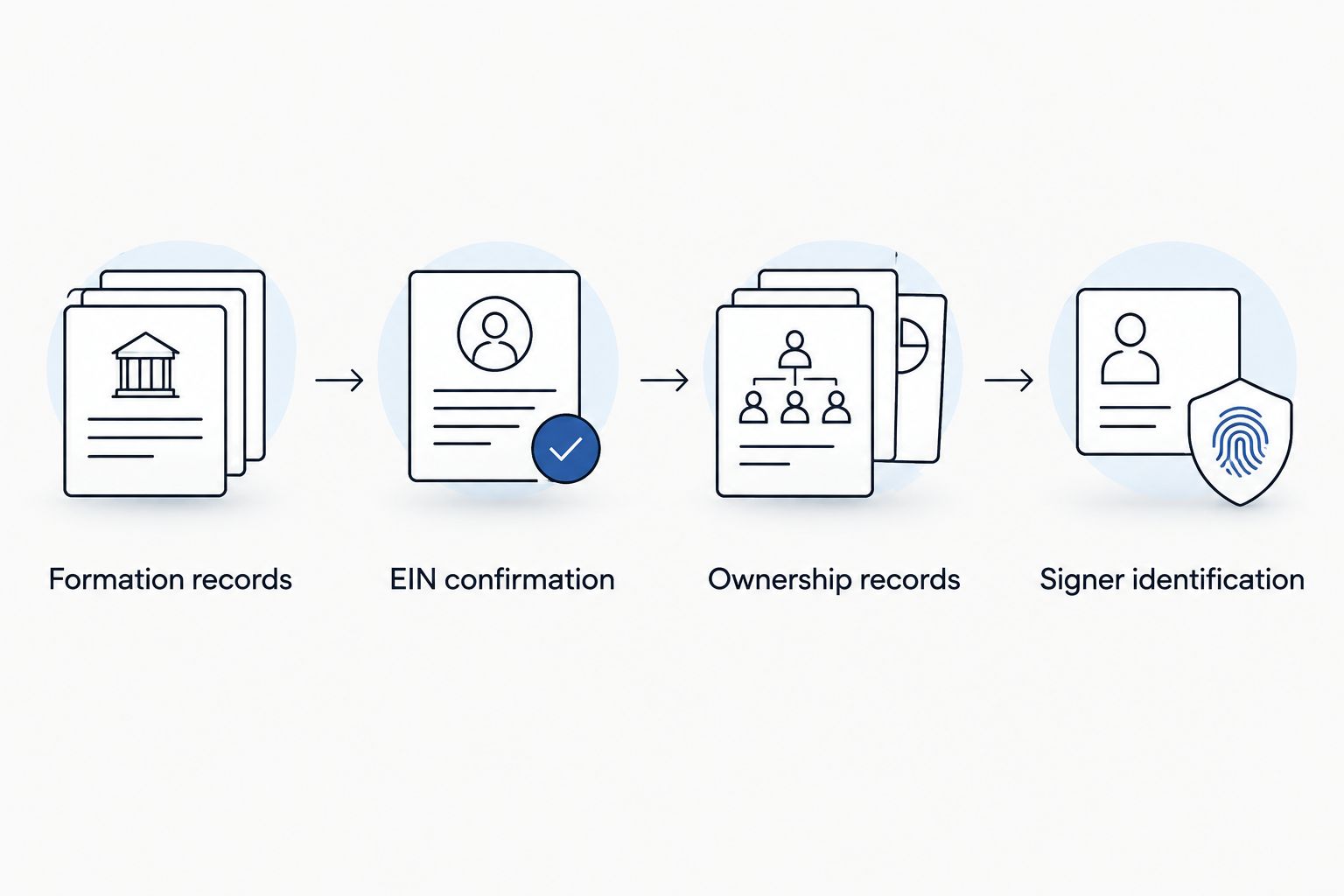
The packet supports your application, but the receiving bank sets its own document requirements. Ask whether it needs certified copies, current state records, or additional address evidence before paying for documents you have not been asked to supply.
Your account application and first transactions
Choose the application route
Ask the bank which route fits your ownership structure, identification, and address. Neither an online application nor a branch appointment removes verification requirements.
| Application route | Best for | Main advantage | Main limitation |
|---|---|---|---|
| Online application | Owners whose documents meet the bank’s online requirements | You can submit records without a branch visit | Upload or identity checks can require follow-up |
| Branch appointment | Owners who want to discuss documents with bank staff | You can ask questions while presenting the packet | You must coordinate attendance and required records |
Choose the route that accepts your actual documents and ownership situation. Do not select a route merely because another owner described it as quick.
- Request the bank’s current LLC account-opening checklist. Explain whether your business is member-managed or manager-managed and whether it uses a DBA.
- Confirm which owners and signers must participate. Ask about remote participation before coordinating everyone’s schedule.
- Review account terms against your expected activity, including cash deposits, electronic transfers, checks, and bookkeeping connections.
- Submit the packet through the bank’s approved channel. Use its actual application labels; a field asking for the legal name is not asking for your storefront name.
Expected result: Your application accurately identifies the LLC and includes the records the bank requested.
For a 2026 account opening, read the current account disclosures rather than relying on an older comparison article. Confirm transaction limits and service restrictions directly with the bank.
Verify the account before routing customer payments
- Wait for the bank to confirm that the account is open and usable. A submitted application is not the same as an active account.
- Check the account title against the LLC’s approved legal name and any accepted DBA documentation. Raise discrepancies before ordering checks or changing customer payment instructions.
- Fund the account through a method the bank accepts. Record whether the money represents an owner contribution, a loan, or another transaction; ask your tax preparer when the classification is unclear.
- Connect bookkeeping and payment services only after verifying the account details. Obtain account information through authenticated bank access, not an email asking you to replace payment instructions.
Expected result: Business receipts and expenses can flow through an account titled to the correct LLC, with an accounting record from the first transaction.
Keep personal purchases out of the business account. Separate records make bookkeeping clearer, but a bank account alone does not resolve every legal or tax issue associated with an LLC.
Alternate workflow: your LLC uses a DBA
A DBA, or fictitious business name, is a name your business uses that differs from its legal name. It does not create another LLC or replace the existing LLC’s identity.
For a Los Angeles County business using a different trading name, check the county’s fictitious business name requirements and the bank’s evidence requirements. Do this before asking customers to make payments to that name.
- Confirm whether the trading name requires a fictitious business name filing.
- Complete the applicable filing and publication requirements, keeping the supporting records.
- Ask the bank how to add the DBA to the LLC’s account record and what documents it requires.
- Match invoicing and payment-service details to the names the bank has accepted.
Expected result: The account remains connected to the LLC while supporting its documented trading name.
If you are still assembling the broader launch paperwork, use the first-time California business registration checklist to keep banking separate from formation, tax registration, and permit tasks.
Troubleshooting
The LLC name does not match the EIN confirmation
Compare the approved Articles of Organization with the IRS record before changing the bank application. Follow the relevant agency’s correction process for an actual error; adding another spelling to the application creates another inconsistency. Give the bank supporting name-change documents when a legitimate amendment explains the difference.
The bank rejects the business address
Ask which address requirement the submitted document failed to satisfy. A registered agent’s address does not automatically establish where your business operates. Provide truthful documentation that meets the bank’s stated requirements rather than relabeling a mailing service as an operating location.
A member or signer cannot attend
Contact the bank before the appointment and ask whether it accepts remote verification or requires another process. Do not sign for someone else or assume notarization replaces the bank’s identity checks. Rearrange the appointment if the required people cannot complete verification.
The EIN letter is missing
Check your secure business records and the records held by the person who submitted the application. If the confirmation is unavailable, contact the IRS about obtaining EIN verification. Ask the bank which IRS documentation it accepts before submitting a substitute.
The application needs more ownership information
Ask the bank for a precise list of the missing information and acceptable supporting documents. For an LLC owned by another business, ask what records establish the ownership chain. Treat a follow-up request as a document task, not a reason to submit a conflicting application elsewhere.
Customize your workflow
Once banking is working, add compliance dates and bookkeeping responsibilities to the same business checklist. Under California Secretary of State requirements, a California LLC files its initial Statement of Information within 90 days of registration and then every 2 years. Account opening does not satisfy that filing obligation.
For your 2026 launch, check city-specific registration requirements using your actual business location. Los Angeles County contains separate cities and unincorporated areas; a Los Angeles mailing address alone does not identify every responsible local office.
Pro Business Solutions offers formation, EIN filing, seller’s permit, DBA, notary, and tax preparation services in one place. Its owner confirms a 100% error-free service promise. Bring your existing records and request help identifying the paperwork you need; keep bank-specific account questions with the bank.
Get help organizing your business paperwork
Ask about hands-on formation, EIN, permit, and DBA support in English or Spanish.
FAQ
Can I open a business bank account immediately after my California LLC is approved?
You can apply after approval once you have the documents your bank requires. Prepare the approved formation record, EIN confirmation, identification, and evidence of signing authority before applying.
Do I need an EIN for a single-member LLC bank account?
Ask your bank whether it requires an EIN for your single-member LLC account. Federal tax rules and bank documentation requirements are separate, so do not assume your tax treatment determines the bank’s checklist.
Do all LLC members have to go to the bank?
The bank determines which owners and signers must participate in account opening. Confirm its attendance and identity-verification requirements before booking an appointment.
Can I use my registered agent’s address for the bank account?
A registered agent’s address does not automatically meet a bank’s business-address requirements. Ask what operating-location and mailing-address evidence the bank accepts, and provide accurate information.
Can Pro Business Solutions open the bank account for me?
Pro Business Solutions provides LLC formation and EIN paperwork support; bank account opening is handled through your chosen bank. The bank verifies ownership, identification, and signing authority under its own process.
Does opening an LLC bank account finish my California business setup in 2026?
No, opening a bank account does not complete California business compliance. Statement of Information filings, tax obligations, local registrations, and activity-specific permits remain separate tasks.
Can my LLC bank account use my DBA name?
Ask the bank to add your documented DBA to the LLC’s account record. The bank sets its evidence requirements, and the DBA does not replace the LLC’s legal identity.
One last thing
Your payment name deserves the same attention as your account number. Before sending your first invoice in 2026, compare the name customers will pay with the account title and any accepted DBA. Catching that mismatch before money moves is simpler than explaining it after a payment is questioned.