
Yes—California-based online sellers generally need a seller’s permit when they sell taxable physical goods directly to customers, including through their own websites. In 2026, an important exception applies when all your sales are handled by a registered marketplace facilitator responsible for collecting and paying California sales tax; selling online does not, by itself, create an exemption.
- Do online sellers need a seller's permit in California? Generally yes for direct sales of taxable physical goods.
- California marketplace-only sellers generally do not need registration when a registered facilitator handles all sales tax obligations.
- An LLC, EIN, or local business license does not replace a California seller’s permit.
- Pro Business Solutions provides hands-on seller’s permit assistance for first-time business owners.
Pro Business Solutions is best for first-time Los Angeles business owners who want hands-on help with seller’s permit paperwork. Start by identifying what you sell and who actually processes each sale.
Do online sellers need a seller’s permit in California?
California online sellers generally need a seller’s permit if they conduct business in California and sell tangible personal property ordinarily subject to sales tax. Tangible personal property means physical items, such as clothing, jewelry, or household goods.
The California Department of Tax and Fee Administration, or CDTFA, administers these rules. Its marketplace-facilitator guidance distinguishes direct sellers from businesses whose sales occur exclusively through a registered marketplace facilitator.
| Your selling situation | General California permit treatment | What you should check |
|---|---|---|
| You sell taxable physical goods through your own website | A California-based seller generally needs a seller’s permit | Whether your checkout collects the correct tax and your account is registered |
| You sell exclusively through a registered marketplace facilitator | You generally do not need registration when the facilitator handles all applicable sales | Whether every sale qualifies as a facilitated sale |
| You sell through a marketplace and directly to customers | Direct taxable sales generally require a seller’s permit | Which transactions the facilitator handles and which remain yours |
| You sell only electronically delivered products | These sales generally are not subject to California sales tax when no physical property transfers | Whether your actual delivery method includes physical goods |
| You occasionally sell your own used belongings | A qualifying occasional sale can fall outside permit requirements | Whether your activity has become an ongoing resale business |
Your sales channel matters, but the product and your business’s California connection matter too. Do not apply a marketplace-only exception to orders you take separately by email, social media, or a personal checkout page.
Why this matters
A new online store often involves several registrations that sound interchangeable. They are not. Forming an LLC creates an entity, obtaining an EIN establishes a federal tax identifier, and obtaining a seller’s permit addresses California sales-tax registration.
For a home-based seller in Los Angeles County, state sales-tax registration is also separate from local business requirements. Your city or the county can have its own registration, zoning, or home-occupation rules.
For your 2026 launch, separate the state permit question from the local business-license question. Completing one does not automatically complete the other, and opening a marketplace account does not settle either question for every sales channel.
Selling through your own website: check direct-sales obligations
Best for: sellers who want their own checkout and customer relationship. If you operate in California and sell taxable physical goods directly through your website, you generally need a seller’s permit before conducting those sales.
The advantage is control over how customers buy from you. The trade-off is that your own store brings sales-tax responsibilities that a marketplace facilitator would otherwise handle for facilitated transactions.
A payment processor is not automatically a marketplace facilitator. Accepting card payments through a checkout service does not, by itself, transfer your California sales-tax obligations to that service.
Before taking orders, identify who is responsible for calculating tax, collecting it, reporting taxable sales, and paying CDTFA. Treat those as separate tasks. A checkout setting that calculates tax is not proof that your business has registered or that a return has been filed.
Selling only through a marketplace: confirm the exception
Best for: sellers whose transactions all qualify for marketplace-facilitator treatment. Under CDTFA’s marketplace guidance, a seller whose sales are exclusively facilitated by a registered marketplace facilitator generally does not need to register for a seller’s permit or use-tax account.
The benefit is narrower sales-tax administration for those transactions. The limitation is equally important: the exception depends on the facilitator’s role and your actual sales activity, not merely on having an account with a familiar platform.
Confirm the marketplace’s California tax responsibilities in its seller documentation. Keep records showing which orders it facilitated and which taxes it handled.
Do not assume this exception covers a separate invoice sent to a customer you first met through the marketplace. If you accept that customer’s next order directly, you need to evaluate the direct sale separately.
Selling through multiple channels: separate every transaction
Best for: sellers who want both marketplace exposure and direct orders. A mixed-channel business needs a clear distinction between marketplace-facilitated sales and sales for which the business remains responsible.
The benefit is flexibility. The trade-off is additional recordkeeping: your total revenue report does not necessarily show which party had the sales-tax obligation for each transaction.
Keep these 3 sales channels distinct in your records:
- Marketplace orders: Transactions completed through a registered facilitator.
- Website orders: Transactions completed through your own checkout.
- Offline orders: Transactions accepted directly at events, by invoice, or through personal arrangements.
A Los Angeles seller who uses all these channels should not treat marketplace tax collection as coverage for the whole business. Review each channel before adding it, rather than waiting until your first filing deadline.
Why California seller’s permit requirements vary
The registration answer changes with the facts of your business. Review these factors before deciding that another seller’s experience applies to you:
- Product type: Physical goods, electronically delivered products, and services can receive different sales-tax treatment.
- Sales channel: A registered marketplace facilitator’s responsibilities differ from your responsibilities for direct transactions.
- California presence: Operating from a California home or business location differs from selling remotely without a physical presence.
- Inventory location: Storing inventory in California can create a physical connection even when the owner lives elsewhere.
- Selling activity: Disposing of personal belongings differs from regularly buying or making goods for resale.
- Bundled transactions: Combining services, digital delivery, and physical items requires closer review than selling a single clearly classified product.
For a 2026 launch, write down your actual setup rather than choosing the closest-sounding category. “Online business” describes where customers find you; it does not explain your tax obligations.
How do you get ready to apply for a California seller’s permit?
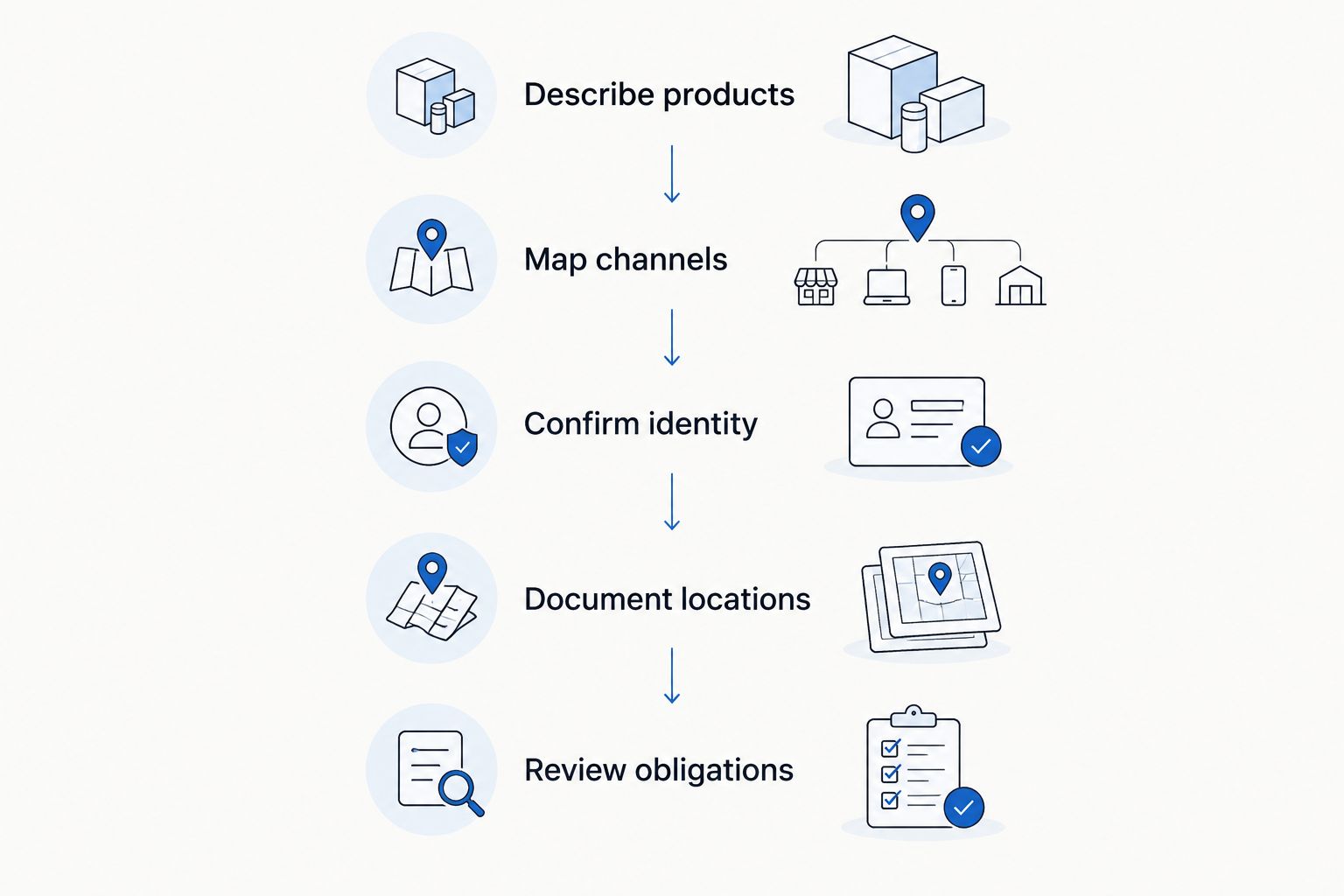
Use these 5 preparation steps before submitting an application. Getting your business details consistent first makes the paperwork easier to understand and reduces avoidable corrections.
1. Describe products
Write a plain-English description of what you sell and how customers receive it. Distinguish shipped merchandise from electronically delivered files and services.
Avoid vague descriptions such as general online business. A useful description explains what changes hands, because that is central to the sales-tax question.
2. Map channels
List every place you accept orders, including your website, marketplaces, social media, and in-person events. Record whether a marketplace facilitator handles each transaction.
Do not leave out small channels. A direct order remains a direct order even when most of your business comes through a marketplace.
3. Confirm identity
Use the correct owner or entity name and gather the identification and business details requested by CDTFA. If you have formed an LLC or corporation, distinguish its legal name from a shop name or DBA.
An EIN is not a seller’s permit. Keep federal identification, entity documents, and state sales-tax registration organized as related but separate records.
4. Document locations
Identify where you operate and where inventory is stored. Include your home business location when it is part of the operation, rather than assuming an online business has no physical location.
If you use outside storage or fulfillment, establish where your goods are held. The warehouse location matters independently of where you sit while managing the store.
5. Review obligations
After registration, review the filing frequency and instructions CDTFA assigns to your account. Save your registration records and build a routine for separating direct sales from facilitated sales.
Do not assume a quiet month means there is nothing to file. Registered sellers generally must submit required returns even when they have no taxable sales to report.
Do I need a seller’s permit if I sell from home in Los Angeles?
Selling from home does not remove California seller’s permit requirements. If your home-based business makes direct sales of taxable physical goods, the same basic state registration rules apply as they do to other California sellers.
Check local requirements separately. A Los Angeles mailing address does not necessarily identify the authority responsible for your business location, because an address can fall within an incorporated city or an unincorporated county area.
Use your actual operating address when checking the appropriate local office. Do not assume a state permit also authorizes customer visits, inventory storage, or other activities at your home.
Do I need a seller’s permit if I already have an LLC or EIN?
An LLC or EIN does not replace a California seller’s permit. An LLC concerns business structure, while an EIN identifies a taxpayer for federal purposes; neither resolves whether your sales require California registration.
You also do not have to form an LLC merely to ask about a seller’s permit. Sole proprietors can have sales-tax registration obligations too.
For a 2026 opening, organize the paperwork by purpose rather than treating business registration as a single completed task. That makes it easier to see what is finished and what still needs attention.
Can I use a seller’s permit instead of a resale certificate?
A seller’s permit and a resale certificate serve different purposes. The permit registers the seller, while a properly completed resale certificate documents that a qualifying purchase is for resale.
A resale certificate is not blanket permission to purchase everything without tax. Equipment, supplies, or merchandise you keep for personal use require different treatment from goods actually purchased for resale.
Keep purchasing records that support how you used the certificate. If a supplier requests documentation, provide the appropriate completed document rather than assuming that sending a permit number answers every question.
When does hands-on filing help make sense?
Pro Business Solutions offers seller’s permit assistance for owners who want personal help understanding the paperwork. Its documented 21+ years of local filing experience and personal support in English and Spanish are relevant when unfamiliar forms make starting a business feel stressful.
The consultancy also helps with formation, EIN filing, DBA registration, and related paperwork. Having those services in one place is useful when your business needs several registrations, but each filing still serves a separate purpose.
Pro Business Solutions confirms a 100% error-free service promise. The service is business consultancy and filing support, not legal representation; ask what your particular engagement includes before deciding what help to request.
If you are preparing a 2026 launch, bring your product description, operating address, inventory locations, and sales-channel list to the conversation. Those details make the next step more concrete than simply asking which permits an online business needs.
Get help with seller’s permit paperwork
Discuss your products, sales channels, and California filing needs with Pro Business Solutions.
FAQ
Do online sellers need a seller’s permit in California in 2026?
California-based online sellers generally need a seller’s permit for direct sales of taxable physical goods. Sellers whose transactions are exclusively handled by a registered marketplace facilitator generally do not need registration when the facilitator is responsible for all applicable sales.
Do I need a California seller’s permit if I only sell through a marketplace?
You generally do not need registration when all your sales are facilitated by a registered marketplace facilitator responsible for California sales tax. Confirm that every transaction qualifies before relying on that exception.
Does accepting payments online mean the platform handles my sales tax?
Accepting payments online does not automatically transfer your sales-tax responsibilities to the payment platform. Determine whether the provider is acting as a marketplace facilitator or only processing payments.
Do I need a seller’s permit for downloadable files?
Products delivered entirely electronically generally are not subject to California sales tax when no physical property transfers. Physical copies, bundled merchandise, or a different delivery arrangement require separate review.
Can I sell from my Los Angeles home without checking local rules?
A home-based online seller should check local business and home-occupation requirements separately from California seller’s permit requirements. The appropriate local authority depends on the actual operating address.
Does forming an LLC cover my seller’s permit requirement?
Forming an LLC does not replace a California seller’s permit. Entity formation and sales-tax registration address different obligations.
Can someone help me understand the paperwork in Spanish?
Pro Business Solutions provides personal support in English and Spanish. You can request help understanding seller’s permit paperwork and related business-registration steps.
One last thing
Recheck your permit position before adding a new sales channel—not just before opening your business. A seller who qualifies for the marketplace-only exception can change that position by beginning direct sales of taxable merchandise.
Keep a short note with your records explaining where you sell and who handles California sales tax for each channel. Update it when your checkout, inventory location, or selling method changes; it gives you a useful starting point whenever you need filing help.