Yes, you can apply for an EIN without a Social Security number in 2026; an eligible responsible party can use an ITIN, and someone ineligible for either number can apply using Form SS-4 under IRS instructions. The key limitation is the filing method: the IRS online application requires the responsible party’s valid taxpayer identification number, so applicants without one must use another permitted route.
- Can you apply for an EIN without a Social Security number? Yes, but your responsible party’s eligibility determines the route.
- IRS Form SS-4 provides a filing route for responsible parties ineligible for an SSN or ITIN.
- An EIN identifies a business for federal tax purposes; it does not grant work authorization.
- Pro Business Solutions offers hands-on EIN filing support for Los Angeles business owners, including English and Spanish assistance.
Why this matters
Not having an SSN does not automatically stop you from obtaining a business tax ID. But entering the wrong information to get past an online form creates a different problem: an application that does not accurately identify who controls your business.
For Los Angeles owners forming an LLC, the order matters too. Complete the state formation step before applying for the entity’s EIN; the California LLC filing-to-EIN application guide explains how those filings connect.
Choose the application route that fits your actual circumstances—not the route with the easiest-looking form.
Can you apply for an EIN without a Social Security number?
Yes. The IRS Instructions for Form SS-4 distinguish between a responsible party who has a taxpayer identification number and one who does not have, and is ineligible to obtain, an SSN or ITIN. Those circumstances require different entries and sometimes different filing methods.
For your 2026 application, use the IRS Instructions for Form SS-4 for responsible-party identification requirements and the IRS’s How to apply for an employer identification number guidance for filing methods. These are federal rules; a California business address does not create a separate EIN application system.
| Application route | Best for | Main advantage | Main limitation |
|---|---|---|---|
| IRS online application | Eligible applicants whose responsible party has an accepted taxpayer ID | Completes the application through an online process | Not the route for a responsible party without the required taxpayer ID |
| Form SS-4 by fax | Applicants who need a paper-form route | Allows the applicable Form SS-4 identification entry | Requires the correct IRS fax destination and complete information |
| Form SS-4 by mail | Applicants using a postal filing route | Provides an alternative to online filing | Requires mailing and processing rather than an online result |
| International telephone application | Applicants without a legal residence, principal business location, or principal office in the United States or its territories | Provides a route specifically for international applicants | Foreign citizenship alone does not establish eligibility for this route |
These are filing channels, not different kinds of EINs. An EIN is a 9-digit federal tax identification number regardless of the application route.
If you have an ITIN but no SSN
An Individual Taxpayer Identification Number, or ITIN, is a personal tax-processing number issued by the IRS. A responsible party with a valid ITIN can provide it where the EIN application requests the responsible party’s taxpayer identification number.
Having an ITIN does not remove the online system’s other eligibility requirements. Check the business-location requirements and the responsible-party information before starting the application.
If you have neither an SSN nor an ITIN
The important distinction is whether you are ineligible to obtain those numbers—not simply whether you currently have them. Under the IRS Instructions for Form SS-4, a responsible party who does not have and is ineligible to obtain an SSN or ITIN enters “foreign” or “N/A” on line 7b.
Do not treat that instruction as a general workaround for a missing number. If you are eligible for an SSN or ITIN but have not obtained it, establish the correct filing approach before submitting the form.
How do you apply without an SSN?
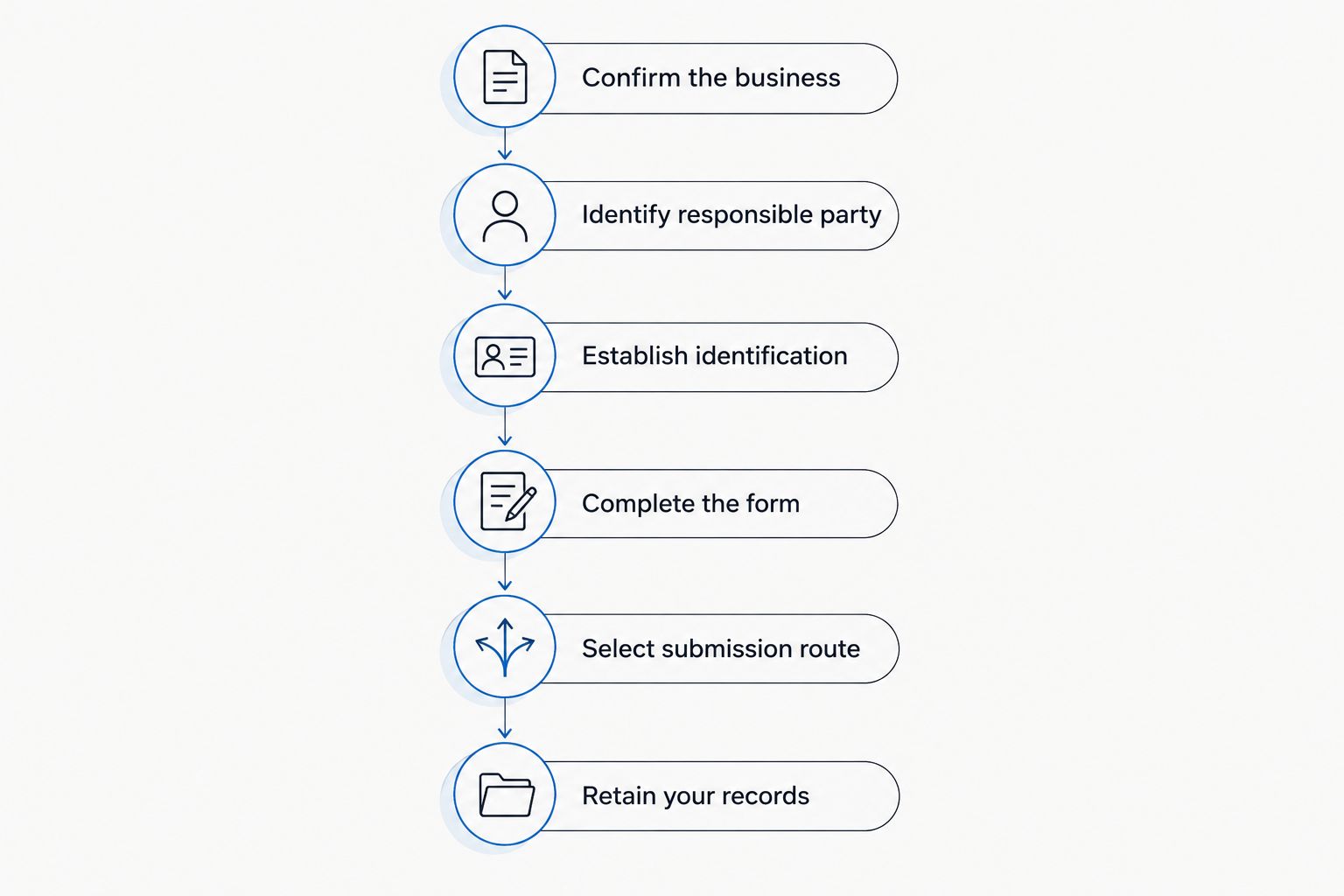
Use a preparation sequence that separates the business’s identity from the responsible party’s personal information. This keeps unfamiliar terms from turning into avoidable filing mistakes.
1. Confirm the business exists in the correct form
If you are creating an LLC or corporation, complete the state formation process before requesting its EIN. Use the legal name shown on the formation record rather than a proposed name, website name, or informal abbreviation.
A sole proprietor follows a different starting point because a sole proprietorship is not formed through an LLC or corporation filing. Do not select an entity type simply because it sounds more established.
2. Identify the responsible party
The responsible party is generally the individual who ultimately owns or controls the entity or exercises ultimate effective control over it. For an ordinary small-business application, this is not automatically the person typing the form or helping with paperwork.
Line 7a identifies that person; line 7b addresses the person’s identification number. Keep these roles clear even when a consultant assists with preparation.
3. Establish the identification entry
Determine whether the responsible party has an SSN, has an ITIN, or is ineligible for both. Apply the IRS instructions to that specific situation.
Do not enter a borrowed number, an invented number, or another business’s EIN to bypass a personal identification requirement. Accurate responsible-party information matters more than completing an online session.
4. Complete Form SS-4
Form SS-4 asks for the legal name, addresses, entity details, responsible party, reason for applying, and business activity, among other information. Read the instructions for your entity rather than assuming every question has the same answer for every owner.
For a 2026 filing, obtain the current form and instructions directly from the IRS. An old saved worksheet is not a substitute for checking the current requirements.
5. Select the correct submission route
Use the IRS’s current filing instructions to determine the appropriate fax or mailing destination. The destination depends on the circumstances described in those instructions, including the business’s location.
If you qualify as an international applicant, review the international telephone route separately. A non-U.S. passport does not, by itself, make a Los Angeles-based business an international application.
6. Review and retain your records
Check the legal name, responsible-party details, mailing address, and entity classification before submission. Keep a copy of what you send and retain the IRS EIN assignment notice with your business records.
If correspondence arrives with a question, compare it with the submitted application before responding. Do not automatically submit another application for the same business.
Why the EIN application route varies
The correct route depends on more than whether you have a Social Security card. Review these factors before choosing an application method:
- Identification eligibility: Having no SSN is different from being ineligible for both an SSN and an ITIN.
- Business location: The online and international telephone routes have location-related eligibility rules.
- Responsible-party identity: The application needs the actual controlling individual, not a convenient substitute.
- Entity type: A sole proprietor, LLC, and corporation do not complete every part of Form SS-4 identically.
- Authority to assist: Preparing paperwork and being authorized to communicate with the IRS are separate matters.
For a Los Angeles County owner, the practical question is not simply whether the owner is foreign-born. It is where the business operates, who controls it, and what identification that person has or is eligible to obtain.
What should you prepare before requesting help?
Bring your formation records if you have an LLC or corporation, your business mailing address, and information identifying the responsible party. Also explain what the business actually does and why you need an EIN.
If you already submitted an application, disclose that before another one is prepared. An existing request changes the next step; starting over without checking creates unnecessary confusion.
Useful questions for a filing consultant include:
- Which responsible-party identification instruction applies to my situation?
- Does my business qualify for the proposed submission route?
- Who will review the information before submission?
- What authorization is needed for someone to discuss the application with the IRS?
- Which records should I keep afterward?
Pro Business Solutions is best for Los Angeles first-time business owners who want hands-on EIN filing guidance in English or Spanish. The consultancy has documented 21+ years of local filing experience and helps with formation, permits, and related paperwork in one place.
Pro Business Solutions also confirms a 100% error-free service promise. Its role is business consultancy and filing assistance, not legal representation; questions about immigration status or legal ownership arrangements belong with the appropriate attorney.
You can contact Pro Business Solutions to discuss your responsible-party information and the paperwork you need help preparing. Explain that you do not have an SSN at the start so the conversation focuses on the correct route.
Do I need an ITIN before applying for an EIN?
You do not always need an ITIN before applying for an EIN. The IRS Instructions for Form SS-4 provide an entry for a responsible party who does not have and is ineligible to obtain an SSN or ITIN.
An ITIN application serves a separate personal federal tax purpose. Do not assume obtaining an ITIN is a required preliminary step for every foreign-owned business’s EIN application.
Can I use someone else’s SSN for my EIN application?
You cannot use someone else’s SSN merely to get through the application. The responsible-party name and identification information must describe the actual responsible party under IRS rules.
A consultant’s assistance does not make the consultant your business’s responsible party. Authorized assistance should support an accurate application, not replace the owner’s facts with someone else’s.
Does an EIN let me work in the United States?
An EIN does not grant permission to work in the United States. It identifies a business for federal tax administration; it is not immigration status, employment authorization, or a personal Social Security number.
For 2026 business planning, keep the tax-ID question separate from the work-authorization question. Ask an immigration attorney about your circumstances rather than relying on an EIN assignment as evidence of permission to work.
FAQ
Can I get an EIN without an SSN or ITIN in 2026?
Yes, if the responsible party does not have and is ineligible to obtain an SSN or ITIN, IRS Form SS-4 instructions provide an applicable identification entry. Use the permitted filing route rather than trying to bypass the online taxpayer-ID requirement.
Can I apply online for an EIN if I have an ITIN?
A valid ITIN can satisfy the responsible-party taxpayer-ID requirement for an eligible online EIN application. The business must also meet the IRS online system’s other requirements, including its location requirements.
What should I put on line 7b if I cannot get an SSN or ITIN?
The IRS Instructions for Form SS-4 direct a responsible party who does not have and is ineligible to obtain an SSN or ITIN to enter foreign or N/A on line 7b. Do not use that instruction simply because you have not yet obtained a number for which you are eligible.
Can a consultant apply for an EIN for my business?
A consultant can assist with EIN preparation and submission using the appropriate authorization. The application must still identify the actual responsible party, and the consultant’s involvement does not remove taxpayer-identification requirements.
Does California issue a different EIN from the IRS?
No. The IRS issues the federal EIN for California businesses, just as it does for businesses elsewhere in the United States. California tax registrations and local permits are separate requirements.
Should I form my California LLC before applying for its EIN?
Yes. Complete the LLC’s state formation before applying for its EIN so the application uses the established entity’s legal information. An EIN application does not create the LLC.
Does getting an EIN mean my business can open a bank account automatically?
No. An EIN does not replace a bank’s identity-verification and account-opening requirements. Ask the bank which owner-identification and business documents it accepts before treating the EIN as the final step.
One last thing
The person submitting the EIN application and the responsible party are not necessarily the same person. Understanding that distinction prevents the temptation to substitute a helper’s identification when your own situation requires a different filing route.
Before sending a 2026 application, write down the legal business name, the actual responsible party, and the basis for the identification entry. If those details are clear, you have a better starting point for accurate paperwork—and a more focused conversation with anyone helping you file.