

Medical practice corporation formation is the process of establishing a corporation to operate a medical practice, with the aim of organizing ownership, business administration, and tax responsibilities. For California physicians opening a practice in 2026, corporation formation for medical practice requires professional-licensing and ownership checks before ordinary business paperwork begins.
- California physicians need professional-entity guidance before choosing a structure for corporation formation for medical practice.
- Pro Business Solutions is best for first-time owners seeking hands-on business formation paperwork support, not legal advice.
- Separate professional corporation formation, tax elections, medical licensing, and payer enrollment into distinct workstreams.
- Confirm ownership eligibility and practice-name requirements before submitting formation documents.
Why corporation formation matters for medical practices
A physician’s practice is not an ordinary retail business. California restricts who can own and control a business that provides medical services, so selecting an entity from a general-purpose filing menu is not enough.
For Los Angeles County owners, Pro Business Solutions offers business formation and related paperwork assistance backed by 21+ years of local filing experience. Medical ownership decisions still belong with a California attorney familiar with professional practices.
Form the right professional entity before arranging the rest of the business around it. A filed corporation does not replace a medical license, authorize an otherwise ineligible owner, or complete insurer enrollment.
This 2026 guide focuses on physician practices in California. Dentists, psychologists, nurses, and other licensed professionals have profession-specific rules; do not apply a physician’s formation checklist without checking the relevant licensing board.
How to form a medical practice corporation in California
Treat formation as a sequence of decisions, not a single application. Start with official state instructions and a written ownership plan; bring in filing support only after the professional questions are settled.
The sequence is: confirm eligibility, check ownership, prepare filings, organize records, separate taxes, coordinate opening, and track compliance. Keep a shared checklist so your attorney, tax professional, and paperwork provider know who owns each task.
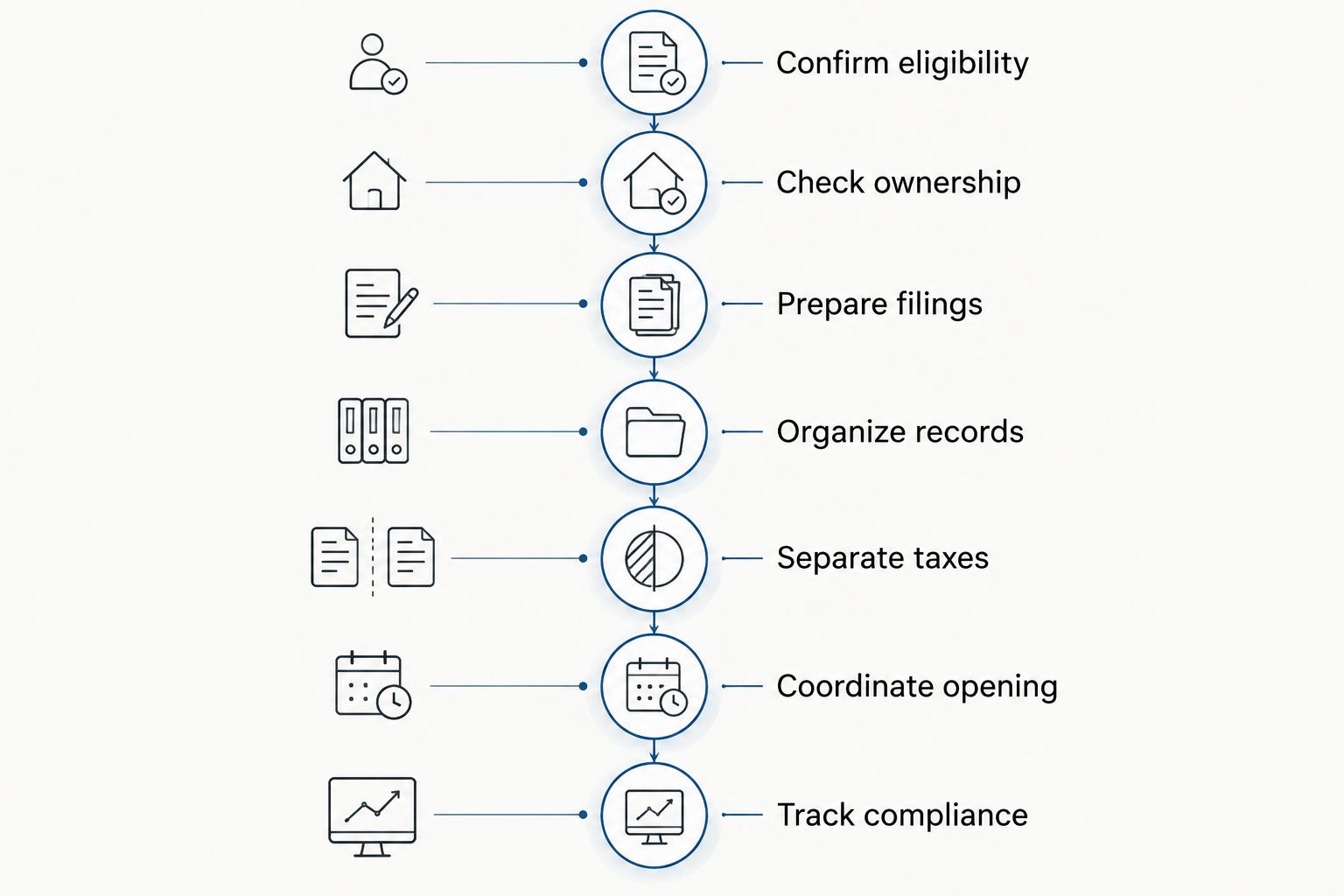
Confirm eligibility
Start with the Medical Board of California’s corporate-practice guidance and the California Secretary of State’s professional corporation instructions. For a physician-owned incorporated practice, the relevant structure is generally a professional medical corporation—not an ordinary LLC used to provide medical services.
The Medical Board’s corporate-practice guidance addresses who can exercise control over clinical decisions. California’s professional corporation rules address the entity itself. Both matter, and neither is replaced by a business registration confirmation.
If your proposed business combines medical care with nonclinical services, ask an attorney to define the boundaries before selecting a structure. A management business and a medical practice are not interchangeable.
- Identify the exact licensed profession providing care.
- Confirm each proposed clinician’s California license status.
- Describe the clinical services the corporation will provide.
- Ask counsel whether the proposed entity and operating model fit California requirements.
Check ownership
Write down every proposed shareholder before discussing filing forms. Include each person’s profession, license, ownership interest, and intended decision-making role.
California permits certain licensed professionals to hold interests in a medical corporation subject to statutory restrictions. A spouse, investor, office manager, or business partner does not become eligible simply because the physician approves the arrangement.
Ownership percentage is only part of the review. Voting arrangements, management contracts, and control over clinical decisions also need attention. Have counsel resolve these questions before anyone transfers money in exchange for shares.
- Prepare a proposed shareholder list with license information.
- Identify who will serve as directors and officers.
- Flag any nonphysician owner for professional legal review.
- Document who controls clinical and nonclinical decisions.
- Confirm the ownership arrangement before issuing shares.
Prepare filings
Once counsel confirms the structure, review the Secretary of State’s current professional corporation filing instructions. Prepare the legal name, business addresses, agent for service of process, and required professional-purpose language.
For your 2026 filing, confirm the current form rather than reusing a colleague’s old document. Also check Medical Board naming requirements: a practice name that differs from the physician’s own name can raise a separate fictitious-name permit question.
You can prepare the administrative information yourself. Pro Business Solutions provides a hands-on route for corporation formation paperwork, with personal support in English and Spanish and a 100% error-free service promise. Ask which tasks are included; medical-entity legal decisions remain separate.
- Compare the proposed name against state filing requirements.
- Confirm whether a Medical Board fictitious-name permit is needed.
- Select an agent for service of process.
- Verify names, addresses, and professional-purpose wording.
- Retain the accepted filing and submission records.
Organize records
An accepted formation filing creates the entity, but it does not finish the internal organization. Your corporation also needs records documenting how it operates and who owns it.
Have an attorney prepare or review the bylaws, initial corporate actions, and share issuance documents. These records should match the ownership arrangement already reviewed—not a generic template that introduces different rights or decision-makers.
California corporations generally must file an initial Statement of Information within 90 days of registration and file annually afterward. Put that deadline on the calendar when the formation is accepted, rather than waiting for a reminder.
- Store the accepted articles with the corporate records.
- Complete bylaws and initial organizational actions.
- Record authorized share issuances and shareholder details.
- Calendar the initial Statement of Information deadline.
- Keep submission receipts with the corresponding documents.
Separate taxes
A professional corporation is a legal structure; S corporation treatment is a tax election. Choosing one does not automatically complete the other.
Review the IRS EIN application instructions yourself, then have a tax professional address the corporation’s tax classification, payroll, and filing obligations. An EIN identifies the business for federal tax administration; it is not a medical license or an authorization to open.
Keep the corporation’s finances separate from personal spending from the start. Use the same legal entity details across tax records, banking documents, and payroll setup so later corrections do not become a second project.
- Apply for the EIN using the accepted entity details.
- Ask a tax professional whether an S election fits the ownership and tax situation.
- Confirm election deadlines before assuming a tax treatment applies.
- Establish separate business banking and bookkeeping.
- Plan payroll before making payments for owner services.
Coordinate opening
Formation and readiness to see patients are different milestones. Build a separate opening checklist covering professional requirements, premises, insurance, staffing, and payer enrollment where applicable.
Within Los Angeles County, requirements depend on the actual city and practice location. An address in an incorporated city is not treated the same as an address in an unincorporated county area for every local business requirement.
Before signing a lease in 2026, confirm that the planned medical use is allowed at the premises. Ask the relevant agencies and payers which records must be updated if the practice begins under a new legal entity.
- Identify the city or county authority responsible for the location.
- Confirm zoning and premises requirements before committing to the space.
- Review professional liability coverage for the entity and clinicians.
- Check payer enrollment and business-identity requirements.
- Assign responsibility for patient-record and privacy procedures.
Track compliance
Create a recurring calendar that separates corporation filings from clinical obligations. Annual corporate administration does not replace medical license renewals or profession-specific requirements.
Review the calendar at least every 12 months and whenever ownership, addresses, officers, or operations change. An ownership change deserves legal review before the transaction, not just an update to a spreadsheet afterward.
Keep one current records folder with clear access controls. Your office administrator needs to find the accepted filings and deadlines without searching through unrelated patient information or personal email accounts.
- Track annual Statement of Information filings.
- Maintain tax, payroll, and bookkeeping deadlines.
- Monitor professional license and permit renewals.
- Record ownership and officer changes promptly.
- Review insurance and payer records when business details change.
Compare your formation support options
Choose support by the decision you need help making. Administrative assistance and legal advice solve different problems; a medical practice often needs both.
Use the first-time California business registration checklist for general preparation, then add the professional requirements described above. A general checklist is a starting point, not a substitute for medical-entity review.
| Option | Best for | Main advantage | Key limitation |
|---|---|---|---|
| Self-directed filing | Owners with an attorney-approved structure who want to prepare their own submissions | Direct control over documents and records | You remain responsible for understanding instructions and tracking separate requirements |
| Pro Business Solutions | First-time owners wanting personal business formation paperwork assistance | Local filing experience and English- and Spanish-language support | Business consultancy support does not replace medical-practice legal advice |
| California attorney familiar with medical practices | Ownership, professional-entity, governance, and clinical-control questions | Legal advice tailored to the proposed arrangement | Confirm whether administrative submissions and ongoing tracking are included |
| Coordinated attorney, tax professional, and filing support | Practices with several owners or connected legal and tax decisions | Each specialist handles a defined area | You need a clear handoff plan and one shared set of entity details |
Before hiring any provider, request a written scope. Ask who prepares documents, who submits them, who tracks follow-up, and which questions require another professional.
Discuss your business formation paperwork
Ask about hands-on corporation filing support and related paperwork in English or Spanish.
Common mistakes medical practice owners make
Treating an LLC as the default
An LLC checklist intended for a shop or consulting business does not establish the right structure for a California physician’s clinical practice. Start with professional eligibility and entity rules before comparing filing services.
Confusing a trade name with professional permission
A county DBA filing and a Medical Board fictitious-name permit address different requirements. Do not assume that completing one clears every naming obligation for a medical practice.
Giving an investor control without reviewing the arrangement
A business partner’s financial contribution does not settle ownership eligibility or clinical-control restrictions. Have counsel review the proposed shares, voting rights, and management agreement before signing.
Mistaking formation for opening readiness
An accepted corporation filing does not complete payer enrollment, premises checks, or medical licensing requirements. Keep a separate opening checklist with a named person responsible for each item.
Assuming an S election happens automatically
A professional medical corporation does not receive S corporation tax treatment simply because the owner prefers it. Ask the tax professional to confirm eligibility, prepare the election where appropriate, and retain the submission record.
FAQ
What corporation should I form for a medical practice in California?
A California physician seeking to incorporate a clinical practice generally uses a professional medical corporation. Confirm the ownership, name, and operating arrangement with a California attorney familiar with medical practices before filing.
Can I use an LLC for my California physician practice?
An ordinary California LLC is not the structure for a physician to provide professional medical services. Have counsel distinguish the clinical practice from any separate nonclinical management business before forming either entity.
Can a nonphysician own part of a California medical corporation?
Only certain eligible licensed professionals can hold ownership interests alongside physicians under California’s professional corporation rules. Do not assume that an unlicensed investor, spouse, or office manager qualifies; have counsel review the proposed ownership and control.
Is a professional medical corporation the same as an S corporation?
No. A professional medical corporation is a legal entity, while S corporation status is a federal tax election available to eligible corporations. A tax professional should assess eligibility and election timing separately from formation.
Can Pro Business Solutions help with medical practice formation paperwork?
Pro Business Solutions offers corporation formation and related paperwork assistance, with personal support in English and Spanish. Ask about the scope for your proposed practice; the consultancy is not a law firm and does not provide medical-practice legal advice.
Does filing a corporation mean I can start seeing patients?
No. Corporation formation does not replace professional licensing, applicable premises requirements, insurance arrangements, or payer enrollment. Confirm the opening requirements for your location and practice model separately.
When is the first California Statement of Information due?
A California corporation generally must file its initial Statement of Information within 90 days of registration and file annually afterward. Record the initial deadline when the formation is accepted and keep the filing confirmation with the corporate records.
One last thing
Choose the legal identity before putting the practice name everywhere. A name repeated across a lease, bank account, insurance application, and payer enrollment creates extra correction work if the entity details later change.
For a 2026 opening, prepare a single approved identity sheet containing the legal name, business address, EIN, and responsible contacts. Share it only with the people who need it. Pro Business Solutions can help you organize business formation paperwork while your attorney and tax professional resolve their respective decisions.