

Bring an original, qualifying identification document, such as a California driver’s license, California identification card, or U.S. passport, to your Los Angeles notary appointment. Under California’s identification rules, these documents must be current or have been issued within the past 5 years. A photograph of your ID, an ordinary photocopy, or simply knowing the notary does not replace the required identity verification.
- For notary services Los Angeles identification, a qualifying California driver’s license, California ID, or U.S. passport is a practical choice.
- California’s 5-year rule concerns when an identification document was issued, not how recently it expired.
- California permits credible witnesses only when specific legal conditions are met; forgetting your wallet is not enough.
- Bring the complete document and ask the notary whether your signature must happen during the appointment.
Why this matters
A notary checks the signer’s identity; the notary does not decide whether a business agreement is a good deal or provides the protection you need. For a first-time Los Angeles business owner, separating those jobs prevents confusion about what the appointment accomplishes.
Pro Business Solutions is best for Los Angeles business owners who want personal help with notary services and related business paperwork. The consultancy provides support in English and Spanish, which is useful when you want filing instructions explained clearly. You can request help through Pro Business Solutions.
For appointments in 2026, California law—not a separate Los Angeles County identification standard—sets the identity-verification requirements. Your document’s purpose, however, affects what else you need to prepare.
What identification should you bring to a Los Angeles notary?
Bring the original qualifying ID that most clearly connects your identity to the name on the document. California Civil Code section 1185 identifies the permitted documents and the conditions for using them. The California Secretary of State’s 2026 Notary Public Handbook explains these requirements for California notarial acts.
The table below compares common choices. It is a preparation guide, not an exhaustive list of every identification document California permits.
| Identification option | Best for | What works in its favor | Limitation to check |
|---|---|---|---|
| California driver’s license or identification card | Signers with California-issued identification | Expressly recognized under California’s identification rules | Must be current or issued within the past 5 years |
| U.S. passport | Signers using a federal identity document | Expressly recognized under California’s identification rules | Must be current or issued within the past 5 years |
| Another state’s driver’s license or identification card | Signers whose identification comes from outside California | California permits qualifying out-of-state documents | Must meet the applicable timing and required identifying-feature rules |
| Valid foreign passport | Signers using a passport from their country of citizenship | California permits this identification route | Must meet the statutory conditions, including required identifying features |
| Student card or private-employer badge | Supplemental information only | Can provide context for a name or affiliation | Does not qualify on its own merely because it includes a photograph |
For identification in the additional statutory categories, including qualifying out-of-state documents and foreign passports, California requires a photograph, physical description, signature, and identifying number. Do not assume every government-issued card qualifies just because it looks official.
If your identification is unusual, describe its issuing authority and document type when arranging the appointment. Avoid sending an unsolicited photograph containing your full identification number.
California IDs and U.S. passports: the simplest starting point
A qualifying California driver’s license, California identification card, or U.S. passport is a straightforward starting point because California law specifically lists these documents. Bring the physical original so the notary can examine it and record the required identification information.
The timing test has two separate routes: the document is current, or it was issued within the past 5 years. An expired ID is not automatically disqualified, but its issue date matters.
For a 2026 appointment, do not interpret that rule as permission to use any ID that expired during the previous 5 years. A card issued much earlier does not qualify through the issue-date route merely because its expiration was recent.
Check both dates before leaving home. If the issue date is unclear, tell the notary rather than trying to calculate eligibility from the expiration date alone.
Out-of-state and foreign identification: check the details first
You do not need a California driver’s license solely because the notarization takes place in Los Angeles. California permits specified out-of-state and foreign identification documents when the statutory conditions are satisfied.
The practical concern is the document itself. A foreign passport or another state’s identification card needs the features California requires; citizenship or residence alone does not resolve that question.
Do not treat every foreign government card as interchangeable with a passport. Consular identification documents have their own statutory requirements, and an ordinary foreign national identification card is not automatically acceptable.
When calling, name the exact type of document you hold. Ask whether it contains the required information before scheduling around work, travel, or a business filing deadline.
How should you prepare before the appointment?
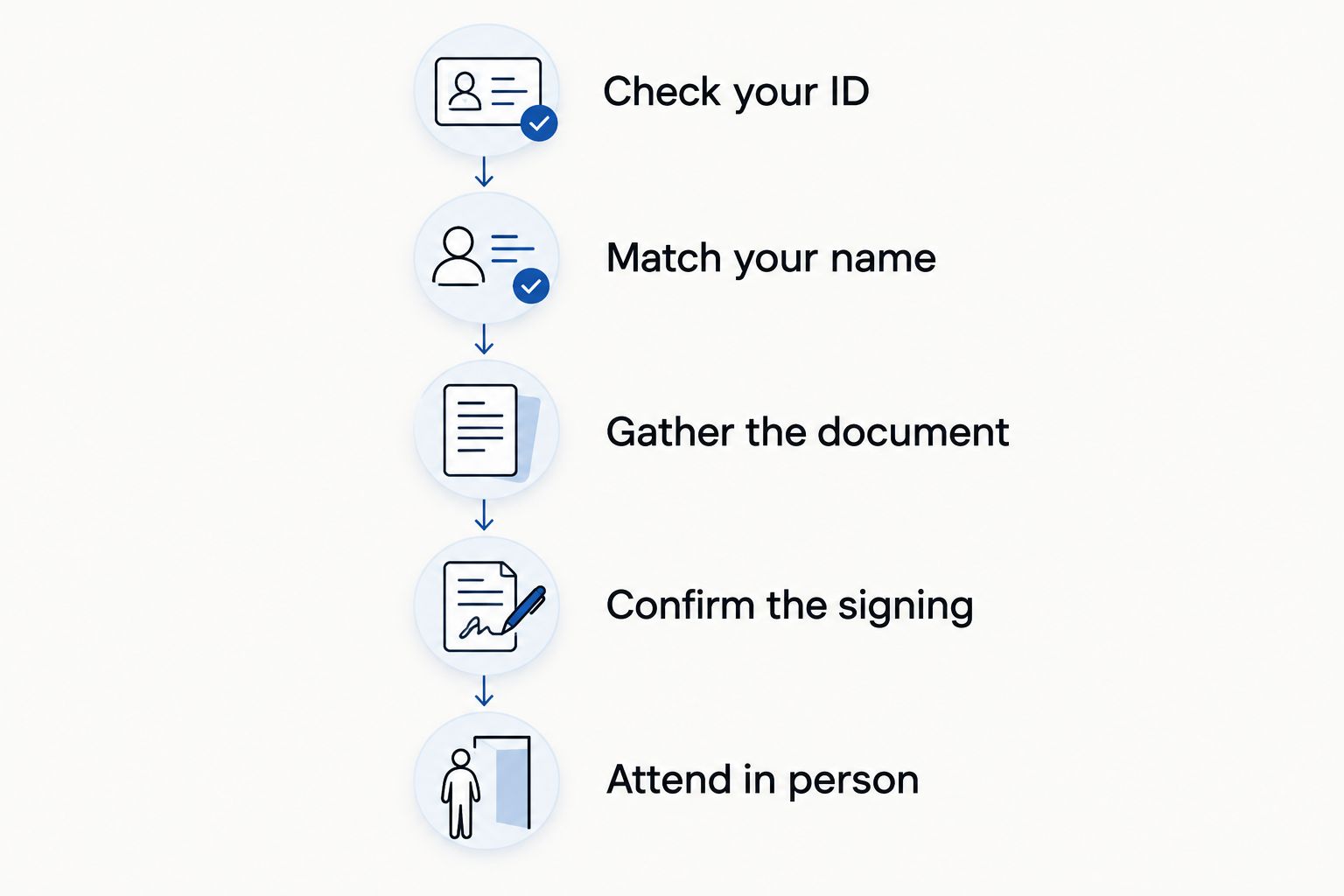
Use this sequence to keep identity questions separate from document questions. It also helps the notary explain what needs attention before you travel.
- Check your ID. Find the physical original, review its issue and expiration dates, and confirm that the photograph and identifying details are readable.
- Match your name. Compare your identification with the name printed on the document. Flag a changed surname, missing surname, or other meaningful difference in advance.
- Gather the document. Bring the complete document, including attached pages and any existing notarial certificate. Do not bring only the signature page unless the receiving party has specifically provided that as the complete document.
- Confirm the signing. Ask whether the requested act is an acknowledgment or a jurat. If you do not know which act is required, ask the document’s receiving organization or an attorney rather than asking the notary to make that legal choice.
- Attend in person. For an ordinary in-person notarization, the signer must personally appear before the notary. Bringing someone else’s signed document and identification does not replace that appearance.
If your paperwork involves a company, distinguish your personal identity from your business role. An LLC’s formation paperwork or an EIN letter does not replace the signer’s qualifying identification.
For example, signing as a company manager still requires the individual signer to satisfy the notary’s identity checks. Questions about whether you have authority to sign belong with the receiving organization or an attorney.
Why identification preparation varies
California’s rules apply statewide, but these details change what you need to discuss before an appointment:
- The issuing authority. California identification, another state’s identification, and foreign documents fall into different statutory categories.
- The document’s dates. A current ID and an expired ID issued within the past 5 years rely on different parts of the timing rule.
- The identifying features. Some permitted categories must include a photograph, physical description, signature, and identifying number.
- The signer’s name. A marriage-related change, different surname, or inconsistent spelling needs attention before the notary can determine satisfactory evidence of identity.
- The requested notarial act. An acknowledgment and a jurat have different signing requirements, even though both require identity verification.
- The absence of qualifying identification. Credible-witness procedures require specific facts; they are not a routine substitute for bringing your ID.
These are reasons to prepare, not reasons to feel overwhelmed. Explain the issue plainly and let the notary identify which requirements apply.
Can you use an expired ID at a Los Angeles notary?
The 5-year issue-date rule can allow an expired qualifying ID. California accepts the specified identification when it is current or was issued within the past 5 years; the relevant alternative is not how long ago it expired.
For your 2026 appointment, check the actual issue date and the document category together. If your ID fails the timing requirements, bring another qualifying document or discuss whether a lawful credible-witness route applies.
Can you get notarized without qualifying identification?
California allows 1 credible witness personally known to the notary, or 2 credible witnesses whose identities the notary verifies using qualifying identification, when the statutory conditions are met. The witnesses must personally know the signer and swear to the required facts, including that obtaining another form of identification would be very difficult or impossible and that the signer does not possess an authorized identification document.
The witnesses also cannot be named in the document or have a financial interest in it. A friend who accompanies you does not automatically qualify, and leaving your valid ID at home does not satisfy these conditions.
Should you sign before meeting the notary?
For a jurat, you must sign in the notary’s presence and take an oath or affirmation. For an acknowledgment, a document can already be signed, but you must personally appear and acknowledge executing it.
If you are unsure which act your document requires, wait to sign and ask the receiving party for instructions. A notary cannot choose the legal form of notarization for you simply because the document lacks a certificate.
When hands-on help is useful
Pro Business Solutions combines notary services with business formation, permits, and related paperwork support. Its documented 21+ years of local filing experience makes that assistance relevant to first-time owners who want unfamiliar steps explained in plain English.
The benefit is personal guidance across related tasks. The boundary is equally important: Pro Business Solutions is a business consultancy and notary service, not a law firm, and notarization does not answer legal questions about your agreement.
The owner confirms a 100% error-free service promise. That accuracy promise concerns the service’s paperwork; it is not a promise of legal protection.
If you need English or Spanish support, mention your preference when requesting an appointment. Ask what to bring for your specific document rather than assuming every business form requires notarization.
Ask about your notary appointment
Explain your document and identification, and request personal support in English or Spanish.
FAQ
Do I need a REAL ID for a Los Angeles notary appointment?
No. California’s notary identification rules do not require the REAL ID designation. A California driver’s license or identification card must instead satisfy the applicable identification and timing requirements.
Can I show a photo of my driver’s license on my phone?
A photograph of your driver’s license does not substitute for the original qualifying identification document at an ordinary in-person California notarization. Bring the physical document for the notary to examine.
Does my identification have to show a Los Angeles address?
No. California permits several qualifying identification types, including U.S. passports and specified out-of-state identification documents. A Los Angeles address is not a separate requirement for notarization.
Can I use an expired California driver’s license in 2026?
An expired California driver’s license can satisfy the timing rule if it was issued within the past 5 years. The rule concerns its issue date, not simply whether it expired within the past 5 years.
What if my business document has a different name from my ID?
Tell the notary about the name difference before the appointment. The notary must establish satisfactory evidence of your identity; do not alter a legal document simply to make it match without appropriate instructions.
Can a friend identify me if I have no acceptable ID?
A friend can serve as a credible witness only when California’s specific witness requirements are satisfied. The rules differ for 1 witness personally known to the notary and 2 witnesses identified through qualifying documents, and neither route is a shortcut for forgotten identification.
Does a notarized document prove that its contents are true?
Notarization does not establish that a document’s contents are true or that its terms protect you. An acknowledgment concerns the signer’s identity and acknowledgment of execution; a jurat includes an oath or affirmation about the document’s truthfulness.
Do I need to give a thumbprint for a California notarization?
California requires a journal thumbprint for certain documents, including powers of attorney and specified real-property documents. It is not a universal requirement for every notarization; tell the notary what kind of document you are bringing.
One last thing
Your business name is not your personal identification. Even when the document prominently displays your LLC or corporation, the notary must identify the person appearing to sign.
Before your 2026 appointment, place your original qualifying ID beside the complete document and check the signer’s name. That simple comparison surfaces a question you can resolve before making the trip.