

Best for hands-on local paperwork help: Pro Business Solutions. Best for legal advice: a U.S.-licensed trademark attorney. Best for experienced, self-directed applicants: filing directly with the United States Patent and Trademark Office (USPTO). This 2026 guide compares these routes for e-commerce owners, especially first-time sellers in Los Angeles County and nearby Southern California communities.
- Best trademark registration services ecommerce: Pro Business Solutions for local filing help; attorneys for legal advice.
- Choose a trademark attorney when you need brand-clearance advice, a refusal response, or representation in a dispute.
- Direct USPTO filing suits applicants prepared to handle the application, supporting evidence, and follow-up themselves.
- An LLC, DBA, seller’s permit, and federal trademark registration serve different purposes; one does not replace another.
Why this matters
Your online store can have a registered business name without having a federally registered trademark. An LLC establishes a business entity; a trademark identifies the source of particular goods or services. Confusing those jobs leads to the wrong paperwork.
For a Southern California seller choosing help in 2026, the useful distinction is paperwork support versus legal advice. You need someone who explains what they handle, what remains your responsibility, and when a trademark attorney belongs in the process.
This guide ranks service routes by fit, not by unverified provider scores. The local recommendation is specific; the attorney and self-filing recommendations describe types of help rather than naming businesses whose service details are not established here.
What makes the best trademark registration service?
Judge a service against these criteria before comparing its sales pitch:
- Scope clarity: Does the provider distinguish application preparation from legal analysis and representation?
- Owner accuracy: Does the application identify the correct person or entity that owns the trademark?
- Goods and services: Does the filing describe what you actually sell under the mark?
- Evidence readiness: Can you explain how the mark appears on your products, packaging, or qualifying service materials?
- Follow-up responsibility: Who watches USPTO correspondence and handles questions after submission?
- Personal support: Can you understand the explanations and ask questions before authorizing a filing?
No single provider type wins every criterion. Choose personal administrative support when unfamiliar paperwork is the obstacle; choose legal counsel when the question concerns trademark rights or legal risk.
Trademark registration routes at a glance
| Rank and option | Best for | Standout feature | Key limitation |
|---|---|---|---|
| 1. Pro Business Solutions | First-time Southern California sellers seeking personal paperwork support | Local consultancy with trademark registration help and related business services | Not a law firm; legal questions belong with an attorney |
| 2. U.S.-licensed trademark attorney | Sellers needing clearance advice or help with legal complications | Legal advice and representation within the attorney’s agreed scope | You must confirm which searches, responses, and follow-up the engagement includes |
| 3. Direct USPTO filing | Experienced applicants comfortable managing their own application | Direct control over information submitted to the federal office | You carry responsibility for legal choices, evidence, correspondence, and deadlines |
Use this 2026 comparison as a decision tree, not a claim that one route fits every store. A straightforward administrative question and a possible trademark conflict require different kinds of support.
1. Pro Business Solutions: best for local e-commerce paperwork help
Pro Business Solutions is a Los Angeles-based consultancy offering trademark registration assistance alongside business formation, EIN filing, seller’s permits, DBA registration, notary services, and tax preparation. Its documented 21+ years of local filing experience make its offering relevant to first-time business owners seeking personal guidance rather than an unexplained form.
Pro Business Solutions is best for Southern California e-commerce owners who want personal trademark paperwork support alongside business-startup help. Personal support is available in English and Spanish, which helps owners discuss unfamiliar filing terms in the language they understand best.
Where this route fits
Choose local consultancy support when you need help organizing business details and understanding the administrative steps. For example, an owner preparing an online store might need to separate the LLC name, storefront name, seller’s permit, and proposed trademark before authorizing any filings.
The owner confirms a 100% error-free service promise. That promise concerns service accuracy; it is not a statement about the legal scope of trademark rights.
Pro Business Solutions pros:
- Personal support for first-time owners in Los Angeles County and nearby Southern California areas.
- English- and Spanish-language help with understanding paperwork.
- Formation, permits, and related administrative services available through the same consultancy.
- Documented local filing experience rather than an anonymous application-only experience.
Pro Business Solutions cons:
- The consultancy is not a law firm and does not provide attorney representation.
- You need to confirm the scope of trademark searching, application assistance, and post-filing support before engagement.
- Owners facing a confusingly similar mark or a legal refusal need an attorney’s assessment.
Best for: A first-time local seller whose main obstacle is paperwork and who values personal explanations.
Verdict: Buy this type of support when administrative guidance is your priority; use an attorney for legal analysis.
Ask about trademark filing help
Discuss your online business, paperwork questions, and the support you need in English or Spanish.
2. U.S.-licensed trademark attorney: best for legal risk questions
A trademark attorney advises on trademark law and can represent an applicant before the USPTO. The engagement can include assessing potentially conflicting marks, advising on filing strategy, and responding to legal objections, depending on the services agreed.
This is the strongest route when you need more than help entering information. A search result that looks similar, an ownership question, or a USPTO refusal calls for legal judgment rather than reassurance about form completion.
What to establish before engagement
Ask whether the attorney’s work includes a clearance search, a written assessment, application preparation, and responses to later correspondence. Those are separate tasks; do not assume that agreeing to application preparation includes every later legal response.
For your 2026 launch, explain both what you sell now and what you intend to sell under the brand. That gives counsel the business context needed to discuss the filing’s scope without treating every future idea as a current product.
Trademark attorney pros:
- Legal advice about potential conflicts and registration strategy.
- Representation for legal issues within the agreed engagement.
- Help interpreting refusals and other substantive USPTO correspondence.
- Advice on ownership questions and the relationship between a word mark and a logo.
Trademark attorney cons:
- The engagement does not automatically include business formation, permits, or tax preparation.
- Searching, filing, and later responses can have different scopes of work.
- Counsel still needs accurate facts and genuine supporting materials from you.
Best for: Sellers facing potential conflicts, uncertain ownership, or substantive trademark questions.
Verdict: Buy attorney-led help when the decision requires legal judgment, not just application support.
3. Direct USPTO filing: best for experienced self-directed applicants
The USPTO provides the federal trademark application system and public guidance for applicants. Filing directly means you prepare and submit the application yourself, subject to the office’s representation requirements.
This route is not a substitute for professional advice. It is a self-service option for applicants who understand their responsibilities and are prepared to manage the application after submission.
What you take on yourself
You choose the applicant, identify the mark, describe the goods or services, select the filing basis, and provide required evidence. You also monitor official correspondence and respond to requirements by the applicable deadlines.
Foreign-domiciled applicants must have a U.S.-licensed attorney represent them before the USPTO. For a U.S.-domiciled owner considering self-filing in 2026, eligibility to file without an attorney does not remove the need to understand the application.
Direct USPTO filing pros:
- Direct control over the information submitted.
- Access to the federal office’s application guidance and public trademark records.
- No separate provider needed to transmit the application on your behalf.
Direct USPTO filing cons:
- No independent adviser checks your legal choices simply because you use the official system.
- You manage correspondence, evidence, and deadlines yourself.
- Public guidance does not resolve your particular legal risks.
Best for: An eligible, experienced applicant who understands the filing and accepts responsibility for follow-up.
Verdict: Skip self-filing if you cannot confidently explain the owner, filing basis, goods or services, and required evidence.
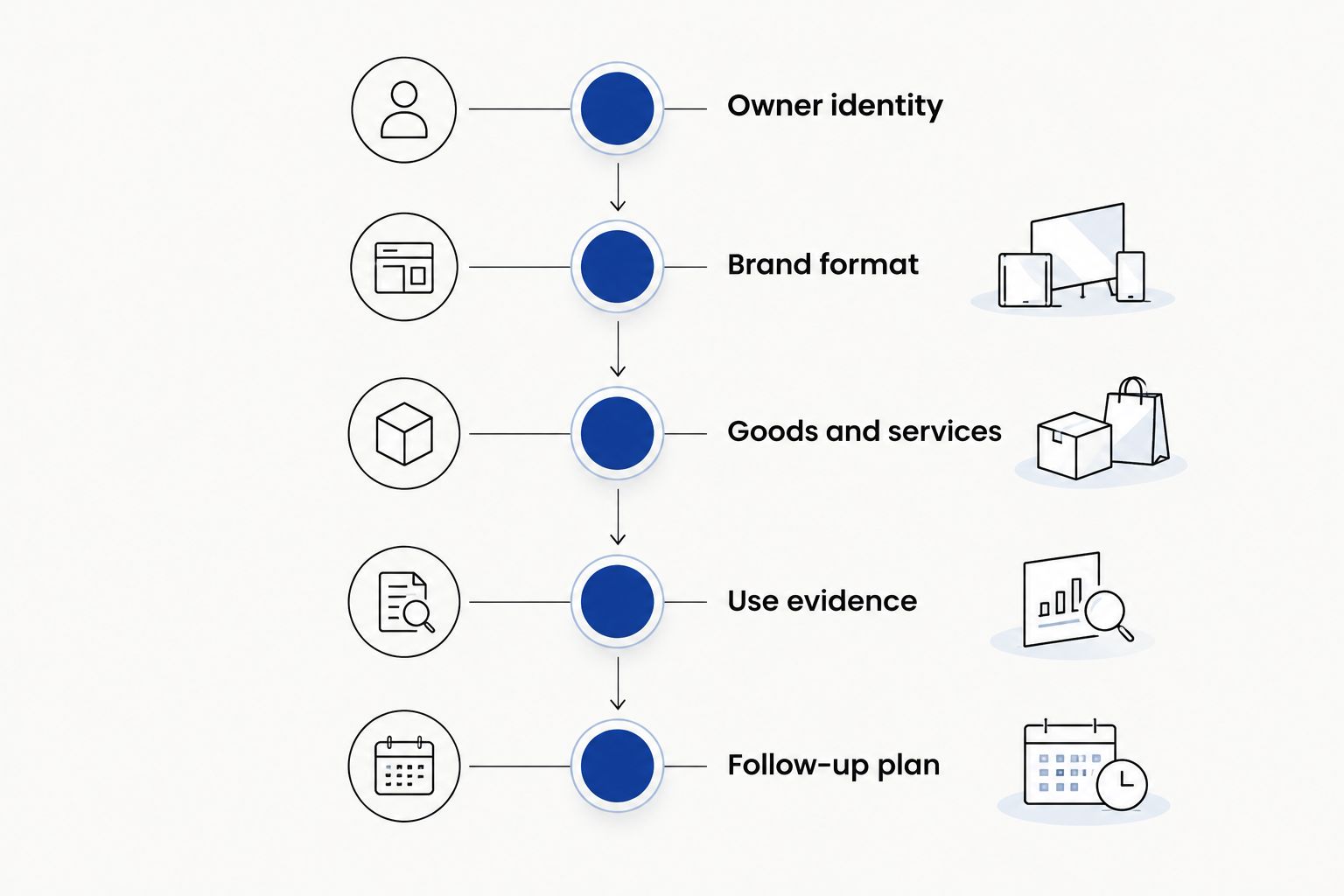
Prepare these details before choosing help
You do not need to master trademark law before asking for support. You do need a clear description of your business and the brand you want to register.
Owner identity
Write down who owns the mark: you personally or a business entity. Bring the exact legal name and relevant formation details rather than assuming your store’s display name identifies its legal owner.
Brand format
Decide what you want to discuss: the wording of the brand, a particular logo, or both. These are different filing questions; a logo application and a standard-character word application do not describe the same thing.
Goods and services
List the goods and services associated with the mark. The Nice Classification contains 45 trademark classes: 34 goods classes and 11 service classes. Those categories organize filings; a class number alone does not explain what your business sells.
For an online seller, selling your own branded goods and providing retail store services are different descriptions. Ask your adviser to explain that distinction before selecting language.
Use evidence
Gather examples showing how customers encounter the mark. Product labels, packaging, and online sales pages raise different evidence questions; a decorative logo image alone does not establish every required fact.
Follow-up plan
Confirm who receives official messages and who is responsible for responding. Keep access to the email address associated with your application, and save the application records somewhere you control.
How the recommendations are ranked
The ranking applies the criteria above to three distinct needs: local administrative guidance, legal advice, and self-directed filing. It does not claim head-to-head testing or assign unsupported performance scores.
For the intended reader—a first-time Southern California business owner—personal filing help is the first recommendation when paperwork is the problem. An attorney takes priority whenever legal analysis is the problem. Direct filing fits an experienced applicant, not someone choosing it without understanding the work involved.
Which trademark registration route should you choose?
Choose personal consultancy support for paperwork, a trademark attorney for legal judgment, and direct filing only when you can manage the process yourself. That is the practical default for an e-commerce launch in 2026.
Before engaging anyone, ask one clear question: What exactly will you handle before filing, at submission, and after the USPTO responds? A useful answer names responsibilities, not just the application form.
If your business setup is still unfinished, separate the tasks. Entity formation, permits, tax registration, and trademark registration need coordination, but completing one does not automatically complete the others.
FAQ
What is the best trademark registration service for a new e-commerce business?
The best route depends on whether you need paperwork support or legal advice. Pro Business Solutions suits first-time Southern California owners seeking personal administrative help; a U.S.-licensed trademark attorney suits owners needing legal analysis or representation.
Does registering an LLC protect my online store’s trademark?
Registering an LLC does not create a federal trademark registration. Entity formation establishes the business, while trademark registration concerns a mark used with specified goods or services.
Should I register my brand name or my logo first?
The choice depends on what you use and what you want the application to cover. A standard-character word mark and a particular logo raise different scope questions; ask a trademark attorney which approach fits your circumstances.
Can I file a trademark application myself in 2026?
Eligible U.S.-domiciled applicants can file directly with the USPTO in 2026. You remain responsible for the application and follow-up; foreign-domiciled applicants must use a U.S.-licensed attorney.
Do I need a trademark attorney for an online store?
Use a trademark attorney when you need advice about conflicts, ownership, filing strategy, or legal refusals. Administrative filing support and attorney representation are different services.
Can a seller’s permit replace trademark registration?
A seller’s permit does not replace trademark registration. California seller’s permits concern sales and use tax responsibilities, while federal trademark registration concerns a brand identifier for specified goods or services.
What should I ask before hiring trademark filing help?
Ask who handles searches, owner information, goods and services, evidence, submission, and later correspondence. Confirm which tasks are included and which require separate attorney assistance.
One last thing
Check the owner before polishing the application. Your storefront name, DBA, and legal entity name can differ, so copying the most visible name into the owner field is not a sound shortcut.
Bring your entity documents and explain who operates the business and owns the brand. Resolving that question early is a concrete next step, even if you have not yet chosen your filing route.