Yes. In California, you can generally get a seller’s permit without first obtaining a local business license because the state tax registration and local business registration are separate requirements. Getting the seller’s permit does not replace any city or county registration, zoning clearance, or activity-specific permit you need before opening.
- Can you get a seller's permit without a business license? In California, generally yes; local operating requirements remain separate.
- CDTFA handles California seller’s permits; your city or county handles applicable local business registration.
- A seller’s permit does not replace zoning clearance, a DBA filing, or business formation.
- Confirm your business address and sales activities before submitting applications.
Can you get a seller’s permit without a business license?
Yes—the two filings serve different purposes, and obtaining one does not complete the other. For your 2026 startup checklist, separate state sales-tax registration from permission to operate at your specific address.
Pro Business Solutions helps Los Angeles-area owners with seller’s permits, business formation, and related paperwork. The practical starting point is identifying which registrations apply to your business, rather than treating every document as a business license.
| Document | Issuing agency or office | What it does | What it does not replace |
|---|---|---|---|
| California seller’s permit | California Department of Tax and Fee Administration, or CDTFA | Registers qualifying sellers for California sales and use tax purposes | Local business registration or zoning clearance |
| Local business registration or license | Applicable city or county office | Meets the local registration or licensing requirement for that jurisdiction | A required seller’s permit |
| EIN | Internal Revenue Service | Identifies a business for federal tax purposes | State or local operating requirements |
| Fictitious business name filing, often called a DBA | Applicable county office | Registers a qualifying business name used by its owner | Entity formation or sales-tax registration |
California’s seller’s permit guidance from CDTFA distinguishes sales-tax registration from other business requirements. Use that distinction when you prepare your 2026 applications: a state tax account and a local registration are not interchangeable.
Why this matters
The word license causes confusion because people use it for several unrelated documents. You might hear it used for a seller’s permit, a city tax registration, or a permit tied to a particular activity.
That confusion creates an incomplete opening checklist. A seller’s permit addresses your sales-tax responsibilities; it does not tell you whether your apartment, storefront, or commercial kitchen is approved for the activity you plan to conduct.
Ask what the document authorizes, not just what someone calls it. This keeps your paperwork tied to the actual business you want to open.
What changes between Los Angeles city and county requirements?
Your business address determines which local office to contact. A Los Angeles mailing address alone does not establish whether your location falls within the City of Los Angeles, another incorporated city, or an unincorporated county area.
Inside the City of Los Angeles
The City of Los Angeles uses a Business Tax Registration Certificate, commonly called a BTRC, for business tax registration. Check the city’s registration requirements separately from your CDTFA seller’s permit application.
A BTRC is not a substitute for zoning clearance or an activity-specific permit. Describe your actual work when asking the city what applies, including whether customers visit and whether you store merchandise onsite.
In another Los Angeles County city
If your business operates in another incorporated city, check that city’s business licensing and tax registration rules. Do not assume a City of Los Angeles registration covers an address elsewhere in the county.
For a 2026 opening, use the current requirements of the city responsible for your business location. An old checklist from another municipality is not a reliable filing sequence.
In unincorporated Los Angeles County
Check Los Angeles County’s requirements for your particular activity and address. County business licensing applies to specified activities; it is not a universal replacement for every city’s registration system.
Confirm the jurisdiction before choosing an application. This matters especially when your postal address uses a familiar city name but the property sits outside that city’s boundaries.
How do you apply without mixing up the requirements?
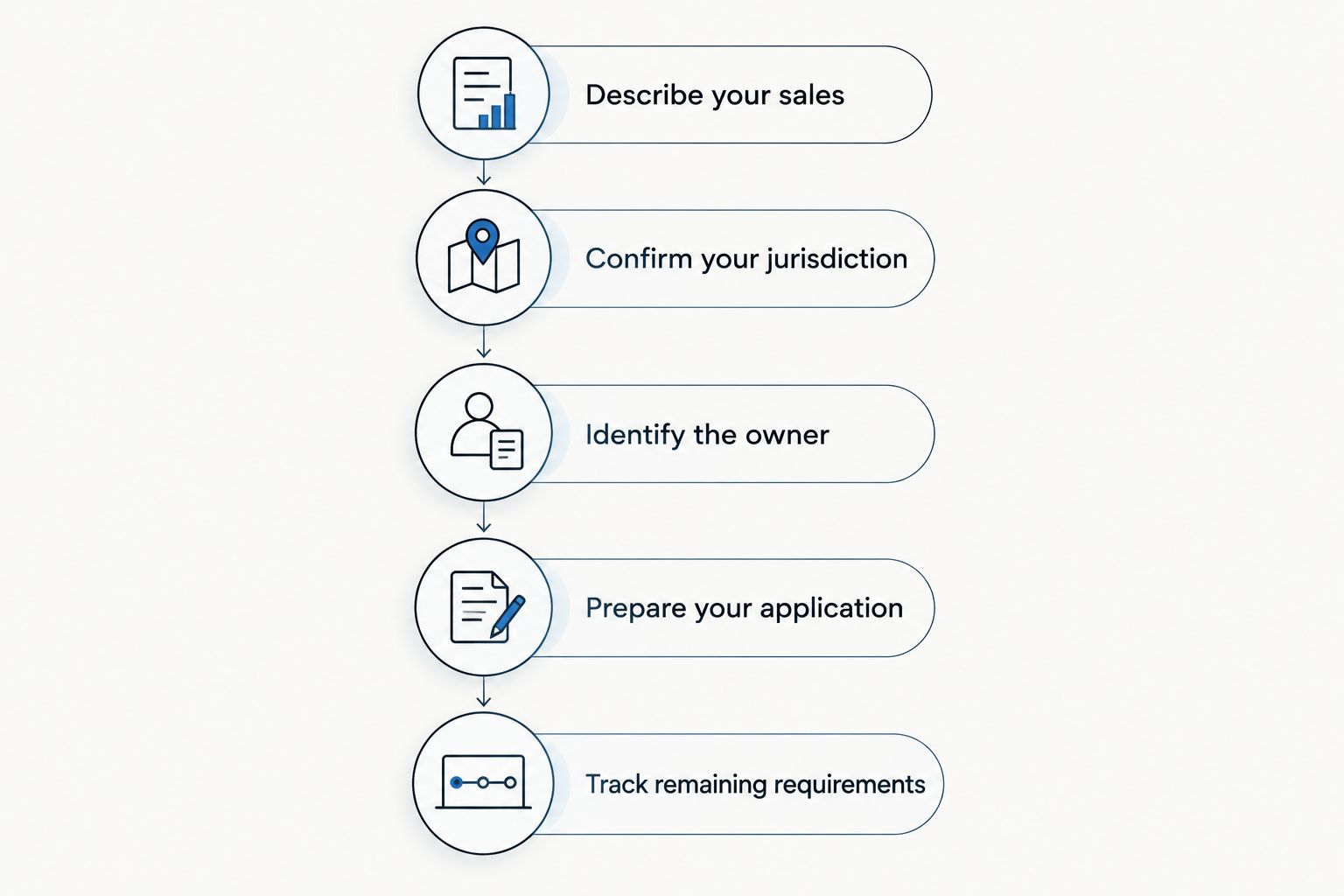
Use these 5 filing steps to separate the state application from the local operating checklist. The steps organize your decisions; they do not mean every business needs every document mentioned.
- Describe your sales. Write down what you sell, whether it is physical merchandise, and whether you sell directly, through a marketplace, or both. CDTFA generally requires a seller’s permit when you are engaged in business in California and sell or lease tangible personal property ordinarily subject to sales tax.
- Confirm your jurisdiction. Identify the city or unincorporated county area responsible for your operating address. Ask that office about business registration, zoning, home-occupation rules, and activity-specific requirements.
- Identify the owner. Decide who will operate the business: you individually, a partnership, an LLC, or a corporation. If a new entity will own the business, establish that entity before applying in its name.
- Prepare your application. Gather the identification, ownership, address, and business-activity details requested by CDTFA. Keep the legal name and ownership information consistent with your supporting records.
- Track remaining requirements. Record which local registrations and clearances remain unfinished. Receiving a seller’s permit is not the signal to ignore those items.
The filing order is not the same as permission to open. You can work on separate applications while still waiting to complete the requirements that apply before operating.
What information should you gather first?
Organize 4 record categories before you begin: identity, ownership, location, and sales activity. This is a preparation method, not a substitute for the application’s actual document requests.
- Identity: The applicant’s identifying information and the identification requested for the application.
- Ownership: The legal owner’s name and any applicable entity or federal tax identification details.
- Location: The operating address and any additional business locations relevant to registration.
- Sales activity: What you sell, how you sell it, and the business activity information requested by CDTFA.
If you plan to use a trade name, distinguish that name from the legal owner. A DBA filing does not turn an individual business into an LLC, and an EIN does not create a business entity.
Why your local requirements vary
For a 2026 launch in Southern California, the right checklist depends on your location and activities—not simply on whether you already have a seller’s permit.
- Jurisdiction: An incorporated city and an unincorporated county area have different responsible offices and rules.
- Business location: A home, retail unit, shared workspace, and temporary event site raise different land-use questions.
- Products sold: Food, alcohol, and other regulated products involve requirements beyond ordinary sales-tax registration.
- Sales channel: Marketplace-only sales and direct sales require different analysis of your sales-tax registration obligations.
- Business ownership: Operating individually differs from applying under an LLC or corporation’s legal name.
- Customer activity: Customer visits, deliveries, storage, and onsite operations matter when checking local zoning requirements.
Give each office the same description of your business. Saying online store to one office and retail shop to another leaves out details that determine which rules apply.
Do you need an LLC before getting a seller’s permit?
No—an LLC is not required to obtain a California seller’s permit. An individual operating as a sole proprietor can register when the business meets the seller’s permit requirements.
If an LLC or corporation will own the business, complete the entity formation before applying under that entity’s name. Choose the owner first so the tax registration identifies the business that will actually make the sales.
Can you sell online without a local business license?
Selling online does not automatically exempt you from local business registration. A home-based online business still needs to check the rules for its operating address, including applicable home-occupation requirements.
Marketplace sales also require a separate sales-tax review. CDTFA’s marketplace facilitator guidance provides a registration exception for qualifying sellers whose sales are all handled by a registered marketplace facilitator; direct sales or other activities can change that result.
Can you start selling as soon as the permit arrives?
A seller’s permit alone does not establish that you have completed every requirement to open. Before making sales, confirm the applicable local registration, zoning, and product-specific requirements.
Keep approval documents organized by issuing office. A document from CDTFA answers a different question from a clearance issued by a planning department or health agency.
Should you handle the paperwork yourself or get help?
Pro Business Solutions is best for first-time Los Angeles-area owners who want hands-on business formation and permit-filing support. The consultancy brings 21+ years of local filing experience and offers personal support in English and Spanish.
The right choice depends on whether you can confidently identify the required filings and keep the ownership details consistent. Compare the scope of support, not just the number of forms someone offers to submit.
| Approach | Best for | Main advantage | Limitation |
|---|---|---|---|
| Filing directly with the agencies | Owners comfortable reading agency instructions and tracking separate requirements | Direct access to each agency’s application and guidance | You coordinate the state, local, and activity-specific checks yourself |
| Pro Business Solutions business formation and permit support | First-time local owners who want personal help understanding paperwork | Help with formation, permits, and related filings in one place | It is a business consultancy and notary service, not a law firm |
The consultancy’s owner confirms a 100% error-free service promise. That promise concerns paperwork accuracy; questions requiring legal advice belong with an attorney.
For a 2026 consultation, bring your operating address, proposed owner’s name, and a plain-English description of what you will sell. Ask which filings the proposed service covers and which tasks you will handle separately.
You can contact the consultancy to discuss your starting point without needing to arrive with every form already identified.
FAQ
Can I get a California seller’s permit before my city business license?
Yes, you can generally obtain a California seller’s permit without first obtaining a city business license. The registrations are separate, and you still need to complete applicable local requirements before operating.
Is a seller’s permit the same thing as a business license?
No, a California seller’s permit is a state sales-tax registration, not a substitute for local business registration. Your city or county determines the local requirements for your address and activities.
Do I need an LLC to apply for a seller’s permit?
No, a sole proprietor can obtain a California seller’s permit when the business meets the registration requirements. If an LLC will own the business, form it before applying in its name.
Do I need a seller’s permit if I only sell services?
Providing services alone does not automatically require a California seller’s permit. Some transactions involving services and tangible goods are taxable, so describe the full transaction when checking CDTFA’s requirements.
Does selling from home mean I can skip local registration?
No, working from home does not automatically remove local registration or zoning requirements. Check the rules for your exact address, including any applicable home-occupation requirements.
Do marketplace sellers always need a California seller’s permit?
No, qualifying sellers whose sales are all handled by a registered marketplace facilitator can fall within CDTFA’s registration exception. Review the requirements separately if you also sell directly or conduct other business activities.
Can Pro Business Solutions help if I am confused about the forms?
Yes, Pro Business Solutions helps with business formation, seller’s permits, and related paperwork, with personal support in English and Spanish. It is a business consultancy and notary service, not a law firm.
One last thing
Your mailing address is not proof of your local licensing jurisdiction. Before filing, confirm which city or county office actually serves the property where you will operate.
Then keep a simple status list: state tax registration, local registration, and any activity-specific clearances. You do not need to understand every government term at once—you need to know what each required document does and what remains unfinished.