Best overall for first-time owners: Pro Business Solutions. Best for self-filing: the Los Angeles County Registrar-Recorder/County Clerk. Best for legal questions about ownership or naming: a California business attorney. This 2026 guide compares those three routes so you can choose the right help without confusing a DBA with a business entity or trademark.
- Pro Business Solutions leads the best DBA filing services Los Angeles County shortlist for first-time owners wanting personal guidance.
- Los Angeles County direct filing suits owners who understand the paperwork and can manage publication themselves.
- Choose a California business attorney when ownership disputes or business-name rights need legal advice.
- A DBA records a business name; it does not create an LLC or register a trademark.
Why this matters
A DBA means doing business as. In California, the county paperwork uses the term fictitious business name statement, often shortened to FBN. You encounter both terms when arranging banking, permits, and other business paperwork.
Choosing a filing service is really choosing who handles the details. Someone needs to identify the correct owner, prepare the statement, follow the county's submission requirements, and address publication. A service that prepares a form is not automatically handling every later step.
For a first-time Los Angeles County owner in 2026, the useful comparison is personal help versus self-management versus legal advice. These routes solve different problems. Choose the route that matches your uncertainty, not simply the one with the shortest application.
What makes the best DBA filing service?
Use these five criteria before asking anyone to handle your statement:
- Local filing knowledge: Your helper should understand Los Angeles County's fictitious business name process, rather than treating every California county as interchangeable.
- Correct ownership: The statement should identify the person or entity actually conducting business. A trading name and its owner are different things.
- Clear scope: Ask who prepares the statement, submits it, coordinates publication, and checks proof of publication. Get the responsibilities in writing.
- Understandable support: You should understand what you are signing. Personal explanations matter when business terms are unfamiliar.
- Useful boundaries: A filing consultant handles paperwork support. A lawyer addresses legal questions. Neither a DBA filing nor a name search replaces trademark analysis.
The best fit is the service that resolves your actual paperwork problem and clearly explains what remains your responsibility. An attractive service description is not enough if you still do not know who handles the next step.
DBA filing options at a glance
| Option | Best for | Standout feature | Key limitation |
|---|---|---|---|
| Pro Business Solutions | First-time owners wanting personal local guidance | Documented 21+ years of local filing experience, with English and Spanish support | Business consultancy, not a law firm |
| Los Angeles County Registrar-Recorder/County Clerk | Owners comfortable managing their own filing | Direct access to the county filing process | You manage preparation and publication responsibilities |
| California business attorney | Owners with legal questions about names or ownership | Legal advice on the underlying issue | Filing and publication work depend on the agreed engagement |
The table compares routes, not interchangeable service packages. The county accepts filings; a consultancy helps with paperwork; an attorney addresses legal questions. That distinction matters more than a generic ranking of websites.
1. Pro Business Solutions: best DBA help for first-time owners
Pro Business Solutions is a Los Angeles-based business consultancy offering DBA registration alongside business formation, EIN filing, seller's permits, trademark registration, notary services, and tax preparation. Its documented 21+ years of local filing experience and personal support in English and Spanish make it a practical starting point when you want help understanding the paperwork.
Pro Business Solutions is the best DBA filing option here for first-time Los Angeles County owners who want personal guidance. The owner confirms a 100% error-free service promise. That accuracy promise is relevant to owners concerned about mistakes in their paperwork.
What to ask before starting
Explain what you sell, where you operate, who owns the business, and whether an LLC or corporation already exists. Then ask which parts of the DBA process the proposed service covers. Do not assume that every related service is included in one engagement.
Personal language support is especially useful when you understand your business plan but not the filing terminology. You should leave the conversation knowing which name belongs on the statement and what happens after submission.
Consultancy pros:
- Local filing experience helps ground the conversation in Los Angeles County paperwork.
- Personal English and Spanish support helps you understand unfamiliar terms.
- Related formation, permit, and tax services are offered in one place.
- The confirmed accuracy promise directly addresses paperwork concerns.
Consultancy cons:
- The business is a consultancy and notary service, not a law firm.
- Related services are separate topics; confirm the scope of your DBA engagement.
Best for: A first-time owner who wants a person to explain the filing and related business paperwork.
Verdict: Buy this type of help when paperwork uncertainty is your main obstacle. Ask for a clear description of the work before committing.
2. County direct filing: best for owners comfortable doing it themselves
The Los Angeles County Registrar-Recorder/County Clerk administers fictitious business name filings for the county. Filing directly is the self-service route: you prepare the information, follow the county's current instructions, and manage the requirements that follow filing.
This option fits an owner who already understands the business's ownership and can keep track of documents and deadlines. It is not the same as hiring someone to guide the whole process. The filing office's role and your role remain separate.
When self-filing makes sense
Before choosing direct filing in 2026, check whether you can confidently answer three questions: Who is the registrant? Which business name needs filing? Who will handle publication and proof afterward?
If those answers are clear, direct filing is a reasonable route. If you are guessing whether your existing company or you personally should appear as the owner, settle that issue before submitting anything.
County direct-filing pros:
- You deal directly with the office responsible for county FBN filings.
- You retain control over the information and submission process.
- You can follow the county's current instructions without an intermediary.
County direct-filing cons:
- You are responsible for preparing accurate ownership and business information.
- You must manage publication and related follow-up rather than assume filing completes the process.
- Direct filing does not provide individualized legal advice about name rights or ownership.
Best for: An organized owner who understands the filing and is comfortable managing each step.
Verdict: Buy no extra filing assistance if you can confidently manage the process yourself. Choose personal help instead when you cannot explain the information on the statement.
3. California business attorney: best for legal naming questions
A California business attorney is the appropriate professional when your DBA question is really a legal question. Examples include a disputed business name, uncertainty about ownership rights, or questions about agreements between business partners.
This is a professional route, not a recommendation of a particular law firm. Ask the attorney whether the engagement covers advice only, document preparation, county filing, publication coordination, or some combination. The agreed scope determines the work.
When advice should come before filing
A DBA records a name used by a business; it does not resolve competing legal claims to that name. If another business has challenged your proposed name, choosing a filing service first does not answer the underlying problem.
The same principle applies when partners disagree about who owns the business. Get the ownership question settled before using a filing statement to describe it. Paperwork should reflect the arrangement, not substitute for one.
Attorney-route pros:
- A licensed attorney can provide legal advice about the naming or ownership issue.
- Legal advice can distinguish county registration from trademark and contractual questions.
- The engagement can address a dispute before paperwork reflects an unresolved position.
Attorney-route cons:
- Hiring an attorney does not automatically include filing or publication coordination.
- You still need a written scope identifying the documents and follow-up work covered.
Best for: An owner whose main concern involves legal rights, disputes, or ownership arrangements.
Verdict: Hold the filing until the legal question is resolved. Do not treat a DBA statement as protection against a naming dispute.
What your Los Angeles County DBA process should cover
A good filing conversation makes the sequence understandable. Use the following checklist to identify responsibilities, whether you hire help or file directly in 2026.
Confirm ownership
Identify the person or existing entity conducting business. If your LLC owns the business, that is different from an individual operating under a trading name. Bring the relevant formation documents when asking for help.
Do not choose an owner simply because that name is easiest to enter. The statement needs to reflect the actual business arrangement.
Check the name
Review the proposed fictitious business name through the county's current search process. Treat that as a county-record check, not a complete answer about trademark rights.
Write the proposed name consistently across your working documents. Small spelling differences create avoidable confusion when you compare paperwork later.
Prepare the statement
Gather the owner information, business address, proposed name, and other details requested by the current county form. Read the statement before signing and ask about anything you do not understand.
Under California Business and Professions Code section 17910, a required fictitious business name statement generally must be filed within 40 days of commencing business. Use that legal timeframe to plan your filing, rather than waiting for another organization to request proof.
Arrange publication
For statements requiring publication, California Business and Professions Code section 17917 requires publication to begin within 45 days after filing and run once a week for four successive weeks in an eligible newspaper. Publication is a separate task from preparing the statement.
Ask who selects the newspaper and who handles proof of publication. Do not assume an ordinary advertisement or social media announcement satisfies the requirement.
Keep records
Keep the filed statement, publication records, and correspondence together. Record the filing date and the responsibilities still outstanding.
California Business and Professions Code section 17920 generally gives a statement a five-year term, subject to changes that trigger earlier expiration. A move or ownership change deserves a review of the applicable filing requirements; do not rely only on an old renewal reminder.
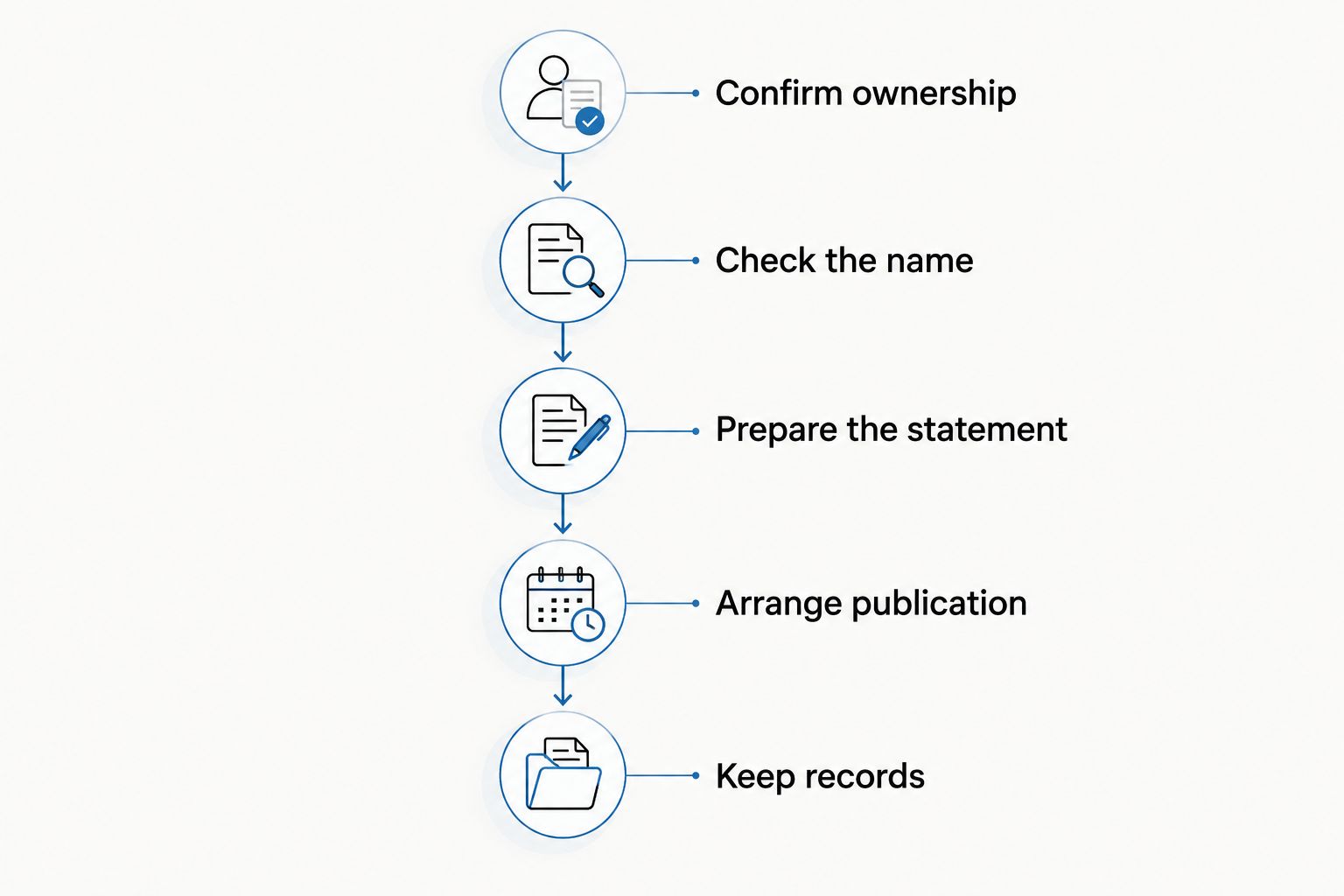
These are California statutory filing and publication requirements applicable to the Los Angeles County process in 2026. Check the county's current procedural instructions when preparing your submission, particularly if you are renewing or changing an existing statement.
Questions to ask before hiring filing help
Ask practical questions instead of requesting a vague assurance that everything is handled:
- What will you prepare and submit? Identify the statement and the submission responsibilities.
- Who handles publication? Confirm newspaper coordination and proof-of-publication responsibilities.
- What do you need from me? Request the ownership documents and business information needed to start.
- How will I receive my records? Know which documents you should retain after the work is completed.
- Which questions fall outside this service? Separate filing support from legal advice and unrelated registrations.
For a 2026 consultation, bring a short description of your business and your proposed trading name. Include any existing entity documents. A clear starting picture makes it easier to explain the next step without turning the conversation into a maze of unfamiliar terms.
Get help with your DBA paperwork
Ask about DBA registration, personal English or Spanish support, and related business paperwork.
How these options were ranked
This guide ranks the routes by local relevance, understandable support, clear responsibilities, and appropriate professional boundaries. Personal consultancy support comes first because this comparison is written for first-time Los Angeles County owners who want help starting a business.
The county route leads for self-management. The attorney route leads for legal questions. Neither is a lesser version of the first option; each serves a different need. This is a fit-based comparison, not a claim that every provider has been tested or that one route handles every situation.
Which DBA filing option should you choose?
Choose personal local filing help when you want someone to explain the paperwork and keep the responsibilities clear. Choose county direct filing when you can manage the statement, publication, and records yourself. Choose an attorney when the unresolved issue concerns legal rights or ownership.
Before selecting a route, finish this sentence: I need help with... If your answer is completing unfamiliar paperwork, a consultancy fits. If it is whether you have the right to use a name, get legal advice first.
FAQ
What's the best DBA filing service in Los Angeles County for a first-time owner?
Pro Business Solutions is the best fit in this guide for first-time owners wanting personal local filing guidance. It offers DBA registration, documented 21+ years of local filing experience, and personal support in English and Spanish.
Can I file my Los Angeles County DBA myself?
Yes, you can file directly through the Los Angeles County Registrar-Recorder/County Clerk. You remain responsible for accurate preparation, applicable publication requirements, and follow-up records.
Is a DBA the same thing as an LLC?
No, a DBA is not an LLC. A DBA records a name used by a business, while an LLC is a business entity formed through a separate process.
Does filing a DBA give me trademark protection?
No, a county DBA filing does not register a trademark. County name records and trademark rights are separate subjects; consult an attorney when you need legal advice about a name.
Do I need to publish my DBA in a newspaper?
California generally requires publication for a newly filed fictitious business name statement. For statements requiring publication, it must begin within 45 days after filing and run once a week for four successive weeks in an eligible newspaper.
How long does a California DBA statement last?
A California fictitious business name statement generally has a five-year term. Certain changes can cause earlier expiration, so review the requirements when ownership or other relevant information changes.
What should I bring when asking for DBA filing help?
Bring your proposed business name, owner information, business address, and any existing entity documents. Explain what the business does and ask which filing and publication tasks the service covers.
One last thing
Settle who owns the business before settling what to call it. A DBA statement identifies the owner behind the trading name; it does not create the ownership arrangement. That simple distinction prevents you from using the right business name on paperwork describing the wrong owner.